


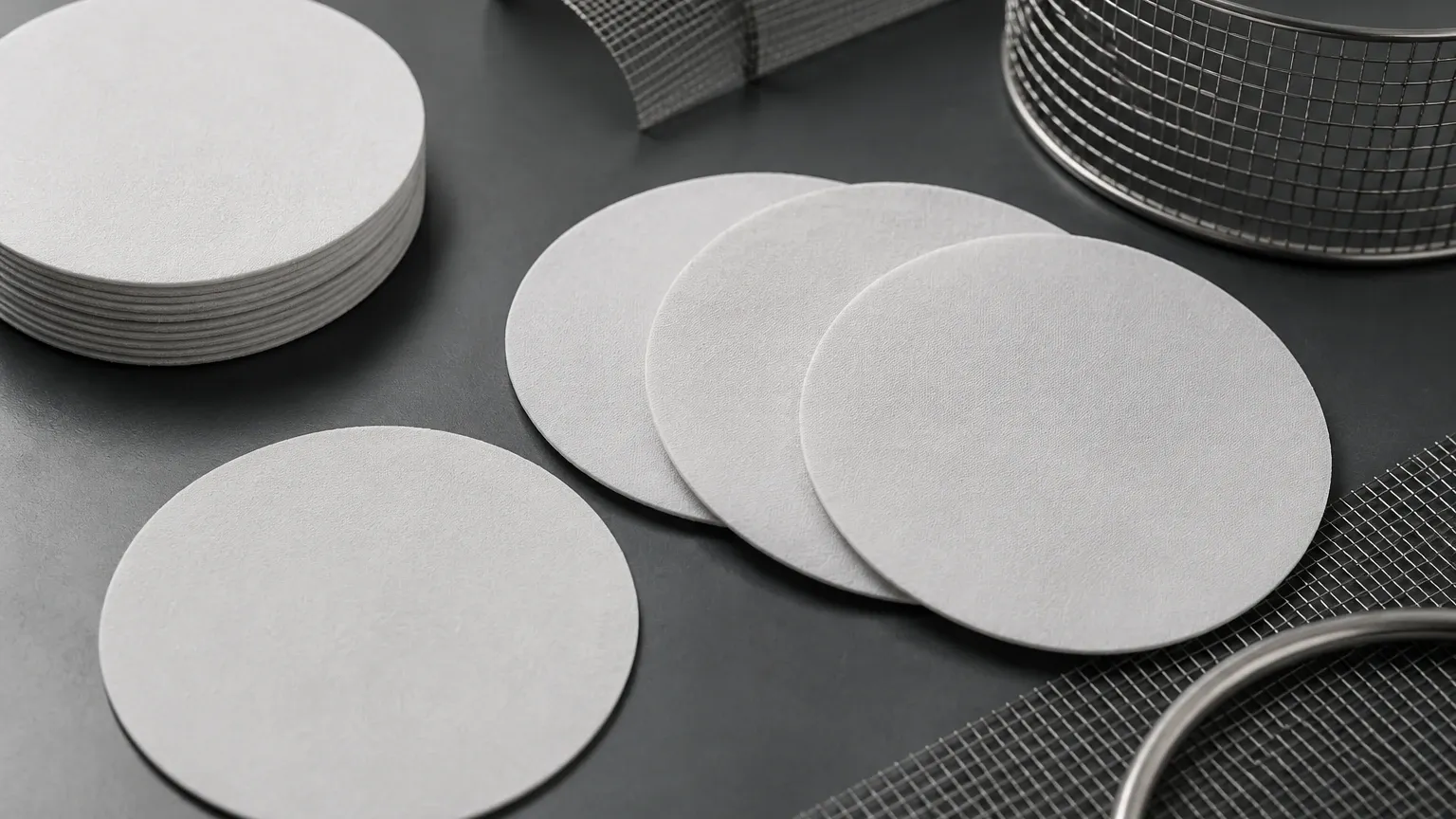
Synthetic Filter Discs 90mm
In industrial filtration and laboratory processing, the selection of the correct filter media is a critical engineering decision that impacts product purity, equipment longevity, and process efficiency. Among the various configurations available, synthetic filter discs 90mm in diameter represent a standard for small-to-medium scale batch processing, pilot plant operations, and specialized laboratory filtration. While metal filtration components, such as those found in professional Filter Discs & Packs, offer unparalleled durability in high-pressure environments, synthetic media provide unique chemical resistances and cost-effective disposable options for specific applications.
Understanding the technical nuances of 90mm synthetic discs requires an analysis of material science, fluid dynamics, and mechanical fitment. This guide examines the performance characteristics, selection criteria, and industrial applications of these components to assist engineers and purchasing teams in optimizing their filtration systems.
Technical Characteristics of Synthetic Filter Media
Synthetic filter discs are manufactured from a variety of polymer resins, each offering distinct physical and chemical properties. Unlike woven metal wire mesh, which relies on precise geometric apertures, synthetic media can be structured as either woven monofilaments or non-woven membranes (depth media).
Material Composition
1. Polypropylene (PP): One of the most versatile and cost-effective materials. Polypropylene discs are widely used due to their broad chemical compatibility, particularly with acids and bases. They are generally limited to temperatures below 90°C (194°F) and are preferred in water treatment and general chemical processing.
2. Nylon (Polyamide): Known for its high mechanical strength and natural hydrophilicity. Nylon filter discs are excellent for aqueous solutions and alcohols. However, they should be avoided with strong acids and certain oxidizing agents.
3. Polytetrafluoroethylene (PTFE): The gold standard for aggressive chemical environments and high-temperature synthetic filtration. PTFE is chemically inert and hydrophobic, making it the primary choice for solvent filtration and gas venting applications.
4. Polyester (PES): Often used in applications requiring high flow rates and low protein binding, such as in the pharmaceutical and food and beverage sectors. PES offers good thermal stability compared to PP.
Pore Size and Filtration Efficiency
The 90mm diameter provides a surface area of approximately 63.6 cm². Within this area, the pore size distribution determines the filtration efficiency. Synthetic discs are available in nominal ratings (where a percentage of particles are retained) and absolute ratings (where 99.9% or more of particles at a specific micron size are captured). For critical industrial processes, engineers must distinguish between surface filtration (retaining particles on the top layer) and depth filtration (trapping particles within the matrix of the material).
Engineering Considerations for the 90mm Diameter
The 90mm dimension is not arbitrary; it is a standardized size compatible with a wide range of industrial filter holders, Buchner funnels, and pressure vessels. When integrating synthetic filter discs 90mm into a system, several engineering factors must be evaluated.
Flow Rate and Differential Pressure
The flow rate through a 90mm disc is governed by the viscosity of the fluid, the porosity of the media, and the applied pressure. As solids accumulate on the surface of the disc, a "filter cake" forms, which increases the differential pressure ($ΔP$). Engineers must calculate the terminal pressure drop—the point at which the disc must be replaced or cleaned to prevent media rupture or bypass.
In synthetic media, the risk of "media migration"—where fibers from the filter itself enter the filtrate—is a concern at high differential pressures. This is one area where stainless steel Filter Discs & Packs often outperform synthetics, as the rigid structure of metal mesh eliminates fiber shedding.
Mechanical Support and Sealing
A 90mm synthetic disc is often thin and flexible. Under high-pressure flow, the disc may deform or tear if not properly supported. In most industrial housings, the synthetic disc is placed on a rigid support plate—often a perforated metal disc or a coarse stainless steel wire mesh.
Sealing is equally critical. If the disc does not fit perfectly within the 90mm housing, fluid will take the path of least resistance around the edges, leading to "bypass." Precision die-cutting is required to ensure the diameter is exactly 90mm with clean, burr-free edges that interface correctly with gaskets or O-rings.
Comparative Analysis: Synthetic vs. Stainless Steel Discs
For many procurement teams, the choice between synthetic and metal filtration components is a balance of upfront cost versus long-term performance. While this guide focuses on synthetic filter discs 90mm, it is essential to compare them against the capabilities of metal alternatives.
| Feature | Synthetic Discs (PP, Nylon, PTFE) | Stainless Steel Discs (304, 316L) |
| :— | :— | :— |
| Initial Cost | Low | High |
| Reusability | Typically Disposable | Cleanable and Reusable |
| Temperature Limit | Low to Moderate (<260°C for PTFE) | Very High (>400°C) |
| Chemical Resistance | Specific to polymer type | Excellent (especially 316L) |
| Structural Rigidity | Low (requires support) | High (self-supporting) |
| Fiber Migration | Possible | Negligible |
Synthetic discs are often the preferred choice for single-use applications where cross-contamination must be strictly avoided, such as in pharmaceutical batch production. Conversely, in high-viscosity hydraulic systems or high-temperature steam filtration, stainless steel Filter Discs & Packs are the standard due to their ability to withstand repeated cleaning cycles and extreme mechanical stress.
Key Evaluation Criteria for B2B Purchasing
When sourcing synthetic filter discs 90mm for industrial use, purchasing departments and engineers should confirm the following technical specifications to ensure the product meets the application's demands.
1. Chemical Compatibility Mapping
It is not enough to know that a disc is "synthetic." The specific polymer must be matched against the process fluid. For example, using a Nylon disc for a solution with a pH below 3 will result in material degradation and filtrate contamination. Always request a chemical compatibility chart from the manufacturer that covers the specific concentrations and temperatures of your process.
2. Extractables and Leachables
In the food, beverage, and pharmaceutical industries, the concern is not just what the filter removes, but what it might add. Synthetic materials can contain residual monomers, surfactants, or plasticizers. Ensure the discs meet relevant regulatory standards, such as FDA CFR Title 21 or USP Class VI plastics testing, to guarantee that no harmful substances leach into the product.
3. Effective Filtration Area (EFA)
While the physical diameter is 90mm, the Effective Filtration Area (EFA) is often smaller due to the space occupied by the sealing gaskets or the clamping ring of the filter holder. If a process requires a specific flow rate, the calculation should be based on the EFA rather than the total disc area. A typical 90mm holder might only provide an EFA of 45-55 cm².
Common Risks and Mitigation Strategies
Implementing synthetic filtration components involves managing risks related to failure modes and process inconsistencies.
* Pressure Spikes: Synthetic media are susceptible to "breakthrough" during sudden pressure increases. If the system is prone to water hammer or pump surges, a multi-layer approach—using a synthetic disc backed by a stainless steel mesh—can provide the necessary mechanical reinforcement.
* Thermal Expansion: Polymers have higher coefficients of thermal expansion than metal housings. At elevated temperatures, a 90mm disc may expand and buckle, creating gaps at the seal. Engineers should specify the operating temperature to ensure the disc material and housing tolerances are compatible.
* Hydrophobic vs. Hydrophilic Barriers: Selecting a hydrophobic PTFE disc for an aqueous filtration task will result in zero flow unless the "water entry pressure" is exceeded, which can damage the media. Conversely, using a hydrophilic disc for gas venting can lead to "pore blinding" if moisture is present.
Customization and OEM Solutions
In many industrial scenarios, a standard off-the-shelf synthetic disc may not suffice. Customization options allow for optimized performance in specialized equipment.
Multi-Layer Laminates
For complex filtration tasks, manufacturers can produce composite discs. This might involve a fine synthetic membrane laminated to a coarser synthetic support layer, or even a synthetic media encapsulated within a metal frame. These Filter Discs & Packs combine the high-precision separation of polymers with the structural integrity of metal components.
Edge Treatment and Gasketing
To simplify installation and ensure a leak-proof seal, 90mm discs can be supplied with integrated gaskets (such as Viton, EPDM, or Silicone) or with ultrasonically welded edges. This reduces the risk of bypass and speeds up the replacement cycle in high-volume production environments.
Determining the Total Cost of Ownership (TCO)
While synthetic filter discs 90mm have a lower unit price than metal filters, the Total Cost of Ownership includes several factors beyond the purchase price:
1. Replacement Frequency: How often does the process require a new disc? High solids loading may make a disposable synthetic disc more expensive over a year than a cleanable stainless steel alternative.
2. Labor Costs: The time required for technicians to open housings and replace discs.
3. Disposal Costs: Depending on the fluid being filtered, used synthetic discs may be classified as hazardous waste, adding to the operational expense.
4. Yield Loss: Any product trapped within the depth of a synthetic disc is lost. For high-value pharmaceutical fluids, surface-filtration metal discs may offer better product recovery.
Conclusion
Synthetic filter discs 90mm are essential components in the toolkit of modern process engineering. By offering a range of material properties—from the chemical inertness of PTFE to the cost-efficiency of Polypropylene—they allow for precise control over fluid purity in a standardized format.
However, the successful application of these discs depends on a rigorous evaluation of chemical compatibility, mechanical support, and the specific requirements of the filtration task. For applications involving extreme temperatures, high pressures, or the need for long-term reusability, transitioning to professional Filter Discs & Packs manufactured from stainless steel is often the more sustainable and reliable engineering choice. By understanding the strengths and limitations of both synthetic and metal media, technical teams can design filtration systems that maximize both performance and cost-effectiveness.
