


40 Mesh Size
In the field of industrial filtration, selecting the appropriate mesh count is a critical engineering decision that directly impacts system efficiency, product purity, and equipment longevity. Among the various specifications available to engineers, the 40 mesh size represents a versatile middle ground, often serving as a primary line of defense in liquid and gas filtration systems. Understanding the technical nuances of this specific mesh count—from its physical dimensions to its hydraulic performance—is essential for optimizing industrial processes.
At its core, the term "mesh" refers to the number of openings per linear inch of a wire cloth. A 40 mesh size indicates that there are 40 wires running in each direction within one inch of the material. However, for a technical professional, the mesh count is only the starting point. To accurately predict how a filter will perform in a chemical plant, food processing line, or hydraulic circuit, one must look deeper into the aperture size, wire diameter, and open area percentage.
Technical Specifications of 40 Mesh Size
The most critical dimension for any filtration media is the aperture size, which determines the largest particle that can pass through the mesh. For a standard 40 mesh size stainless steel wire cloth, the nominal aperture is typically 425 microns (0.425 mm or 0.0165 inches). This rating places 40 mesh in the category of "medium-coarse" filtration, suitable for removing visible particulates, scale, and larger contaminants.
Several variables influence the final performance of a 40 mesh screen:
* Wire Diameter: The thickness of the wire used in the weave significantly affects the aperture. A standard wire diameter for 40 mesh is often around 0.25 mm (0.010 inches). If a thicker wire is used to increase mechanical strength, the aperture size decreases, and the open area is reduced.
* Open Area Percentage: This is the ratio of the area of the openings to the total area of the mesh. For a standard 40 mesh size with 0.25 mm wire, the open area is approximately 36% to 40%. A higher open area results in lower initial pressure drop and higher flow capacity but may sacrifice some structural rigidity.
* Micron Rating: While 40 mesh is nominally 425 microns, it is important to distinguish between absolute and nominal ratings. In a plain weave 40 mesh, the rating is generally considered nominal, as spherical particles slightly larger than the aperture might occasionally pass through due to wire displacement under high pressure.
Engineering Considerations: Flow Rate and Pressure Drop
When integrating a 40 mesh size filter into an industrial system, engineers must calculate the expected differential pressure ($ΔP$). Because 40 mesh has a relatively large open area compared to finer meshes like 200 or 400 mesh, it offers low resistance to flow. This makes it an ideal choice for high-viscosity fluids or high-velocity gas streams where maintaining system pressure is paramount.
However, the "clean" pressure drop is only one part of the equation. As particulates accumulate on the surface of the mesh—a process known as cake formation—the effective open area decreases, leading to a rise in differential pressure. Engineers must specify the maximum allowable $ΔP$ before the filter element requires cleaning or replacement. In many hydraulic applications, a 40 mesh suction strainer is used to protect pumps from large debris; if the mesh is too fine, it can cause pump cavitation. Conversely, if it is too coarse, it may allow contaminants to damage precision internal components.
Material Selection for 40 Mesh Filters
The environment in which the filter operates dictates the choice of material. While 40 mesh can be manufactured from various alloys, stainless steel remains the industry standard due to its mechanical properties and chemical resistance. On the Main Page of technical filtration resources, stainless steel grades 304 and 316L are the most frequently cited for their durability.
* Stainless Steel 304: Suitable for general industrial use, offering good corrosion resistance and high-temperature stability. It is commonly used in water treatment and basic chemical applications.
* Stainless Steel 316L: The "L" stands for low carbon, which provides superior resistance to intergranular corrosion after welding. 316L contains molybdenum, making it essential for applications involving chlorides, marine environments, or highly acidic pharmaceutical and food processing fluids.
* Specialty Alloys: For extreme environments, 40 mesh can be produced in Monel, Inconel, or Hastelloy. These are reserved for high-temperature oxidation resistance or highly corrosive chemical vapor phases where standard stainless steels would fail.
Industrial Applications of 40 Mesh Size
The 40 mesh size is utilized across a broad spectrum of industries, each relying on its specific particulate retention capabilities.
Chemical and Petrochemical Processing
In chemical manufacturing, 40 mesh screens are often used in basket strainers to remove pipe scale, weld slag, and gaskets from process streams. This protects downstream equipment like flow meters and control valves. It is also used in the filtration of resins and polymers to ensure a consistent texture before final processing.
Food and Beverage Industry
Compliance with hygiene standards is critical in food production. 40 mesh is frequently used for straining pulps, seeds, or large aggregates in juices and sauces. Because it can be easily cleaned and sterilized, stainless steel 40 mesh is a staple in dairy processing for removing milk stones or solid impurities without significantly hindering the flow of viscous liquids.
Water Treatment and Irrigation
In water filtration systems, 40 mesh serves as an effective pre-filter. It removes sand, grit, and organic debris that would otherwise clog finer membranes or UV sterilization systems. In agricultural irrigation, 40 mesh filters protect spray nozzles from clogging, ensuring uniform water distribution across crops.
Hydraulic and Lubrication Systems
Protecting the "lifeblood" of machinery is a primary application for 40 mesh. It is commonly found in suction line filters for hydraulic reservoirs. By capturing large contaminants before they enter the pump, the 40 mesh size prevents catastrophic mechanical failure while ensuring that the pump remains properly primed with fluid.
Customization and Structural Integrity
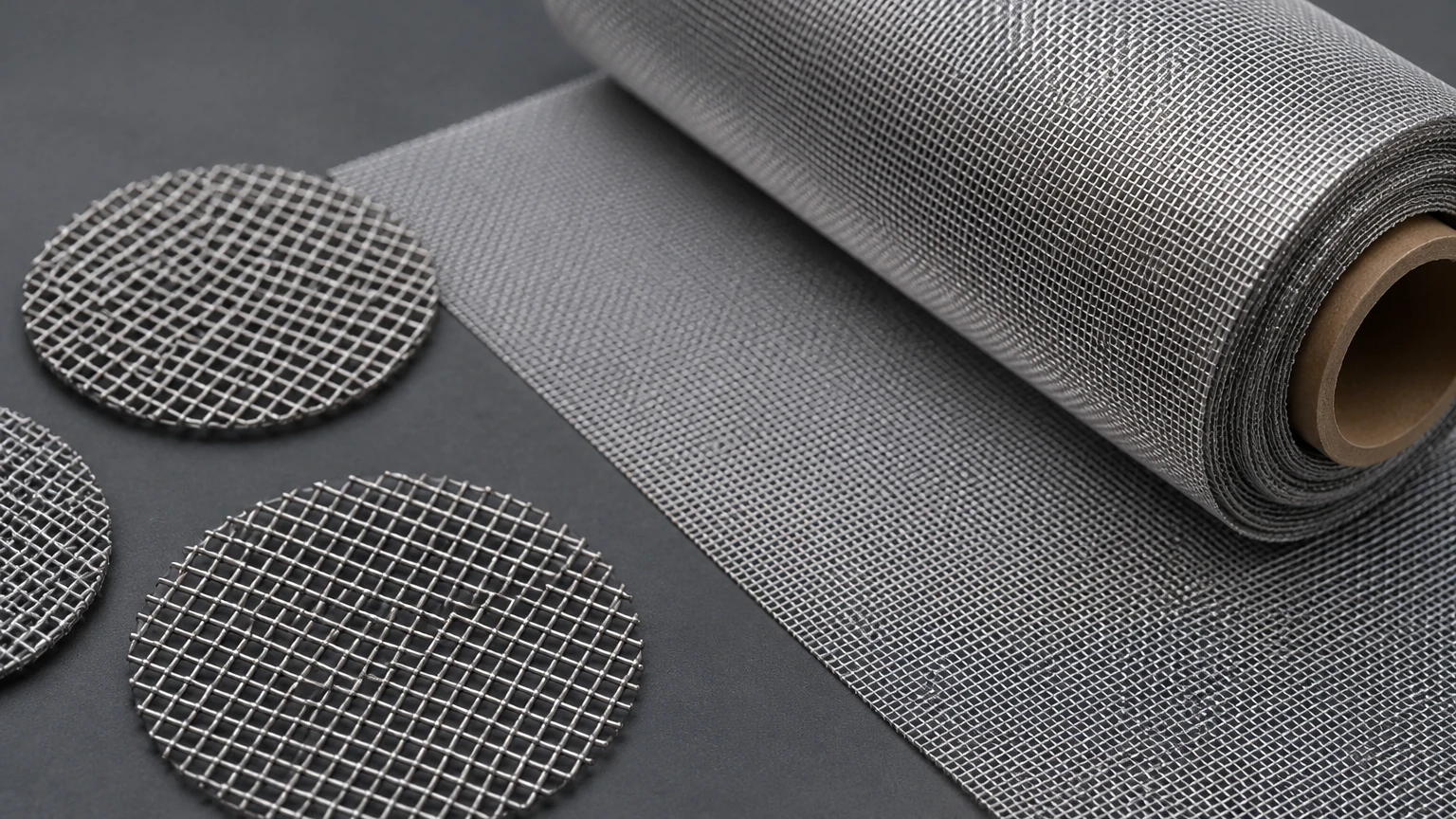
Standard wire cloth is often not enough for demanding industrial environments. Engineers frequently require 40 mesh to be integrated into complex filter assemblies. Customization options provided by manufacturers like Kaifil allow for the adaptation of 40 mesh into various forms:
1. Sintered Mesh: To increase the pressure rating and prevent wire migration, 40 mesh can be sintered (diffusion bonded) with other layers of mesh. This creates a robust, multi-layer composite that retains the 425-micron filtration of the 40 mesh layer while gaining the structural support of coarser base layers.
2. Pleated Elements: To increase the effective filtration area within a small footprint, 40 mesh can be pleated. This design reduces the flow velocity through the media, which in turn lowers the pressure drop and extends the time between cleaning cycles.
3. Reinforced Cartridges: In high-pressure applications, a 40 mesh screen may be wrapped around a perforated metal core. This prevents the mesh from collapsing or deforming under the force of the fluid flow.
Maintenance and Total Cost of Ownership
One of the primary advantages of utilizing a stainless steel 40 mesh size filter is its cleanability. Unlike disposable synthetic filters, stainless steel mesh can be cleaned and reused multiple times, significantly reducing the total cost of ownership (TCO).
Cleaning methods for 40 mesh typically include:
* Backwashing: Reversing the flow of the fluid to dislodge particles trapped on the surface.
* Ultrasonic Cleaning: Using high-frequency sound waves in a solvent bath to remove fine particles embedded within the wire intersections.
* Chemical Cleaning: Using specialized surfactants or acids to dissolve organic or mineral deposits, provided the mesh material is compatible with the cleaning agent.
Engineers must monitor the "blinded" state of the mesh. Blinding occurs when particles that are nearly the same size as the aperture become wedged in the openings. If 40 mesh is frequently blinding, it may indicate that the particulate distribution in the process fluid is not well-suited for this mesh size, and a shift to a different specification or a multi-stage filtration approach may be necessary.
Conclusion for Technical Procurement
Selecting a 40 mesh size filter involves more than just picking a number from a catalog. It requires a thorough analysis of the fluid properties, the nature of the contaminants, and the mechanical requirements of the system. With a nominal aperture of 425 microns, the 40 mesh size provides a reliable solution for coarse-to-medium filtration tasks across the chemical, food, and hydraulic sectors.
When sourcing these components, it is vital to work with a manufacturer that understands the engineering rigors of industrial filtration. Precise weaving, consistent wire diameters, and high-quality material grades ensure that the filter performs as expected under pressure. Whether used as a standalone strainer or as part of a complex multi-layer sintered element, the 40 mesh size remains a fundamental tool in the engineer's pursuit of process efficiency and equipment protection.
