


Auto Backwash Filter
In modern industrial processing, the demand for continuous operation and minimal manual intervention has driven the evolution of filtration technology. The auto backwash filter represents a critical component in systems where fluid purity is paramount, and downtime for filter cleaning is economically unfeasible. These self-cleaning systems are designed to remove suspended solids from liquid streams automatically, ensuring that the process remains online while maintaining the integrity of downstream equipment.
For engineers and procurement teams, selecting an auto backwash filter involves more than just matching a pipe size. It requires a deep understanding of fluid dynamics, particle load, and the mechanical limits of the filter media. As a specialized manufacturer of stainless steel filtration solutions, Kaifil provides the high-precision components necessary to ensure these systems operate with maximum efficiency and durability.
The Operational Mechanism of Auto Backwash Systems
An auto backwash filter operates on a simple yet highly effective principle: using the process fluid itself, or an external clean source, to flush accumulated debris from the filter element without stopping the main flow. This is typically achieved through one of two primary triggers: pressure differential or a timed interval.
Pressure Differential (DP) Trigger
As the filter element—often a stainless steel wire mesh or wedge wire screen—captures contaminants, the effective open area of the media decreases. This leads to an increase in the pressure drop across the filter. Sensors monitor the inlet and outlet pressure; once the differential reaches a pre-set threshold (commonly between 0.5 to 1.0 bar, depending on the application), the control system initiates the backwash cycle. This method is the most efficient as it responds directly to the actual contaminant load.
Timer-Based Trigger
In applications where the contaminant load is relatively constant or where preventing any potential for extreme pressure spikes is critical, a timer-based trigger is used. The system initiates a cleaning cycle at fixed intervals, regardless of the pressure drop. Most industrial units utilize a combination of both DP and timer triggers to ensure redundancy.
The Cleaning Cycle
During the backwash cycle, a motorized internal mechanism—such as a rotating scanner, a suction nozzle, or a backwash arm—moves across the surface of the filter element. A backwash valve opens to the atmosphere or a low-pressure drain. The resulting pressure gradient causes a high-velocity reversal of flow through the filter media, dislodging the "filter cake" and flushing it out of the system. In many designs, only a small portion of the filter area is cleaned at a time, allowing the main process flow to continue uninterrupted.
Engineering Considerations for Filter Media Selection
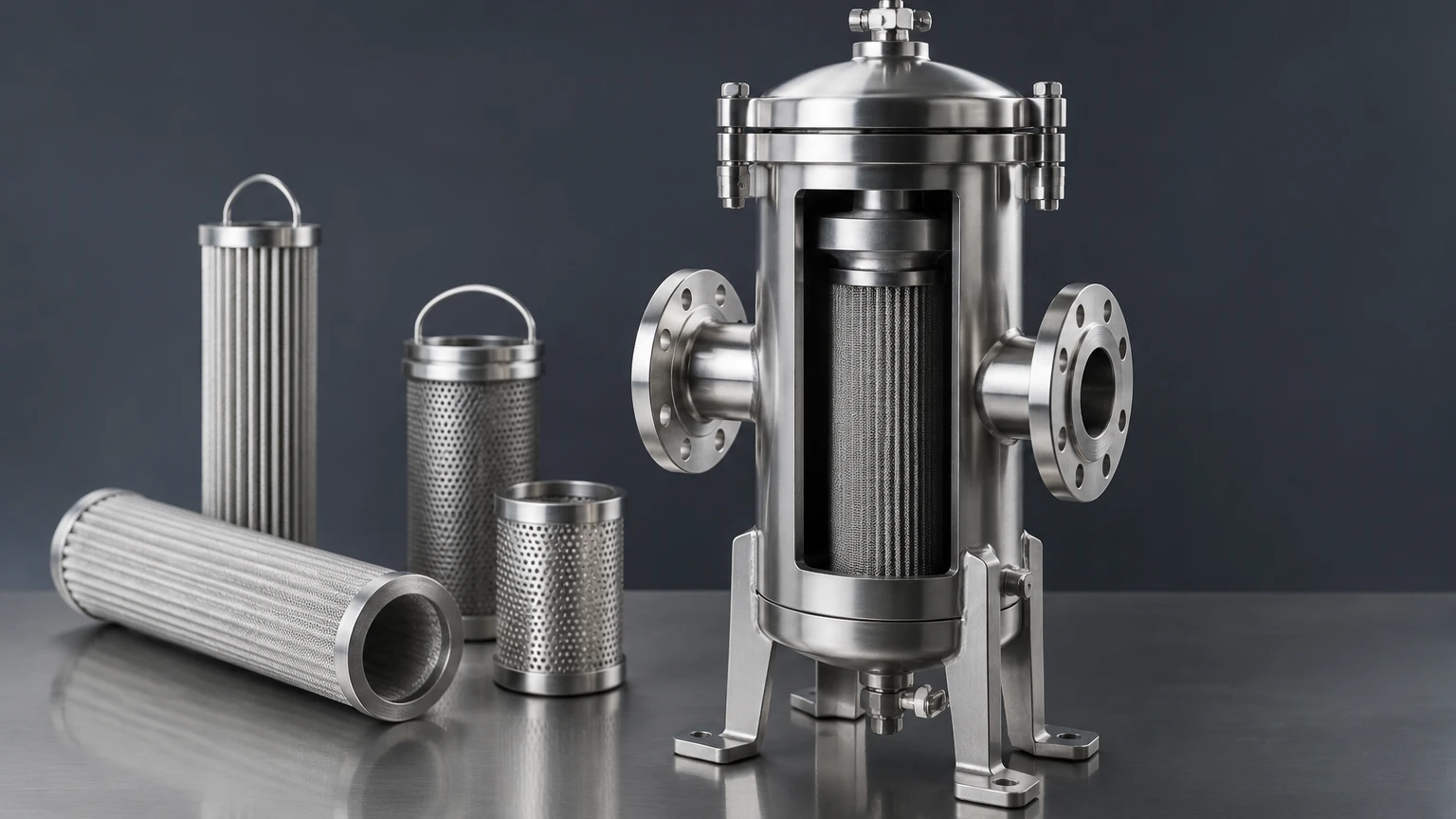
The heart of any auto backwash filter is the filter element. The choice of material and construction method directly impacts the cleaning efficiency and the service life of the unit. Stainless steel is the industry standard due to its mechanical strength and resistance to corrosion and temperature extremes.
Stainless Steel Wire Mesh
For fine filtration, multi-layered sintered wire mesh is often preferred. This material combines the precision of fine mesh with the structural support of coarser layers. It provides a stable pore size and can withstand the repetitive mechanical stresses of the backwash cycle. Kaifil specializes in custom wire mesh filters that can be tailored to specific micron ratings, ensuring that the media does not deform under high-pressure reversals.
Wedge Wire Elements
Wedge wire, or V-wire, is ideal for applications involving fibrous or sticky contaminants. The V-shaped profile of the wire creates a widening gap in the direction of the flow, which reduces the likelihood of particles becoming wedged in the media. This geometry is particularly effective during backwashing, as the reverse flow encounters less resistance when pushing particles away from the surface.
Material Grades
Selecting the correct grade of stainless steel is essential for chemical compatibility. While SS304 is suitable for general water treatment, SS316L is required for more corrosive environments, such as chemical processing or marine applications. For extreme conditions involving high chlorides or acidic solutions, specialized alloys may be necessary to prevent pitting and stress corrosion cracking.
Key Evaluation Criteria for Industrial Filtration
When evaluating an auto backwash filter for a specific project, engineers must look beyond the initial capital expenditure and focus on total cost of ownership (TCO) and performance reliability. Key metrics include:
1. Filtration Accuracy (Micron Rating): Determine the absolute vs. nominal rating required. Over-specifying (choosing a micron rating much finer than necessary) leads to frequent backwashing and higher water/fluid loss.
2. Backwash Fluid Loss: Calculate the volume of fluid discharged during each cleaning cycle. In high-value liquid applications, minimizing this loss is critical for ROI.
3. Flow Rate and Velocity: Ensure the filter housing and element are sized to maintain a fluid velocity that does not cause excessive turbulence or premature wear on the mesh.
4. Minimum Operating Pressure: Most auto backwash filters require a minimum line pressure (often around 2-3 bar) to drive the backwash mechanism effectively. If the system pressure is too low, a booster pump or an external backwash source may be required.
For a detailed look at the technical specifications of various filter components, technical professionals can refer to the Main Page of the Kaifil website to review product options and application support.
Common Operational Risks and Mitigation
Despite their automated nature, these systems are not "set and forget." Understanding common failure modes helps in designing a more resilient filtration stage.
Media Blinding
Blinding occurs when particles are forced into the pores of the mesh so deeply that the backwash flow cannot dislodge them. This is common with deformable particles or biological growth. Mitigation strategies include using specialized coatings, adjusting the backwash velocity, or incorporating chemical cleaning ports into the filter housing.
Mechanical Wear of Seals and Bearings
The moving parts within an auto backwash filter—specifically the scanning arm and the backwash valve—are subject to wear. In abrasive environments (e.g., sand or scale removal), seals can degrade quickly. Selecting units with high-quality, wear-resistant seals and ensuring easy access for maintenance is vital.
Control System Failure
If the PLC or the DP sensors fail, the filter may stop cleaning, leading to a complete blockage of the process line. It is recommended to install manual bypass valves and mechanical pressure gauges as a secondary monitoring method to allow for manual intervention if the automation fails.
Application-Specific Requirements
The design of an auto backwash filter must be adapted to the specific industry it serves:
* Chemical Processing: Requires high resistance to aggressive solvents and precise control over emissions. Filters must often meet specific pressure vessel codes (like ASME Section VIII).
* Food and Beverage: Demands sanitary designs with smooth surfaces (low Ra values) to prevent bacterial growth. The filter must be compatible with Clean-in-Place (CIP) procedures.
* Cooling Water Systems: Often deal with high flow rates and large volumes of organic debris. The focus here is on robust mechanical construction and the ability to handle seasonal fluctuations in water quality.
* Oil and Gas: Requires explosion-proof electrical components and the ability to handle high-viscosity fluids, which may necessitate heating jackets for the filter housing.
Technical Checklist Before Procurement
Before finalizing the design or purchase of an auto backwash filter, engineers should confirm the following data points with the manufacturer:
* Fluid Characteristics: Viscosity, density, and temperature at operating conditions.
* Contaminant Profile: Particle size distribution (PSD), concentration (PPM), and the nature of the solids (hard, soft, fibrous, or sticky).
* Inlet/Outlet Requirements: Connection types (flanged, threaded) and orientation (in-line, L-type).
* Electrical and Pneumatic Availability: Voltage, phase, and frequency for the motor, and air pressure for pneumatic valves.
* Space Constraints: Ensure there is sufficient clearance for removing the internal element during major maintenance intervals.
By addressing these factors, purchasing teams can ensure that the selected filtration solution provides the necessary protection for downstream equipment while optimizing the efficiency of the entire industrial process. Kaifil’s expertise in custom stainless steel filtration ensures that every component, from the outermost housing to the finest wire mesh, is engineered to meet the rigorous demands of modern industry.
