


Basket Type Strainer
In industrial fluid handling, the protection of sensitive downstream equipment—such as pumps, valves, meters, and spray nozzles—is a primary engineering concern. The basket type strainer serves as a critical line of defense, designed to remove unwanted solids from liquid streams through a perforated or wire mesh straining element. Unlike simpler filtration components, the basket type strainer is characterized by its upright, bucket-shaped chamber, which provides a significantly larger surface area for debris collection and a lower pressure drop compared to Y-strainers of similar pipe sizes.
For engineers and procurement teams, selecting the correct basket type strainer requires a deep understanding of fluid dynamics, material compatibility, and the specific mechanical requirements of the application. This guide explores the technical nuances of basket strainers, their design variations, and the factors that influence long-term operational efficiency.
Engineering Principles and Design Advantages
The fundamental advantage of a basket type strainer lies in its internal geometry. The "basket" design allows for a high open-area ratio—the ratio of the total open area of the strainer element to the cross-sectional area of the inlet pipe. In many high-performance industrial designs, this ratio is 6:1 or higher. A high open-area ratio ensures that the strainer can accumulate a substantial amount of debris before the pressure drop (ΔP) reaches a level that necessitates cleaning.
Flow Dynamics
Fluid enters the strainer housing and is directed into the top or side of the basket. As the liquid passes through the mesh or perforated metal, solids are trapped inside the basket. Because the debris is contained within the basket, it is easily removed when the top cover is opened, preventing contaminants from falling back into the downstream piping during maintenance. This "top-loading" or "side-entry" configuration is particularly beneficial in high-viscosity applications or systems where heavy particulate loads are expected.
Pressure Drop Considerations
Pressure drop is the most critical metric in strainer selection. An undersized basket type strainer will cause excessive energy loss and may lead to pump cavitation. Engineers must calculate the clean pressure drop based on the fluid’s viscosity and specific gravity, as well as the flow rate. As the basket fills with contaminants, the effective filtration area decreases, causing the differential pressure to rise. Most industrial systems utilize differential pressure gauges to signal when the basket requires servicing.
Material Selection for Industrial Environments
The durability of a basket type strainer is dictated by its materials of construction. While the housing can be made from various metals, the internal basket—the component most exposed to wear and chemical attack—requires precise material selection. Kaifil specializes in custom stainless steel filtration solutions, providing the technical expertise needed to match materials to specific environmental stressors.
1. Stainless Steel (304 and 316L): These are the industry standards for corrosion resistance. 316L is preferred in environments containing chlorides or in pharmaceutical and food-grade applications where preventing metallic contamination is paramount.
2. Carbon Steel: Often used in oil and gas or non-corrosive water services where cost-effectiveness is a priority.
3. Specialty Alloys: For highly aggressive chemical processing, materials like Monel, Hastelloy, or Duplex stainless steel may be required to withstand pitting and stress corrosion cracking.
Beyond the housing and basket, the choice of seals (O-rings or gaskets) is equally vital. Common materials include Buna-N, Viton (FKM), EPDM, and PTFE. The seal must be compatible with the process fluid and the operating temperature range to prevent bypass or external leaks.
Simplex vs. Duplex Basket Strainers
When specifying a basket type strainer, the operational continuity of the system determines whether a simplex or duplex design is required.
Simplex Basket Strainers
A simplex strainer consists of a single chamber and one basket. It is the most common choice for batch processes or systems where the flow can be safely interrupted for cleaning. Simplex designs are compact and cost-effective, but they require the system to be shut down or bypassed during maintenance. For more information on standard and custom designs, engineers often refer to the Main Page of specialized manufacturers to review technical specifications.
Duplex Basket Strainers
In continuous-flow applications—such as cooling water systems for power plants or lubrication lines for large turbines—downtime is not an option. A duplex basket strainer features two separate chambers connected by a diverter valve (often a ball or plug valve). When one basket becomes clogged, the operator can switch the flow to the clean chamber without interrupting the process. The dirty basket can then be cleaned and replaced while the system remains online. This design significantly reduces the risk of system failure in mission-critical environments.
Technical Specifications: Mesh and Perforation
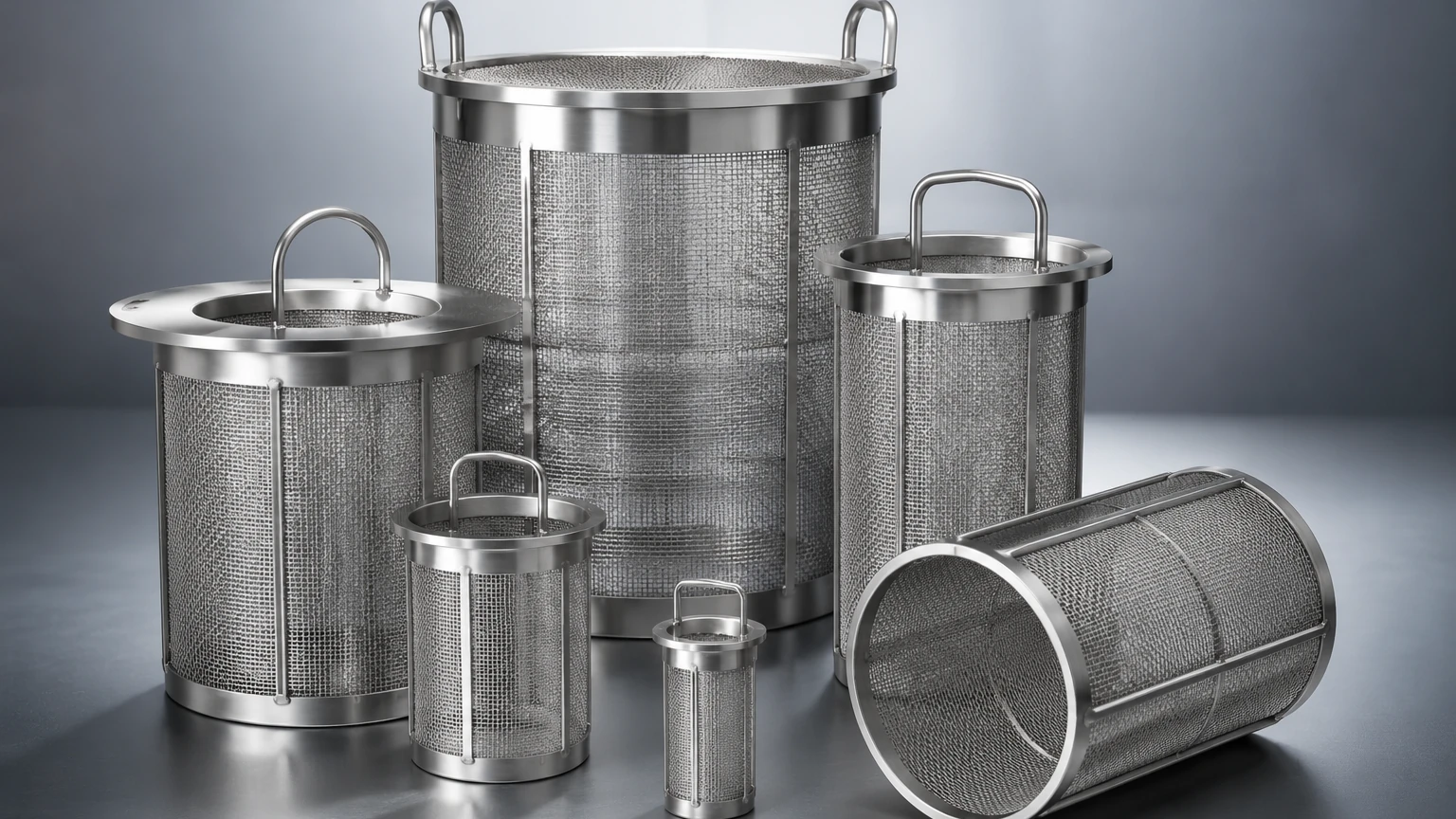
The performance of a basket type strainer is largely defined by the "media" used in the basket. This usually involves a combination of a perforated metal support and a fine wire mesh lining.
* Perforated Plate: This serves as the structural backbone of the basket. Common hole sizes range from 1/32" to 1/2". The thickness of the plate must be sufficient to withstand the differential pressure across the basket when it is fully loaded.
* Wire Mesh: For finer filtration requirements (down to 5 microns or 400 mesh), a stainless steel wire mesh is layered inside the perforated plate. The mesh count refers to the number of openings per linear inch. Engineers must balance the need for fine filtration with the reality that finer meshes clog more quickly and increase initial pressure drop.
* Sintered Mesh: In high-pressure or high-temperature applications, sintered multi-layer wire mesh provides superior mechanical strength and prevents the migration of mesh fragments into the process stream.
Customization and OEM Solutions
Standard off-the-shelf strainers often fail to meet the rigorous demands of specialized industrial processes. Customization is frequently necessary to address unique spatial constraints, extreme pressures, or specific filtration accuracies. As a professional manufacturer, Kaifil provides OEM and customized filtration components that integrate seamlessly into existing infrastructure.
Customization options include:
* Specialized Connections: Flanged (ANSI, DIN, JIS), NPT threaded, socket weld, or sanitary tri-clamp connections.
* Magnetic Inserts: Adding magnetic rods to the basket to capture fine iron and steel particles that might otherwise pass through the mesh.
* Heating Jackets: Essential for fluids like bitumen or sulfur that must be maintained at a specific temperature to remain pumpable.
* Automated Blow-down: Integrating valves that allow for the removal of heavy sludge from the bottom of the strainer without opening the cover.
Maintenance, Cleaning, and Replacement Cycles
The total cost of ownership for a basket type strainer is heavily influenced by its maintenance requirements. A well-designed strainer should allow for rapid access to the basket. Quick-opening covers (such as swing-bolt or clamp designs) are preferred over bolted covers in applications requiring frequent cleaning.
Cleaning Procedures
Baskets should be cleaned using methods that do not compromise the integrity of the wire mesh. High-pressure water or air, ultrasonic cleaning, or chemical baths are common. Abrasive cleaning or mechanical scraping should be avoided, as it can enlarge the mesh openings or create bypass paths.
Replacement Indicators
While baskets are designed to be reusable, they are wear items. Signs that a basket requires replacement include:
* Visible deformation or "bowing" of the perforated plate.
* Frayed or broken wires in the mesh lining.
* Permanent clogging (blinding) that cannot be removed by standard cleaning methods.
* Corrosion or thinning of the basket material.
Engineers should maintain a stock of spare baskets to ensure that a damaged element does not lead to extended system downtime.
Selection Criteria for Industrial Applications
To ensure the optimal performance of a basket type strainer, the following data must be confirmed during the procurement phase:
1. Fluid Properties: Viscosity, specific gravity, and chemical composition.
2. Flow Rate: Minimum, normal, and maximum flow rates (GPM or m³/h).
3. Operating Pressure and Temperature: Including potential surge pressures.
4. Particle Load: The type and concentration of solids to be removed.
5. Target Filtration Level: The maximum allowable particle size to pass through the strainer.
6. Allowable Pressure Drop: Both clean and dirty limits.
By addressing these factors, engineering teams can select a filtration solution that minimizes maintenance labor and maximizes the lifespan of downstream equipment. Whether for water treatment, chemical processing, or food production, the basket type strainer remains a versatile and indispensable component in modern industrial piping. For those looking to explore high-precision metal filter components and custom designs, visiting the Main Page of a dedicated manufacturer like Kaifil provides the technical resources necessary to make an informed decision.
