


Belt Presses
In the landscape of industrial dewatering and solid-liquid separation, belt presses—often referred to as belt filter presses—stand as a cornerstone technology. These systems are engineered to extract liquid from sludge or slurries, producing a concentrated solid "cake" that is easier to handle, transport, or dispose of. For engineers and procurement professionals in sectors ranging from municipal wastewater treatment to chemical processing and food production, understanding the mechanical nuances and material requirements of belt presses is essential for optimizing operational efficiency.
The performance of a belt press is inextricably linked to the quality and specification of its filter media. As a specialized manufacturer of stainless steel filtration solutions, Kaifil recognizes that the interaction between the sludge and the filter belt determines the ultimate success of the dewatering process. This article provides a technical overview of belt press mechanics, the critical role of stainless steel mesh components, and the engineering considerations necessary for selecting the right filtration media.
Engineering Fundamentals of Belt Presses
The operation of belt presses relies on a series of mechanical stages that progressively increase pressure on the material to force out moisture. Unlike centrifugal or vacuum-based systems, belt presses use mechanical compression between two tensioned belts to achieve separation. The process typically follows three distinct zones:
1. Gravity Drainage Zone
Before the sludge enters the high-pressure stages, it is often pre-treated with polymers or flocculants to aggregate fine particles into larger "flocs." This conditioned sludge is then fed onto a moving porous belt in the gravity drainage zone. Here, the free water drains through the mesh by gravity. A well-designed gravity zone can remove up to 75% of the initial water content, which is vital for preparing the sludge for the subsequent compression stages.
2. Wedge Zone (Transition Zone)
As the sludge moves forward, it is sandwiched between the primary belt and a secondary upper belt. The gap between these belts gradually narrows, forming a "wedge" shape. This zone applies a gentle, increasing pressure that stabilizes the sludge cake and prevents it from being squeezed out of the sides of the belts during the high-pressure stage.
3. High-Pressure (Compression) Zone
The sandwiched belts then travel over a series of rollers, often arranged in a serpentine or "S" configuration. As the belts pass over these rollers, the shear forces and compressive pressure squeeze the remaining moisture out through the mesh. The diameter of the rollers typically decreases toward the end of the process, which increases the pressure applied to the cake, ensuring maximum dryness.
The Role of Stainless Steel Mesh in Belt Press Performance
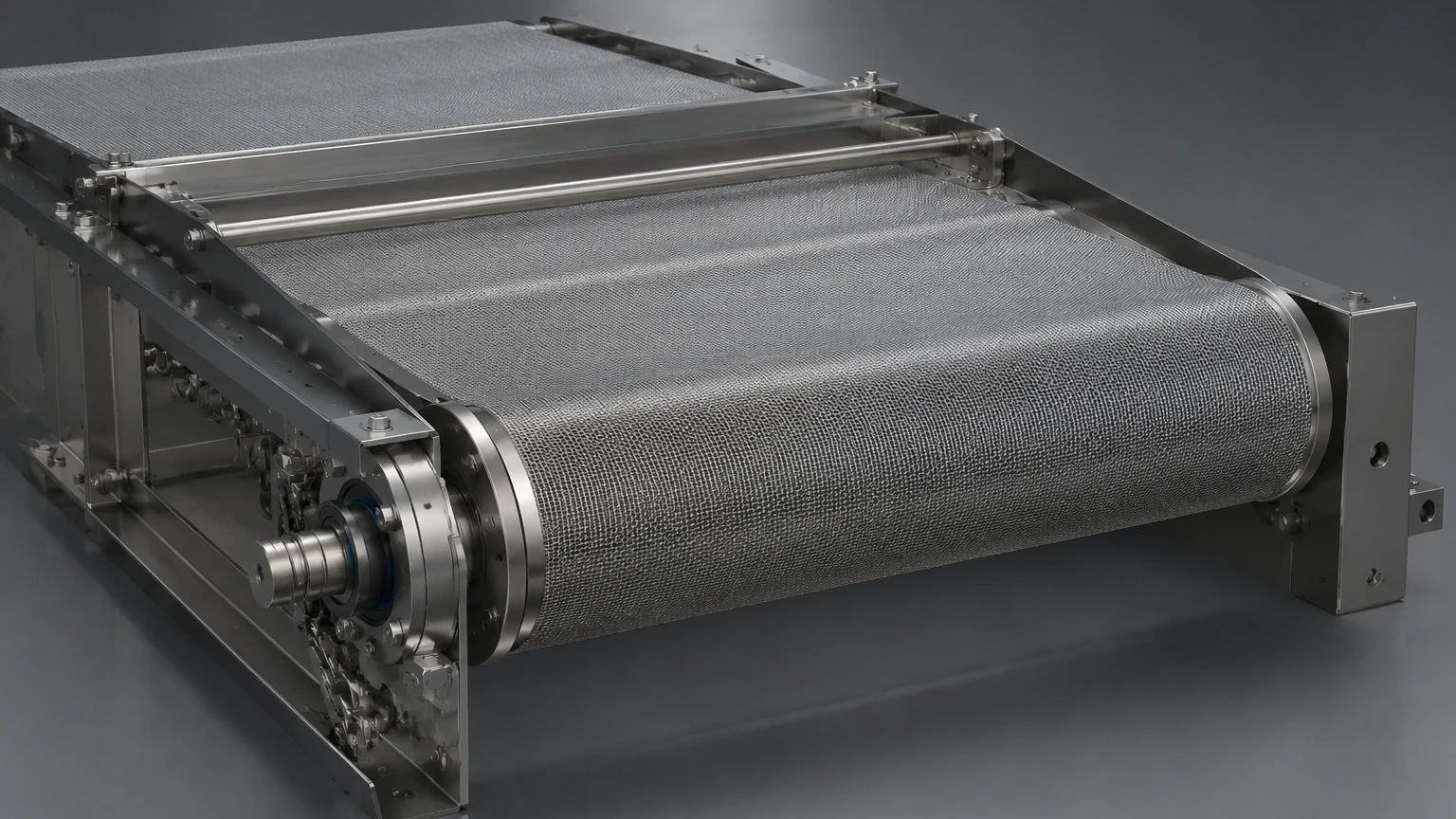
While the mechanical frame and rollers provide the structure, the filter belt itself is the most critical consumable component. In many demanding industrial environments, synthetic belts (such as polyester or polypropylene) may lack the thermal stability, chemical resistance, or mechanical strength required for long-term reliability. This is where stainless steel wire mesh becomes a superior alternative.
Stainless steel belts, often utilized in specialized belt presses for high-temperature or highly corrosive applications, offer several engineering advantages:
* Dimensional Stability: Stainless steel does not stretch or deform under high tension as easily as synthetic fibers. This ensures consistent tracking and prevents the belt from narrowing over time.
* Thermal Resistance: In applications involving hot slurries or steam cleaning, stainless steel maintains its structural integrity at temperatures that would melt or weaken polymers.
* Chemical Compatibility: For chemical processing or pharmaceutical applications, 304 or 316L stainless steel provides excellent resistance to a wide range of pH levels and aggressive solvents.
* Surface Smoothness: Precision-woven metal mesh can be manufactured with specific surface characteristics that facilitate "cake release," ensuring that the dried solids fall away cleanly at the discharge point.
For those evaluating specific filtration components for these systems, visiting the Main Page of a specialized manufacturer like Kaifil provides insights into the various weave patterns and material grades available for industrial-grade filtration.
Key Technical Specifications for Selection
Selecting the correct media for belt presses requires a deep dive into several technical parameters. Engineers must balance the need for high solids capture with the requirement for rapid drainage.
Micron Rating and Aperture Size
The "open area" of the mesh determines how quickly water can pass through. If the aperture is too large, fine solids will pass through (low capture rate), resulting in poor filtrate quality. If the aperture is too small, the belt may "blind" or clog rapidly, requiring frequent cleaning and reducing throughput.
Weave Type
* Plain Weave: Offers a simple, consistent aperture but may have lower mechanical strength for high-tension applications.
* Twill Weave: Allows for a heavier wire diameter in a given mesh count, increasing durability.
* Dutch Weave: Provides a tortuous path for particles, offering high-precision filtration and excellent strength, though it may be more challenging to clean in sludge applications.
Tensile Strength and Edge Reinforcement
Belt presses exert significant lateral and longitudinal tension. The mesh must be capable of withstanding these loads without tearing. Furthermore, the edges of the belt are subject to wear against tracking sensors and guides. Reinforced edges—often achieved through specialized welding or coating—are essential for extending the service life of the belt.
Common Operational Challenges and Solutions
Even the most robust belt presses encounter operational hurdles. Identifying these early can prevent costly downtime and equipment damage.
1. Belt Blinding
Blinding occurs when fine particles become lodged within the weave of the mesh, or when biological growth/chemical scaling coats the wires. This reduces the drainage capacity. The solution involves high-pressure wash bars that continuously clean the belt on its return path. For persistent blinding, selecting a mesh with a "monofilament-style" metal weave can reduce particle entrapment.
2. Tracking and Alignment Issues
If a belt is not perfectly square or if the rollers are misaligned, the belt will "walk" to one side. This can lead to edge fraying or total belt failure. Modern belt presses use automatic tracking systems, but the inherent stability of a high-quality stainless steel mesh significantly reduces the frequency of these adjustments.
3. Chemical Degradation
In wastewater treatment, the presence of hydrogen sulfide or high chlorine levels can lead to pitting corrosion in lower-grade metals. Utilizing 316L stainless steel, which contains molybdenum, provides the necessary resistance to chloride-induced pitting, ensuring the belt does not fail prematurely due to chemical attack.
Customization and OEM Solutions for Belt Presses
Industrial applications are rarely "one size fits all." A belt press used in a fruit juice extraction plant has vastly different requirements than one used in a coal washery. Customization is often the key to achieving the lowest total cost of ownership (TCO).
Kaifil specializes in providing customized filtration components that meet specific OEM (Original Equipment Manufacturer) standards. This includes tailoring the wire diameter to increase abrasion resistance for mining slurries or adjusting the weave density to handle the delicate flocs found in biological wastewater treatment. When engineers collaborate with a manufacturer that understands the mechanical stresses of belt presses, they can specify belts that offer a longer service life and higher filtration flux.
Customization also extends to the joining method. While many belts use a mechanical "clipper" seam for ease of installation, some high-precision or high-sanitation applications require an "endless" belt, where the mesh is woven or welded into a continuous loop to eliminate the seam as a point of weakness or contamination.
Maintenance and Total Cost Considerations
While the initial purchase price of a belt press or its replacement belts is a factor, the long-term operational costs are far more significant. These include:
* Polymer Consumption: A more efficient belt may require less chemical conditioning of the sludge.
* Energy Usage: Efficient drainage in the gravity zone reduces the mechanical load on the drive motors in the compression zone.
* Cake Disposal Costs: Increasing the cake dryness by even 1% or 2% can result in thousands of dollars in annual savings on hauling and landfill fees.
* Downtime: The time required to replace a failed belt is often more expensive than the belt itself. Investing in high-durability stainless steel components reduces the frequency of these interventions.
To ensure optimal performance, maintenance teams should conduct regular inspections of the wash bars, check for uneven belt wear, and monitor the filtrate quality. A sudden increase in solids in the filtrate often indicates a hole in the mesh or a failure in the polymer dosing system.
Conclusion
Belt presses remain a vital technology for industrial liquid-solid separation, offering a balance of continuous operation, high throughput, and reliable dewatering. However, the mechanical efficiency of these machines is entirely dependent on the integrity and specification of the filter belts. By selecting high-quality stainless steel mesh and considering the specific chemical and physical demands of the application, engineers can significantly improve the performance and lifespan of their dewatering equipment.
For technical professionals seeking to optimize their filtration systems or source precision-engineered components, exploring the resources and product options available on the Main Page of a dedicated manufacturer is the recommended next step. Understanding the intersection of metallurgy and mechanical engineering is the key to mastering the complexities of industrial belt presses.
