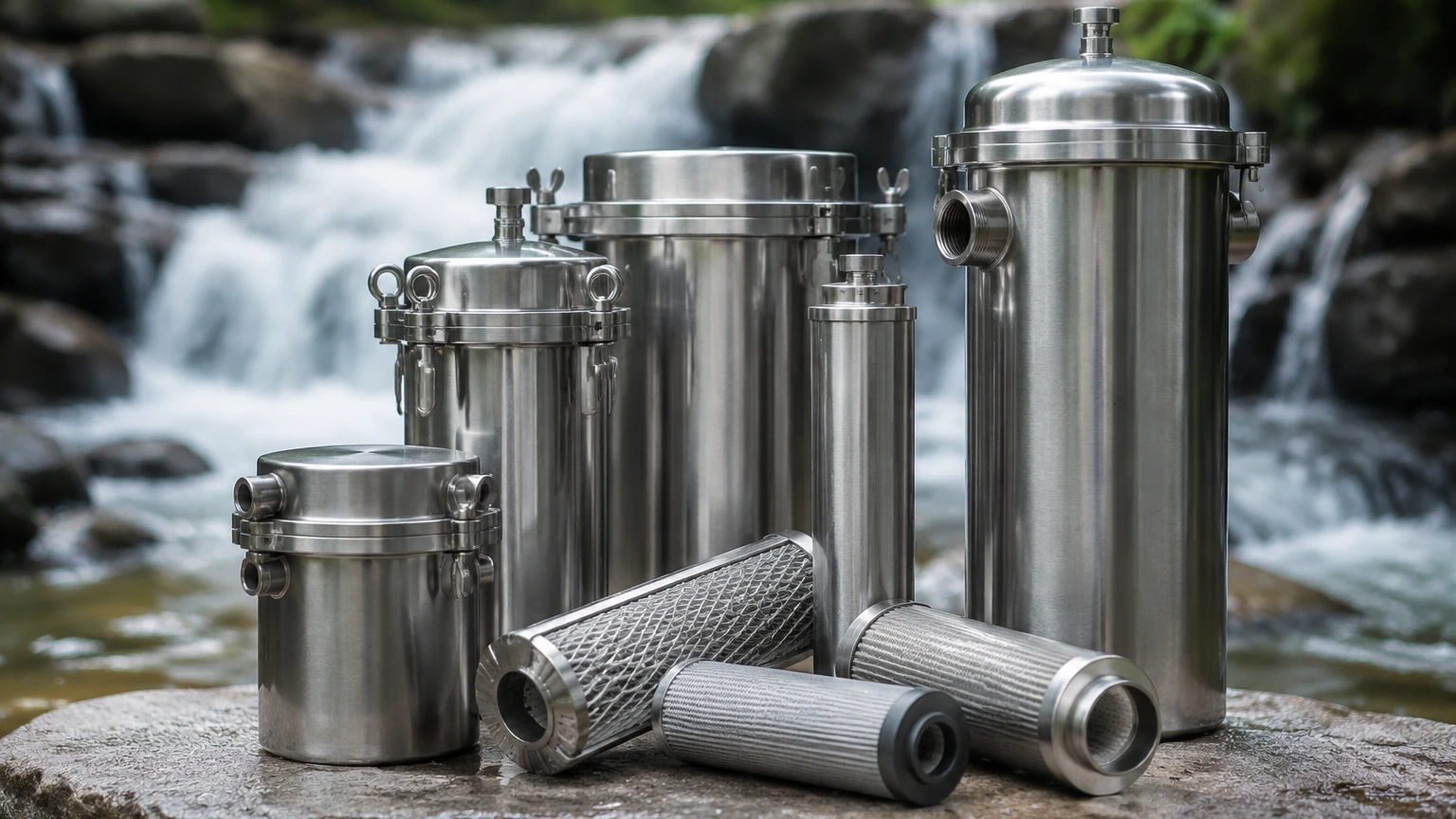
Best Stainless Steel Water Filters
In industrial water treatment, the selection of filtration components is a critical engineering decision that impacts system uptime, product purity, and long-term operational costs. While disposable polymer-based filters are common in low-demand scenarios, industrial applications involving high temperatures, aggressive chemical profiles, or high-pressure differentials necessitate more robust solutions. Stainless steel filtration media have emerged as the industry standard for these demanding environments. Identifying the best stainless steel water filters requires a deep understanding of material science, mechanical design, and the specific fluid dynamics of the application.
Material Selection: Why Grade Matters in Water Filtration
The performance of a stainless steel filter begins with its alloy composition. In industrial water filtration, the two most prevalent materials are AISI 304 and AISI 316L stainless steel.
304 Stainless Steel is suitable for general-purpose water filtration where corrosion risk is moderate. It provides excellent mechanical strength and heat resistance. However, in applications involving brackish water, high-chloride concentrations, or chemical cleaning agents, 304 can be susceptible to pitting and crevice corrosion.
316L Stainless Steel is generally considered the superior choice for high-performance industrial water filters. The addition of molybdenum (2-3%) significantly enhances its resistance to chlorides and acidic environments. The "L" designation stands for low carbon, which improves the material's weldability and reduces the risk of intergranular corrosion after the welding process. For engineers designing systems for pharmaceutical, food and beverage, or chemical processing, 316L is often the non-negotiable standard for ensuring the longevity of the filtration system.
Comparing Filtration Media Structures
The "best" filter is not defined by a single design but by how well the media structure matches the contaminant load. Stainless steel filters are typically manufactured in three primary formats: woven wire mesh, sintered metal, and wedge wire.
Woven Wire Mesh Filters
Woven wire mesh is the most versatile and widely used media. It consists of precise patterns of stainless steel wires woven into a fabric-like structure. These filters are characterized by their high open area, which allows for high flow rates and low initial pressure drops. They are ideal for surface filtration, where particles are trapped on the surface of the mesh. This makes them exceptionally easy to clean via backwashing or ultrasonic methods.
Sintered Metal Filters
Sintered filters are created by bonding multiple layers of wire mesh or metal powder through a high-temperature diffusion process. This creates a porous, monolithic structure with exceptional mechanical stability. Sintered filters provide depth filtration, meaning they can trap particles within the tortuous path of the media. They are the best stainless steel water filters for high-pressure applications where the filter must resist deformation under extreme stress.
Wedge Wire Filters
Wedge wire, or V-wire, filters are constructed by wrapping a profile wire around longitudinal support rods. This creates a continuous slot that widens inwardly. This geometry is specifically designed to prevent clogging, as any particle that passes the initial gap will easily clear the rest of the filter. These are typically used in heavy-duty raw water intake or cooling water systems where large volumes of debris must be managed.
Technical Parameters: Micron Ratings and Flow Dynamics
When evaluating filtration performance, engineers must distinguish between nominal and absolute micron ratings. A nominal rating indicates the filter's ability to retain a majority of particles of a certain size, whereas an absolute rating (often defined as a Beta ratio of 5000 or 99.9% efficiency) guarantees that no particle larger than the specified micron size will pass through the media.
For industrial water systems, the best stainless steel water filters are those that balance filtration fineness with the required flow rate. A filter with an overly tight micron rating will result in frequent clogging and high maintenance costs. Conversely, a filter that is too coarse will fail to protect downstream equipment like high-pressure pumps or sensitive RO membranes.
To optimize this balance, engineers must calculate the Effective Filtration Area (EFA). By increasing the EFA—often achieved through pleating the stainless steel mesh—one can lower the flux (flow per unit area), which reduces the pressure drop and extends the time between cleaning cycles. For detailed technical specifications on EFA and mesh configurations, technical teams often refer to the Main Page of specialized manufacturers to align their designs with available production capabilities.
The Role of Customization in Industrial Water Systems
Standardized filter cartridges often fall short in specialized industrial environments. Customization is frequently required to integrate a filter into existing piping or to meet specific chemical compatibility requirements. The best stainless steel water filters are often those engineered as OEM components, where the end-cap configuration (such as 222, 226, or DOE), the overall length, and the reinforcement internal core are designed to the exact specifications of the housing.
Customization also extends to the structural integrity of the filter. In hydraulic or high-viscosity water-based fluid systems, the filter may need to withstand collapse pressures exceeding 100 or 200 PSI. In such cases, the internal support core must be reinforced with perforated stainless steel or heavy-duty wire cages. Working with a manufacturer that understands these mechanical nuances ensures that the filtration component does not become a point of failure in the system.
Maintenance Strategies and Cleanability
One of the primary advantages of stainless steel over disposable media is cleanability. However, the effectiveness of cleaning depends on the nature of the contaminants and the filter structure.
1. Backwashing: This is the most common method for automated systems. Reversing the flow of water dislodges surface-trapped particles. Woven wire mesh and wedge wire filters are particularly well-suited for this.
2. Chemical Cleaning: For biological fouling or mineral scaling, stainless steel filters can be soaked in caustic or acidic solutions that would destroy polymer filters.
3. Ultrasonic Cleaning: This is the most thorough method for sintered filters. High-frequency sound waves create cavitation bubbles that penetrate deep into the porous structure to remove embedded particulates.
Establishing a clear differential pressure (ΔP) threshold for cleaning is essential. Typically, a filter should be cleaned when the ΔP reaches a predetermined level (e.g., 15-20 PSI) to prevent permanent deformation of the mesh or bypass of contaminants.
Total Cost of Ownership (TCO) vs. Initial Purchase Price
While the initial cost of a stainless steel filter is higher than that of a polypropylene melt-blown or string-wound cartridge, the Total Cost of Ownership is often significantly lower. The longevity of a well-maintained stainless steel filter can span several years, whereas disposable filters may need replacement every few weeks.
When calculating TCO, engineers should consider:
* Replacement Costs: The price of the disposable media over the system's lifespan.
* Labor Costs: The man-hours required to change out filters and manage waste disposal.
* Disposal Costs: Industrial filters used in chemical or oil-contaminated water may be classified as hazardous waste, increasing disposal fees.
* Uptime: The reduction in system downtime due to fewer filter changes.
By investing in the best stainless steel water filters, facilities can transition from a reactive maintenance model to a more predictable, sustainable operational model. This is especially true in high-volume applications where the sheer volume of disposable waste becomes an environmental and logistical burden.
Application-Specific Selection Guidance
To select the correct filter, the following application data must be confirmed:
* Fluid Chemistry: Presence of chlorides, pH levels, and potential for oxidation.
* Operating Temperature: Stainless steel can operate from cryogenic temperatures up to 800°F+, but seals and gaskets (EPDM, Viton, PTFE) must be rated accordingly.
* Contaminant Type: Is the debris hard and angular, or soft and deformable? This determines whether surface or depth filtration is required.
* Flow Rate and Pressure: Determines the required surface area and structural reinforcement.
For engineers and purchasing teams, the path to optimizing water filtration involves moving beyond generic solutions and focusing on the precision engineering offered by metallic media. Whether the goal is protecting sensitive equipment or ensuring the purity of a final product, stainless steel provides the durability and precision required for modern industrial standards. For those seeking to explore specific configurations or request custom OEM designs, reviewing technical resources on a manufacturer's Main Page is a vital step in the procurement process, ensuring that the selected filter meets both the mechanical and filtration requirements of the project.