


Bottle Top Filtration
Bottle top filtration is a fundamental process in both laboratory and small-scale industrial environments, designed for the clarification, sterilization, or particle removal of aqueous solutions and organic solvents. While often associated with disposable plastic units in biological research, the engineering principles behind this method extend into high-performance industrial applications where durability, chemical resistance, and precision are paramount. For engineers and procurement specialists, understanding the technical nuances of filtration media, housing integrity, and material compatibility is essential for optimizing process efficiency and ensuring product purity.
In industrial settings, bottle top filtration often serves as a bridge between research and development (R&D) and full-scale production. It allows for the testing of filtration parameters on a manageable scale before scaling up to larger stainless steel filter cartridges or multi-stage filtration systems. This guide examines the technical considerations of bottle top filtration, focusing on the transition from standard lab-ware to robust, industrial-grade filtration components.
Principles and Mechanics of Bottle Top Filtration
The operation of a bottle top filtration system relies on a pressure differential, typically generated by a vacuum pump. The system consists of a filter funnel (containing the filtration medium) that is secured to the neck of a receiver bottle. When a vacuum is applied to the receiver bottle, the fluid is drawn through the filter medium, leaving contaminants or desired particulates on the surface or within the depth of the filter.
Vacuum-Driven Flux
The flow rate, or flux, in bottle top filtration is governed by Darcy’s Law, which relates the flow rate to the pressure drop, the viscosity of the fluid, and the resistance of the filter medium. In a vacuum-driven setup, the maximum theoretical pressure differential is approximately 1 bar (14.7 psi). However, in practice, most systems operate at lower differentials to prevent the collapse of the receiver vessel or the deformation of the filter medium. Engineers must balance the vacuum strength with the mechanical strength of the filter support to avoid "breakthrough" or media migration.
Effective Filtration Area (EFA)
The Effective Filtration Area (EFA) is a critical metric in determining the capacity and speed of the filtration process. A larger EFA allows for higher throughput and reduces the risk of premature clogging (blinding) of the filter. When selecting components for bottle top filtration, the ratio of the funnel volume to the EFA must be considered to ensure that the entire batch can be processed without requiring a filter change mid-process.
Material Selection: Stainless Steel vs. Disposable Plastics
One of the most significant decisions in specifying bottle top filtration systems is the choice of materials. While disposable plastic units are common for single-use biological applications, industrial processes often demand the resilience of metallic components.
Chemical and Thermal Compatibility
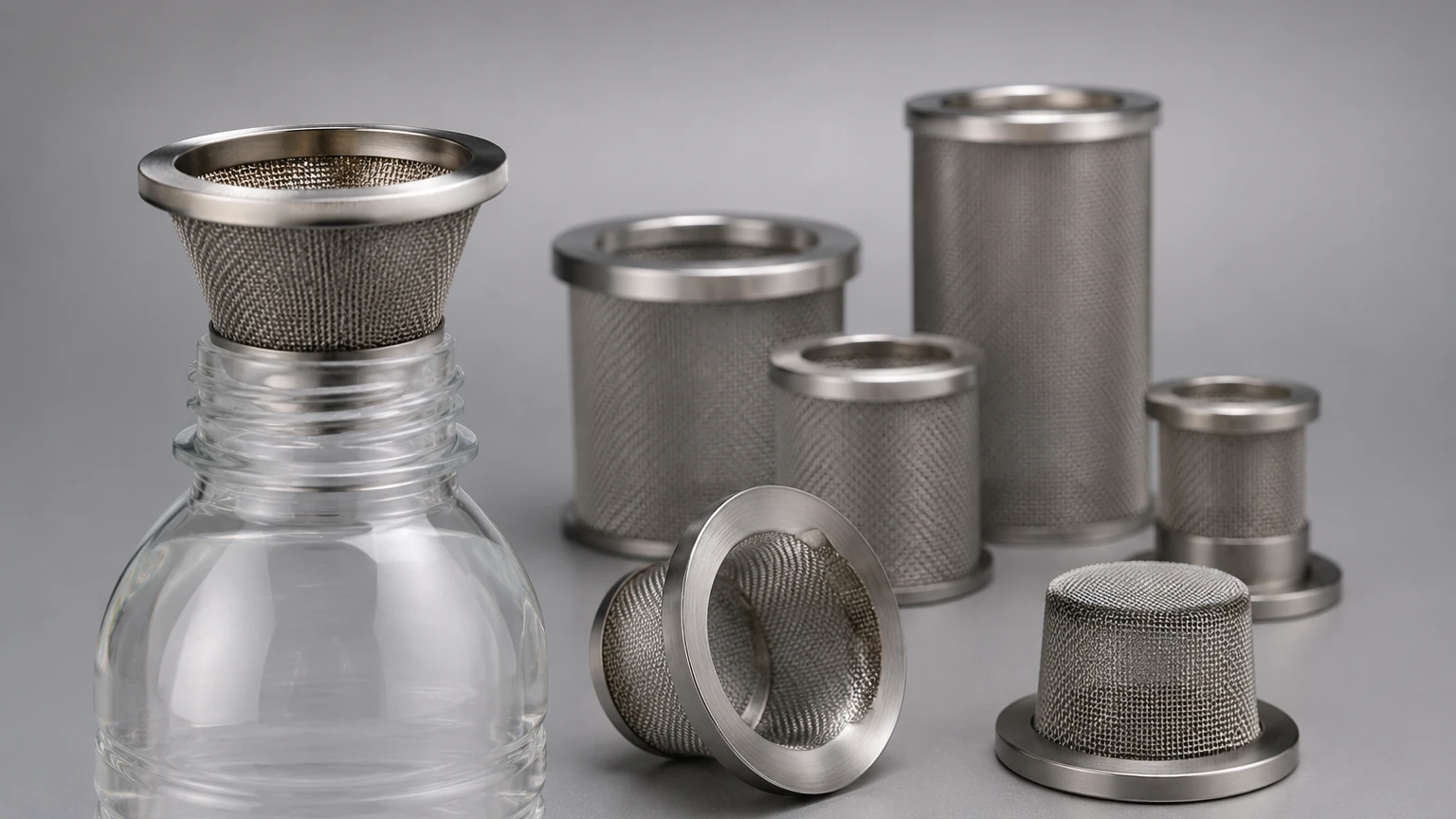
Standard plastic filtration units, often made from polystyrene or polypropylene, have limited resistance to aggressive solvents, high temperatures, and extreme pH levels. In contrast, stainless steel filtration components, such as those manufactured by Kaifil, offer broad chemical compatibility. Using 304 or 316L stainless steel ensures that the filtration process does not introduce leachables or extractables into the filtrate, which is critical in pharmaceutical and fine chemical manufacturing.
Furthermore, stainless steel components can withstand high-temperature sterilization processes, including autoclaving and dry heat sterilization, which would melt or deform standard plastic assemblies. This makes them ideal for applications involving hot oils, steam-jacketed processes, or high-purity solvent recovery.
Durability and Total Cost of Ownership (TCO)
While the initial cost of a stainless steel bottle top filtration assembly is higher than a disposable unit, the total cost of ownership over time is often lower in a B2B or industrial context. Disposable units generate significant plastic waste and require ongoing procurement and inventory management. A reusable stainless steel system, featuring replaceable or cleanable wire mesh filters, provides a sustainable and cost-effective long-term solution. The durability of metal components also reduces the risk of mechanical failure during pressurized or high-vacuum operations.
Engineering Considerations for Precision Filtration
Achieving the desired level of filtration requires a deep dive into the specifications of the filter media itself. In bottle top filtration, the medium is the heart of the system.
Micron Ratings and Pore Structure
Filtration accuracy is defined by the micron rating, which can be absolute or nominal.
* Absolute Rating: Refers to the diameter of the largest hard spherical particle that will pass through the filter under specified test conditions. This is crucial for sterilization or critical particle removal.
* Nominal Rating: An indicated efficiency of particle retention (e.g., 90% of particles of a certain size).
In industrial bottle top filtration, stainless steel wire mesh is often employed for its precise pore structure. Weave patterns such as Plain Weave, Twilled Weave, or Dutch Weave allow engineers to select the exact balance of flow resistance and particle retention required for their specific fluid dynamics.
Depth vs. Surface Filtration
Most bottle top systems utilize surface filtration, where particles are trapped on the upstream side of the medium. However, for fluids with a high concentration of deformable particles or a wide particle size distribution, depth filtration may be integrated. Stainless steel felt or multi-layered sintered mesh can provide depth-loading characteristics within a compact bottle top format, significantly extending the life of the filter before cleaning is required.
Applications in Industrial and Laboratory Environments
Bottle top filtration is utilized across a spectrum of industries where small-to-medium volumes of high-value fluids require precise processing.
Pharmaceutical and Biotechnology
In drug development, bottle top filtration is used for the sterilization of culture media, buffers, and reagents. The use of high-grade stainless steel components ensures that the process meets stringent regulatory requirements for cleanliness and non-reactivity. Precision metal filters are also used in the recovery of expensive catalysts or active pharmaceutical ingredients (APIs) from solvent streams.
Chemical Processing and Petrochemicals
Engineers in the chemical industry use bottle top filtration for the purification of aggressive solvents and the removal of trace contaminants from polymer solutions. The ability of stainless steel to resist corrosion from acids and bases makes it the material of choice for these demanding environments. It is also used in oil analysis labs to filter lubricants and hydraulic fluids for wear debris analysis.
Food and Beverage
In the food industry, this filtration method is employed for quality control testing, such as checking for microbial contamination in beverages or clarifying extracts. The hygienic properties of stainless steel, including its ease of cleaning and resistance to biofilm formation, are essential for maintaining food safety standards.
Maintenance, Sterilization, and Longevity
To maintain the performance of reusable bottle top filtration systems, a rigorous maintenance and cleaning protocol must be established. Unlike disposable filters, stainless steel components are designed for repeated use, provided they are handled correctly.
Cleaning Protocols
Stainless steel wire mesh filters can be cleaned using various methods depending on the nature of the contaminant:
* Ultrasonic Cleaning: High-frequency sound waves create cavitation bubbles that dislodge particles from deep within the mesh.
* Backwashing: Reversing the flow of a clean fluid through the filter to push out trapped debris.
* Chemical Cleaning: Using compatible solvents or detergents to dissolve organic or inorganic build-up.
Integrity Testing
For critical applications, engineers should perform integrity tests, such as the Bubble Point Test, to ensure that the filter medium has not been damaged and that the seals are intact. This involves wetting the filter with a liquid and measuring the pressure required to force air through the largest pore. Consistency in these tests ensures that the bottle top filtration process remains within validated parameters.
Selecting the Right Solution for Your Process
When specifying a bottle top filtration system for industrial use, engineers should evaluate several key factors to ensure the selected components meet the application's demands. It is not merely about fitting a filter to a bottle; it is about integrating a precision component into a controlled process.
1. Fluid Characteristics: What is the viscosity, pH, and temperature of the fluid? Does it contain abrasive particles?
2. Required Clarity: What is the target micron rating? Is absolute retention necessary, or is nominal clarification sufficient?
3. Batch Volume: How much fluid needs to be processed in a single run? This dictates the required EFA and funnel capacity.
4. Connection Standards: Does the assembly need to interface with standard GL45 laboratory bottles, or are custom industrial flanges required?
5. Regulatory Compliance: Does the material need to be FDA-compliant or meet specific industry standards for purity and traceability?
For those seeking high-performance, customized filtration components that go beyond standard laboratory offerings, exploring professional manufacturing capabilities is the next logical step. Detailed technical specifications and engineering support can help in selecting the ideal stainless steel mesh or cartridge configuration for complex industrial tasks. To explore a wide range of industrial filtration solutions and custom manufacturing options, you can visit the Main Page for more information.
Conclusion
Bottle top filtration remains a versatile and essential tool in the industrial toolkit. By moving beyond disposable options and embracing the precision and durability of stainless steel components, engineers can achieve greater process control, improved product purity, and better long-term cost efficiency. Whether for R&D, quality control, or small-batch production, the right filtration strategy begins with a thorough understanding of the materials and mechanics involved. As industrial requirements become increasingly stringent, the role of high-quality, customized filtration solutions will only continue to grow in importance.
