


Bronze Sintered Filter
In industrial filtration, the selection of media is dictated by the specific demands of the environment, including temperature, pressure, chemical compatibility, and the required precision of particle separation. The bronze sintered filter represents a specialized class of porous metal media manufactured through powder metallurgy. These components are valued for their high mechanical strength, controlled porosity, and excellent thermal conductivity. Unlike traditional mesh or fabric filters, sintered bronze provides a rigid, self-supporting structure that can withstand significant differential pressures without deforming, making it a staple in pneumatic, hydraulic, and gas processing systems.
Understanding the technical nuances of bronze sintered filters is essential for engineers and procurement teams who must balance initial acquisition costs with long-term operational efficiency. This guide examines the manufacturing processes, performance characteristics, and engineering considerations necessary to integrate these components into industrial assemblies.
The Engineering Behind Sintered Bronze Filtration
The performance of a bronze sintered filter begins with the selection of raw materials and the precision of the sintering process. Most industrial-grade bronze filters are produced from spherical bronze powder, typically a tin-bronze alloy (approximately 89-90% copper and 10-11% tin). The use of spherical particles is critical; it ensures a highly uniform pore structure and predictable permeability, which are difficult to achieve with irregular or dendritic powder shapes.
The Powder Metallurgy Process
The manufacturing process involves three primary stages: material preparation, shaping, and sintering.
1. Gravity or Isostatic Pressing: The spherical bronze powder is loaded into a mold. In gravity sintering, the powder is simply poured into a mold and vibrated to achieve maximum packing density. For more complex shapes or higher-density requirements, isostatic pressing may be used to ensure uniform pressure distribution across the component.
2. Sintering in a Controlled Atmosphere: The molded powder is heated in a sintering furnace to a temperature below the melting point of the alloy. During this stage, atomic diffusion occurs at the contact points between the spherical particles, creating "necks" or metallurgical bonds. This process is conducted in a reducing atmosphere (often hydrogen or dissociated ammonia) to prevent oxidation and ensure a clean, strong bond.
3. Cooling and Finishing: Once the metallurgical bonds are formed, the component is cooled, resulting in a porous metallic structure that retains the shape of the mold with high dimensional accuracy.
Because the particles are fused without melting the entire mass, the interstitial spaces between the spheres remain open, creating a network of interconnected pores. This tortuous path is what provides the depth filtration capability characteristic of the bronze sintered filter.
Technical Performance and Material Properties
When evaluating a bronze sintered filter for industrial use, engineers must consider the physical properties of the tin-bronze alloy and how the porous structure reacts under operational stress.
Mechanical Strength and Durability
One of the primary advantages of sintered metal is its structural integrity. Unlike pleated paper or polymer membranes, a sintered bronze element can function as a structural component within a housing. It exhibits high compressive strength and can handle high-pressure surges typical in hydraulic systems. The rigid nature of the media prevents "media migration," a common failure in fiber-based filters where fragments of the filter material break off and contaminate the downstream flow.
Thermal and Chemical Resistance
Bronze sintered filters are generally rated for continuous operation at temperatures up to 200°C (approx. 400°F). While this is lower than the limits of stainless steel sintered media, it is significantly higher than most synthetic filters. Chemically, bronze offers excellent resistance to corrosion in marine environments and is compatible with a wide range of oils, fuels, and neutral gases. However, it is susceptible to attack by strong acids, ammonia-based compounds, and high-sulfur environments, in which case stainless steel alternatives from the Main Page may be more appropriate.
Thermal Conductivity
Bronze is an excellent conductor of heat. In applications where the fluid temperature must be regulated or where the filter is exposed to localized heat sources, the bronze media helps dissipate thermal energy quickly, reducing the risk of localized fluid degradation or thermal stress on the filter housing.
Micron Ratings and Porosity Control
The effectiveness of a bronze sintered filter is measured by its micron rating and its permeability. In powder metallurgy, these factors are controlled by the particle size of the bronze powder used during manufacturing.
Nominal vs. Absolute Filtration
Sintered bronze is primarily a depth filtration medium. It captures particles not just on the surface, but within the complex matrix of pores. Most bronze filters are rated nominally, meaning they are designed to capture a high percentage (typically 90-95%) of particles at a specific micron size. Standard industrial ratings for sintered bronze range from 5 microns to 100 microns.
* Fine Grades (5-20 µm): Used for precision pneumatic tools, delicate instrumentation, and fine gas filtration.
* Medium Grades (20-60 µm): Common in hydraulic systems, fuel lines, and general-purpose air silencers.
* Coarse Grades (60-100+ µm): Utilized for high-flow applications, bulk water separation, and as support structures for finer filter membranes.
Pore Size Distribution
A high-quality bronze sintered filter features a narrow pore size distribution. This means the majority of the pores are close to the target micron size, ensuring consistent flow and predictable filtration performance. If the distribution is too wide, larger particles may pass through "oversized" pores, compromising the downstream process.
Fluid Dynamics: Pressure Drop and Flow Rate
For any engineer designing a filtration system, the relationship between the flow rate and the pressure drop ($ΔP$) is a critical calculation. Because the bronze sintered filter consists of a network of interconnected spheres, the flow path is tortuous, which inherently creates more resistance than a thin wire mesh.
Factors Influencing Pressure Drop
1. Media Thickness: Thicker walls provide better depth filtration and higher dirt-holding capacity but increase the initial pressure drop.
2. Porosity Percentage: Sintered bronze typically has a porosity ranging from 30% to 50%. Higher porosity reduces $ΔP$ but can lower the mechanical strength of the element.
3. Fluid Viscosity: As the viscosity of the fluid (oil, air, gas) increases, the pressure drop across the sintered media increases exponentially.
4. Contaminant Loading: As the filter captures debris, the effective pore area decreases, leading to a rise in differential pressure. Monitoring this rise is the standard method for determining when a filter requires cleaning or replacement.
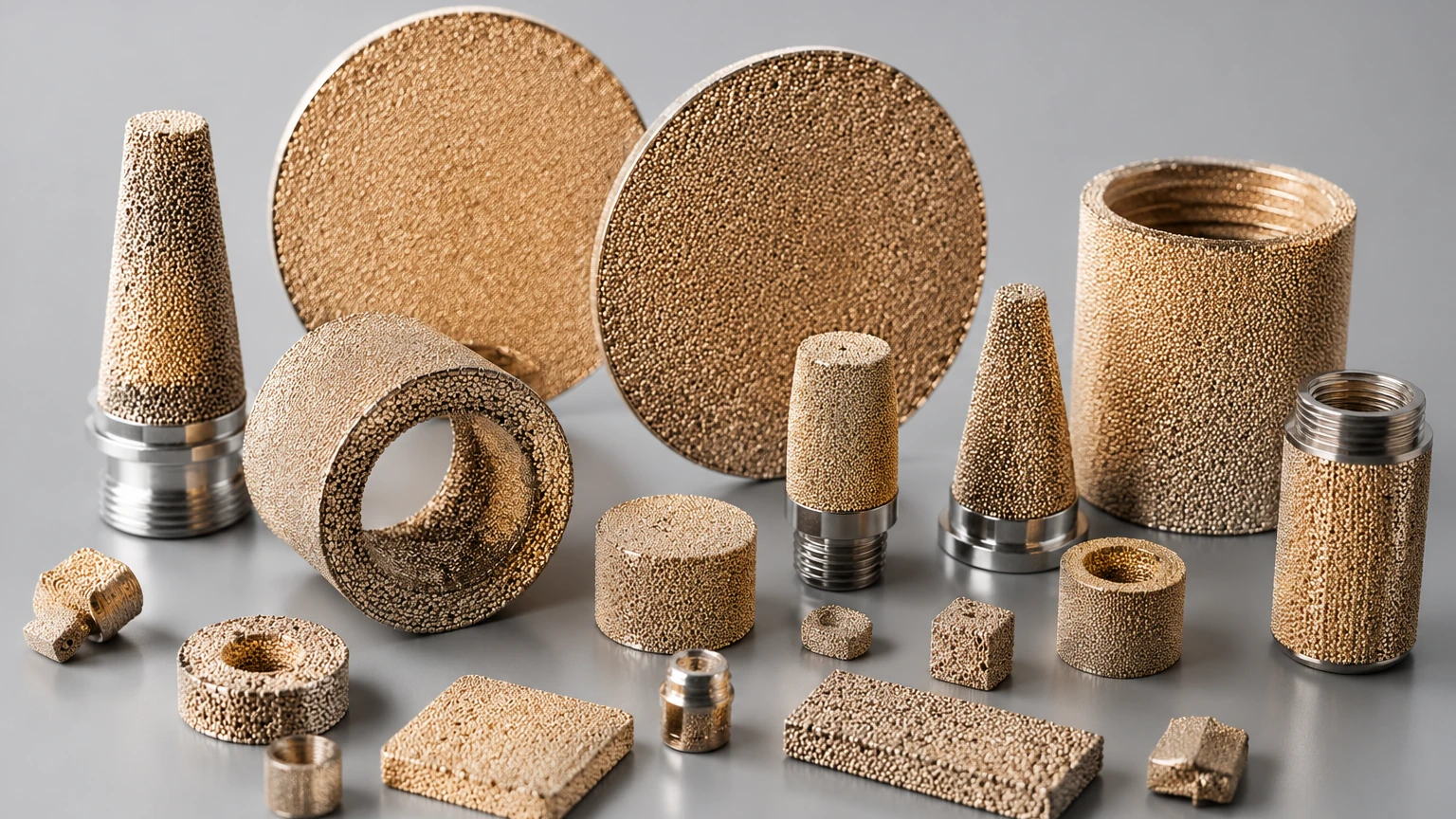
To optimize system design, it is often recommended to maximize the surface area of the filter element. This can be achieved through the use of cylindrical or conical designs, which provide more filtration area within a compact footprint compared to a flat disc.
Industrial Application Scopes
The versatility of the bronze sintered filter makes it indispensable across several heavy industries. Its ability to provide both filtration and flow control is a unique advantage.
Pneumatics and Air Preparation
In pneumatic systems, sintered bronze is the industry standard for mufflers and silencers. By forcing the exhaust air through the porous matrix, the filter breaks up the air stream, significantly reducing noise levels while allowing the air to vent safely. Furthermore, they serve as moisture separators, trapping oil mist and water droplets from compressed air lines to protect downstream valves and actuators.
Flame Arrestors and Explosion Prevention
Due to its thermal mass and controlled porosity, sintered bronze is frequently used in flame arrestors. In the event of a flashback in a gas line, the bronze matrix absorbs the heat of the flame, cooling the gas below its ignition temperature and preventing the flame from passing through to the storage tank or supply line. This is a critical safety feature in chemical processing and gas handling.
Hydraulic Fluid Filtration
In hydraulic power units, bronze sintered filters are used in breather caps and suction strainers. They prevent atmospheric dust and moisture from entering the reservoir while allowing the tank to "breathe" as fluid levels fluctuate. Their rugged construction ensures they can withstand the vibration and pressure pulses inherent in hydraulic machinery.
Instrumentation and Sensor Protection
Sensitive sensors used for gas analysis or pressure monitoring are often shielded by small sintered bronze discs. These discs allow the gas to reach the sensor for measurement but block particulate matter and liquid droplets that could foul or damage the delicate sensing elements.
Maintenance, Cleaning, and Service Life
One of the primary B2B considerations for choosing a bronze sintered filter is the total cost of ownership. Unlike disposable paper filters, sintered metal elements are often cleanable and reusable, provided they are maintained correctly.
Cleaning Methodologies
When the differential pressure reaches a predetermined limit (usually defined by the system manufacturer), the filter must be cleaned. Common methods include:
* Ultrasonic Cleaning: This is the most effective method for depth media. High-frequency sound waves create cavitation bubbles that dislodge particles trapped deep within the pore structure.
* Backwashing/Back-pulsing: Forcing a clean fluid or gas through the filter in the reverse direction can remove surface-loaded contaminants. This is most effective when the filter is cleaned before the pressure drop becomes excessive.
* Chemical Solvents: If the filter is clogged with oils or polymers, compatible chemical solvents can be used to dissolve the contaminants without damaging the bronze alloy.
Replacement Cycles
While reusable, bronze sintered filters do have a finite lifespan. Repeated cleaning cycles can eventually lead to "permanent fouling," where sub-micron particles become irreversibly lodged in the matrix. Additionally, if the filter is exposed to corrosive elements, the metallurgical bonds between the spheres may weaken over time. Engineers should establish a replacement schedule based on the observed rise in $ΔP$ after each cleaning cycle.
Sourcing and Customization Considerations
Selecting the right bronze sintered filter requires more than just picking a micron rating. Most industrial applications require custom geometries, specific flange designs, or integrated threaded fittings. Working with an experienced manufacturer like Kaifil ensures that the filtration component is engineered for the specific stresses of the application.
When consulting with a supplier, engineers should be prepared to confirm the following:
* Operating Temperature and Pressure: To ensure the alloy and wall thickness are sufficient.
* Fluid Compatibility: To verify that bronze is the optimal material compared to 316L stainless steel.
* Flow Rate Requirements: To determine the necessary surface area and porosity.
* Dimensional Tolerances: Sintered parts can be manufactured to tight tolerances, but specifying these early reduces the need for expensive post-sintering machining.
For those evaluating broader filtration needs, including stainless steel cartridges or precision wire mesh solutions, the Main Page offers a technical gateway to specialized manufacturing capabilities. By integrating high-performance metal filters, industrial operations can achieve higher reliability, reduced downtime, and more precise control over their fluid and gas processes.
