


Co2 Sparger
In industrial process engineering, the efficient introduction of gases into liquids is a fundamental requirement for a variety of chemical, biological, and food-processing operations. A CO2 sparger is a precision-engineered component designed to inject carbon dioxide gas into a liquid stream or vessel. Unlike simple drilled pipes, high-performance spargers—particularly those utilizing sintered metal technology—are designed to maximize the gas-liquid interfacial area, ensuring rapid dissolution and minimal gas wastage. For engineers and procurement teams, selecting the correct sparger involves a deep understanding of fluid dynamics, material compatibility, and the specific mass transfer requirements of the application.
The Principles of Gas-Liquid Mass Transfer
The primary function of a CO2 sparger is to facilitate mass transfer. According to Henry's Law, the amount of dissolved gas in a liquid is proportional to its partial pressure above the liquid. However, the rate at which this equilibrium is reached depends heavily on the surface area available for exchange.
When gas is injected into a liquid, it forms bubbles. The total surface area of these bubbles is inversely proportional to their diameter. For instance, replacing a single large bubble with thousands of micro-bubbles significantly increases the contact area, allowing the CO2 to dissolve almost instantaneously. This is critical in applications like beverage carbonation or pH control, where process efficiency directly impacts throughput and operational costs. Sintered metal spargers are preferred in these environments because they can produce bubbles in the range of 10 to 50 microns, whereas traditional perforated pipes often produce bubbles measured in millimeters.
The Engineering Behind Sintered Metal Spargers
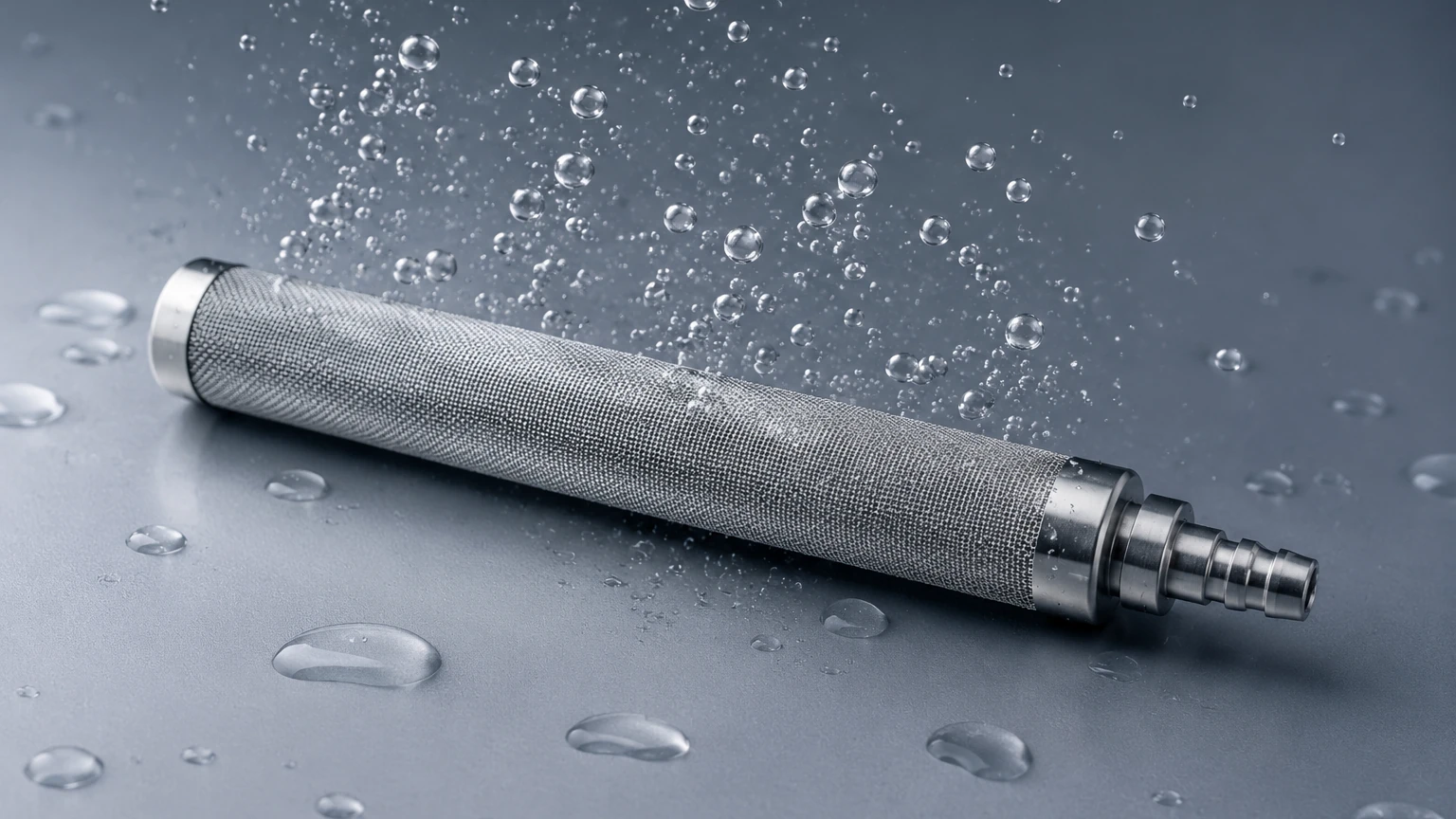
Sintered metal CO2 spargers are manufactured through a powder metallurgy process. Stainless steel powder is compacted and then sintered in a high-temperature furnace, creating a porous structure with interconnected pathways. This construction offers several technical advantages over other sparging methods:
Precise Pore Size Distribution
Engineers can specify the filtration grade or pore size of the sintered media. A 0.5-micron or 2-micron pore size is common for CO2 applications. This precision ensures that the gas is distributed evenly across the entire surface of the sparger element, preventing "channeling" where gas escapes through a single large opening.
Structural Integrity
Unlike ceramic or plastic spargers, sintered stainless steel can withstand high differential pressures and thermal shocks. In industrial systems where steam cleaning (SIP) or high-pressure gas injection is common, the mechanical strength of the metal ensures the component does not crack or migrate particles into the process stream.
Uniform Flux
The permeability of the sintered media is tightly controlled. This allows for a predictable "bubble point"—the pressure at which gas begins to pass through the pores—enabling precise control over the gas flow rate relative to the liquid pressure.
Key Material Considerations for Industrial Applications
Material selection is paramount when integrating a CO2 sparger into a production line. While carbon dioxide itself is generally non-corrosive in its gaseous state, it forms carbonic acid when dissolved in water. This mildly acidic environment can lead to localized corrosion if the wrong materials are used.
Stainless Steel 316L
For the majority of industrial applications, 316L stainless steel is the industry standard. The "L" denotes low carbon content, which prevents carbide precipitation during welding, maintaining the material's corrosion resistance. It is highly resistant to carbonic acid and is compatible with the caustic cleaning agents used in food and pharmaceutical plants.
Specialty Alloys
In environments involving high-temperature chemical processing or aggressive solvents, alloys such as Hastelloy C-276 or Monel may be required. These materials offer superior resistance to pitting and stress corrosion cracking in environments where standard stainless steel might fail.
Surface Finish
In the pharmaceutical and food industries, the external surface finish of the sparger assembly is as important as the internal porosity. Electropolishing is often used to achieve a smooth, Ra < 0.4 µm finish on non-porous sections to prevent bacterial adhesion and ensure the success of Clean-in-Place (CIP) protocols.
Design Parameters for Optimal Carbonation
When designing a system or requesting a custom solution from a manufacturer like Kaifil, several engineering parameters must be evaluated to ensure the CO2 sparger performs as expected.
1. Gas Flow Rate (SCFM/SLPM): The required volume of CO2 per unit of time determines the surface area of the sparger. If the flow rate is too high for the surface area, bubbles will coalesce (merge), reducing efficiency.
2. Liquid Velocity and Viscosity: In-line spargers (sparging into a pipe) depend on the liquid velocity to "shear" the bubbles off the sparger surface. Higher velocities generally result in smaller bubbles. Conversely, high-viscosity liquids require larger pore sizes to overcome the resistance to bubble formation.
3. System Pressure: The sparger must be designed to handle the differential pressure between the gas supply and the liquid process. The gas supply pressure must always exceed the liquid pressure plus the "bubble point" pressure of the porous media.
4. Vessel Geometry: In batch processing, the placement of the sparger at the bottom of the tank is crucial. The "rise time" of the bubbles determines the contact time. Engineers often use sparger rings or manifolds to distribute gas across the entire diameter of large fermentation or carbonation tanks.
Critical Applications in Modern Industry
The versatility of the CO2 sparger allows it to be used across diverse sectors, each with its own set of technical requirements.
Food and Beverage Industry
This is perhaps the most common application. In breweries, soft drink plants, and mineral water bottling facilities, CO2 spargers are used to achieve precise carbonation levels (measured in volumes of CO2). Sintered spargers allow for high-speed in-line carbonation, which is more efficient than the traditional method of pressurizing a headspace in a bright tank.
Water and Wastewater Treatment
CO2 is frequently used for pH adjustment in water treatment. When alkaline water needs to be neutralized, injecting CO2 is often safer and easier to control than using mineral acids like sulfuric or hydrochloric acid. The CO2 reacts with water to form carbonic acid, which lowers the pH. Efficient sparging ensures that the gas is fully utilized, reducing the cost of consumables.
Biotechnology and Pharmaceuticals
In bioreactors, CO2 sparging is used for two main purposes: controlling the pH of the cell culture media and stripping out excess oxygen or other volatile gases. Because these environments are highly sensitive, the spargers must be capable of being sterilized (autoclaved or SIP) without losing their porous characteristics.
Maintenance, Cleaning, and Service Life
A common concern for maintenance engineers is the fouling of the porous media. Because the pores are so small, they can become clogged by particulates in the liquid or by mineral scaling (calcium carbonate) if the water is hard.
Cleaning Protocols
* Backpulsing: Periodically reversing the flow of gas or liquid through the sparger can dislodge surface particles.
* Chemical Cleaning: Soaking the element in mild acidic or alkaline solutions can dissolve organic or mineral deposits. For 316L stainless steel, nitric acid passivation is also an option to restore the protective oxide layer.
* Ultrasonic Cleaning: For stubborn fouling, removing the element and placing it in an ultrasonic bath is the most effective way to clear the internal pore structure.
Replacement Cycles
While stainless steel spargers are durable, they are not infinite. The service life depends on the frequency of cleaning and the aggressiveness of the process. Engineers should monitor the pressure drop across the sparger; a significant increase in the required gas pressure to maintain the same flow rate usually indicates that the element is fouled and requires cleaning or replacement.
Selecting the Right Sparger for Your Project
Choosing a CO2 sparger is not a "one-size-fits-all" decision. Procurement teams should work closely with manufacturers to define the mechanical connections—such as NPT threads, flanges, or hygienic Tri-clamp fittings—to ensure seamless integration into existing piping. Furthermore, the choice between a static in-tank sparger and a dynamic in-line sparger depends on whether the process is batch or continuous.
For those seeking high-performance filtration and gas diffusion components, it is essential to partner with a manufacturer that understands the nuances of porous metal engineering. You can Review product options and application support to better understand how customized designs can meet specific industrial requirements. Whether the goal is to reduce gas consumption, improve product consistency, or ensure hygienic operation, the technical specifications of the sparger will be the deciding factor in the system's overall success.
Conclusion
The CO2 sparger is a critical component that bridges the gap between gas supply and liquid processing. By leveraging sintered metal technology, industries can achieve superior mass transfer efficiency, robust mechanical performance, and long-term reliability. Understanding the relationship between pore size, bubble dynamics, and material science allows engineers to optimize their processes, leading to higher quality outputs and lower operational overhead. When specifying these components, focusing on technical data and application-specific customization ensures that the filtration and sparging system will perform reliably in even the most demanding industrial environments. For more detailed technical specifications and custom engineering solutions, visiting the Main Page of a specialized manufacturer provides the necessary resources for informed decision-making.
