


Coconut Filter
In the global food and beverage industry, coconut processing has evolved into a high-precision sector requiring rigorous filtration standards. Whether producing virgin coconut oil (VCO), coconut water, or coconut milk, the efficiency of a coconut filter system directly impacts product clarity, shelf stability, and overall quality. For engineers and technical procurement teams, selecting the right filtration media involves balancing flow rates with micron-level precision while ensuring compliance with sanitary regulations.
Industrial filtration in coconut processing primarily utilizes stainless steel components due to their durability, corrosion resistance, and ability to withstand the high temperatures and pressures common in extraction and refining. As a specialized manufacturer, Kaifil provides the technical expertise required to navigate these complex variables, ensuring that every filtration component meets the specific demands of the application.
The Role of Filtration in Coconut Product Manufacturing
The term "coconut filter" encompasses a range of equipment and media used at different stages of production. Each product derived from the coconut—oil, water, or milk—presents unique rheological properties and contaminant profiles that dictate the choice of filter structure.
Coconut Oil Filtration
In the production of coconut oil, filtration is essential for removing residual solids (foots) after extraction. In the dry process, where oil is extracted from copra, the oil contains significant particulate matter that must be removed to prevent oxidation and rancidity. In the wet process (VCO production), filtration is used to separate the oil from the protein and aqueous layers after centrifugation or fermentation. High-performance stainless steel mesh filters are preferred here because they can handle the viscosity of the oil, especially when heated to reduce flow resistance.
Coconut Water Clarification
Coconut water is highly susceptible to enzymatic browning and microbial spoilage. A coconut filter used in this context must remove fine suspended solids and proteins that contribute to turbidity. Precision wire mesh or sintered metal cartridges are often employed as pre-filters to protect downstream membrane systems or to provide final clarification before pasteurization and packaging.
Coconut Milk and Cream
Coconut milk contains high levels of fats and proteins. Filtration here is focused on achieving a consistent texture and removing any remaining shell fragments or coarse fibers. The challenge lies in filtering a high-viscosity liquid without stripping away the essential fats that define the product's quality.
Technical Specifications and Engineering Considerations
When specifying a coconut filter for industrial use, engineers must evaluate several technical parameters to ensure the component integrates seamlessly into the production line. On the Main Page of technical filtration resources, these specifications are often categorized by material grade and mechanical structure.
Material Selection: 304 vs. 316L Stainless Steel
For most coconut processing applications, Stainless Steel 316L is the preferred material. Its higher molybdenum content provides superior resistance to organic acids and chlorides compared to 304 stainless steel. In food-grade environments, 316L ensures that there is no metallic leaching into the product, maintaining the sensory profile of the coconut oil or water.
Micron Ratings and Mesh Weave Types
The required filtration accuracy (micron rating) depends on the processing stage:
- Coarse Filtration (100–500 microns): Used for initial fiber removal and protecting pumps.
- Fine Filtration (20–80 microns): Used for clarifying oils and removing smaller particulates.
- Polishing (1–10 microns): Used for final clarity in coconut water applications.
The weave type of the wire mesh also plays a critical role. Plain Weave offers high flow rates and is easy to clean, making it suitable for pre-filtration. Dutch Weave, characterized by a higher density of wires, provides greater mechanical strength and finer filtration levels, which is ideal for high-pressure oil filtration where structural integrity is paramount.
Overcoming Challenges in Coconut Oil Filtration
Filtering coconut oil presents specific engineering challenges, particularly regarding viscosity and pressure management. Because coconut oil solidifies at temperatures below 24°C (75°F), filtration systems must often operate at elevated temperatures to maintain a liquid state and ensure efficient throughput.
Pressure Drop (Delta P) Management
As solids accumulate on the surface of a coconut filter, the pressure drop across the media increases. If the filter is not designed to handle the specific viscosity of coconut oil, the flow rate will diminish rapidly, leading to frequent downtime for cleaning. Engineers must calculate the "clean pressure drop" and establish a maximum allowable Delta P before the system triggers a cleaning cycle or element replacement. Using pleated stainless steel cartridges can increase the available surface area, thereby reducing the initial pressure drop and extending the service life between cleanings.
Resistance to Mechanical Stress
In many industrial setups, coconut oil is processed using pressure leaf filters or high-pressure cartridge housings. The filter media must be able to withstand these pressures without deforming. Sintered wire mesh, which involves bonding multiple layers of mesh through a thermal-pressure process, provides the highest level of structural stability. This prevents "media migration"—the risk of filter wires breaking and contaminating the product—even under fluctuating pressure conditions.
Sanitary Design and Cleanability
In the food and beverage sector, the cleanability of a coconut filter is as important as its filtration efficiency. Biofilm accumulation or residual organic matter can lead to bacterial growth, compromising the entire production batch.
CIP (Clean-In-Place) Compatibility
Modern coconut processing facilities rely on CIP systems to sanitize equipment without disassembly. Stainless steel filters are ideal for CIP because they are compatible with caustic cleaning agents and high-temperature steam sterilization (SIP). Unlike plastic or disposable depth filters, metal filters do not degrade when exposed to harsh chemicals or thermal cycling.
Surface Finish and Weld Quality
To meet sanitary standards (such as 3-A or EHEDG), the internal surfaces of the filter housing and the filter elements themselves must be smooth. Electropolishing is often used to achieve a surface roughness (Ra) of less than 0.8 °m. This prevents particulates from becoming trapped in microscopic crevices, ensuring that the coconut filter can be fully sterilized during the cleaning cycle.
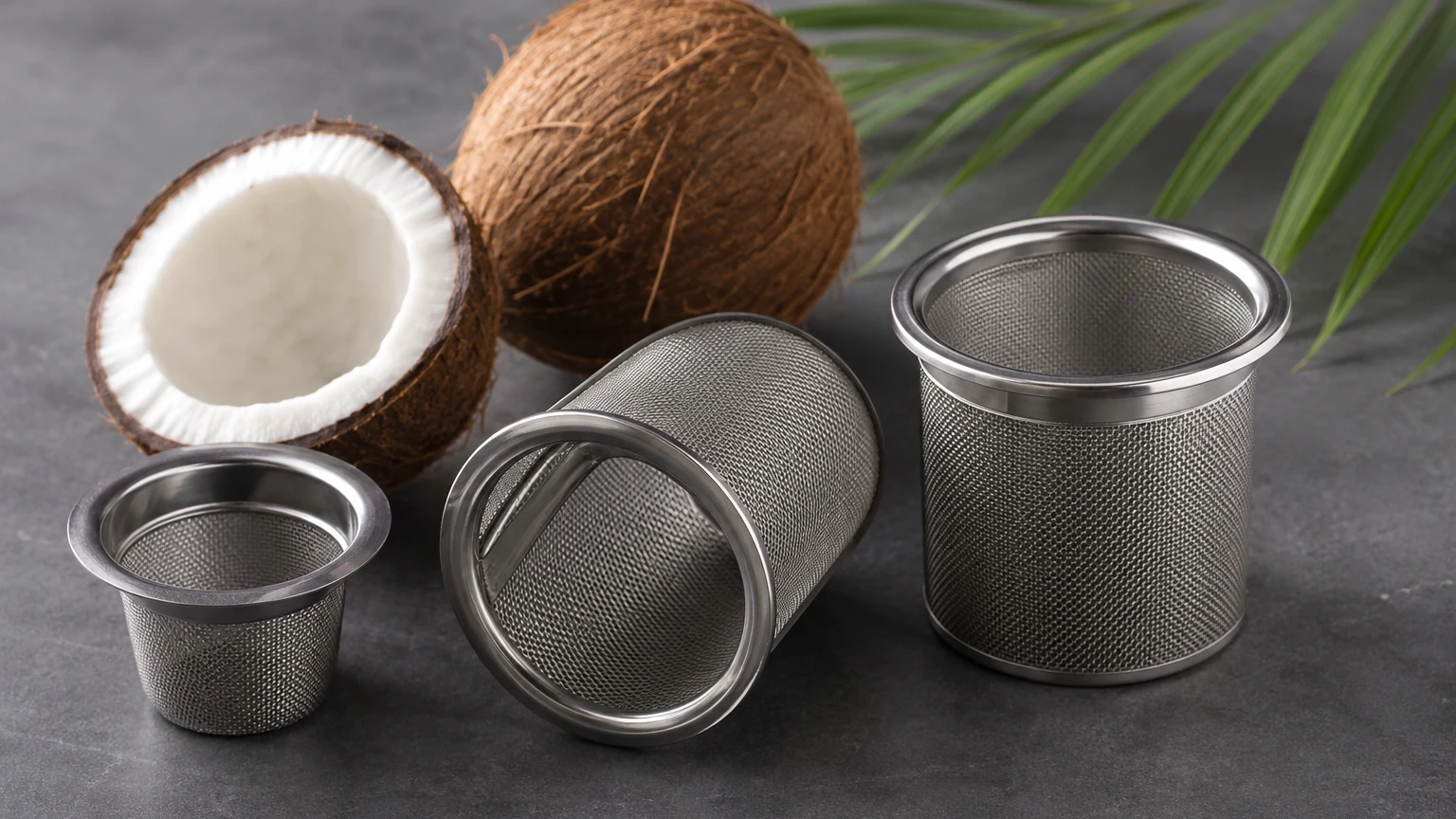
Customization and OEM Solutions for Filtration Systems
No two coconut processing plants are identical. Variations in throughput requirements, piping configurations, and product specifications necessitate customized filtration solutions. Working with a manufacturer like Kaifil allows engineering teams to design filter elements that fit existing housings while optimizing performance.
Customization options include:
- Bespoke End Fittings: Ensuring compatibility with various housing brands (e.g., 222, 226, or NPT threaded connections).
- Reinforced Cores: For high-viscosity applications where the filter must resist collapsing under high differential pressure.
- Specific Dimensions: Tailoring the length and diameter of the filter to maximize surface area within a restricted footprint.
By focusing on these customized details, purchasing teams can achieve a lower total cost of ownership (TCO). While the initial investment in a high-quality stainless steel coconut filter may be higher than disposable alternatives, the longevity, cleanability, and consistent performance lead to significant long-term savings.
Evaluating Total Cost of Ownership (TCO)
When selecting a coconut filter, it is a mistake to look only at the purchase price. A comprehensive TCO analysis includes:
1. Replacement Frequency: Stainless steel filters can be cleaned and reused for years, whereas disposable filters require constant replacement and disposal costs.
2. Product Loss: High-precision filters reduce the amount of product lost in the "filter cake" and ensure that fewer batches are rejected due to clarity issues.
3. Energy Consumption: A well-designed filter with low resistance reduces the load on pumps, leading to lower energy usage over time.
4. Downtime: Durable metal filters reduce the risk of catastrophic failure and unplanned maintenance stops.
Conclusion: Selecting the Right Filtration Partner
Achieving optimal results in coconut processing requires a deep understanding of both the biological nature of the product and the mechanical capabilities of the filtration media. A high-quality coconut filter is not merely a consumable; it is a critical component of the production process that ensures safety, quality, and efficiency.
For engineers and procurement professionals, the path to optimized filtration begins with technical consultation. By reviewing the engineering options available on the Main Page, teams can identify the specific wire mesh structures and material grades that will perform best in their unique environment. Whether the goal is to clarify coconut water to a crystal-clear finish or to remove impurities from industrial-scale coconut oil production, precision-engineered stainless steel solutions provide the reliability required for modern industrial applications.
