


Commercial Inline Water Filter
In industrial and high-capacity commercial environments, the integrity of fluid systems depends heavily on the efficiency of filtration components. A commercial inline water filter is a specialized device integrated directly into a piping system to remove contaminants, particulates, and impurities from water or process fluids. Unlike residential-grade filters, these units are engineered to withstand high flow rates, significant pressure differentials, and often corrosive environments. For engineers and procurement professionals, selecting the right filtration solution requires a deep understanding of material science, fluid dynamics, and the specific demands of the application.
At Kaifil, we specialize in the design and manufacture of high-performance stainless steel filtration solutions. Whether the application involves chemical processing, food and beverage production, or hydraulic systems, the choice of a commercial inline water filter can dictate the lifespan of downstream equipment and the quality of the final product. This guide explores the technical considerations, engineering parameters, and selection criteria essential for implementing effective inline filtration.
Understanding the Engineering of Commercial Inline Water Filters
The term "inline" refers to the filter's installation directly within the fluid path. This design minimizes footprint and allows for continuous or semi-continuous operation. In a commercial or industrial context, these filters are typically housed in robust metallic casings, most commonly stainless steel, to ensure structural integrity under hydraulic stress.
Material Selection: Why Stainless Steel Dominates
While plastic or polymer-based filters may suffice for low-pressure light commercial use, industrial-grade commercial inline water filters almost exclusively utilize stainless steel (Grade 304 or 316L). Stainless steel offers several critical advantages:
* Corrosion Resistance: Essential for applications involving treated water, chemicals, or high-temperature fluids.
* Thermal Stability: Stainless steel maintains its mechanical properties across a wide temperature range, preventing the warping or degradation common in plastic housings.
* Pressure Rating: Industrial systems often experience pressure spikes or high operating pressures that would compromise lesser materials.
* Hygiene and Cleanability: In pharmaceutical and food-grade applications, the non-porous surface of stainless steel prevents bacterial growth and allows for rigorous sterilization processes, including Clean-in-Place (CIP) protocols.
Key Performance Metrics in Filter Selection
When evaluating a commercial inline water filter, engineers must look beyond simple pipe size. The performance of the filter is defined by its ability to balance filtration precision with system throughput.
Micron Rating and Filtration Efficiency
The micron rating determines the size of particles the filter will capture. It is vital to distinguish between "nominal" and "absolute" ratings. A nominal rating indicates the filter can trap a large percentage of particles of a given size, whereas an absolute rating guarantees the capture of virtually all particles of that size. For critical applications, such as protecting precision nozzles or sensitive membranes, an absolute-rated stainless steel wire mesh or sintered metal element is often required.
Flow Rate and Pressure Drop (ΔP)
Every filter introduces resistance to the fluid flow, resulting in a pressure drop. A well-designed commercial inline water filter maximizes the surface area of the filter media—often through pleating or multi-layer mesh construction—to ensure high flow rates with minimal initial pressure drop. As the filter accumulates debris, the ΔP will increase. Engineering teams must calculate the maximum allowable pressure drop before the system's efficiency is compromised or the filter element risks structural failure.
Dirt Holding Capacity
This metric refers to the amount of contaminant a filter can retain before reaching its terminal pressure drop. A higher dirt holding capacity translates to longer service intervals and reduced downtime. In commercial settings, where labor costs and production uptime are critical, choosing a filter with a high-capacity pleated element can significantly lower the total cost of ownership.
Structural Variations: Mesh, Sintered, and Cartridge Filters
Commercial inline water filters utilize various types of internal media depending on the required precision and the nature of the contaminants.
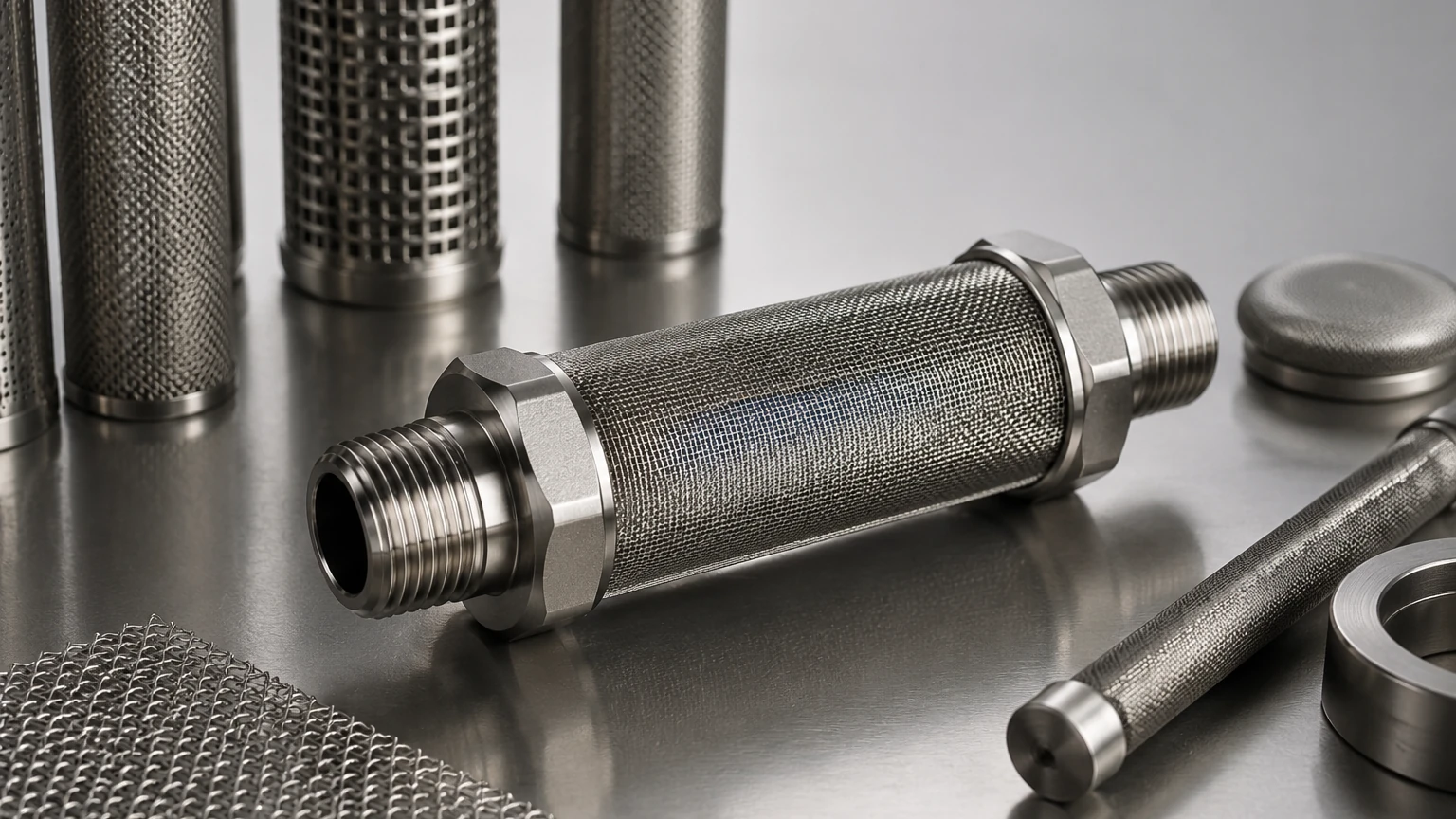
1. Stainless Steel Wire Mesh Filters: These are ideal for removing larger particulates and are often used as pre-filters. They are highly durable and can be cleaned and reused multiple times, making them a cost-effective choice for heavy-duty industrial water treatment.
2. Sintered Metal Filters: Created by fusing metal powders or multiple layers of wire mesh under heat and pressure, sintered elements provide exceptional strength and precise filtration. They are used in high-pressure environments where the filter must resist deformation.
3. Pleated Filter Cartridges: By pleating the stainless steel mesh, manufacturers can vastly increase the effective filtration area within the same physical footprint. This design is preferred for high-flow commercial inline water filter applications where space is limited but performance cannot be sacrificed.
For more information on the full range of custom filtration components available, you can visit our Main Page to review product options and application support.
Operational Considerations and Maintenance
The longevity of a commercial inline water filter is not solely dependent on its build quality but also on how it is integrated into the maintenance cycle of the facility.
Cleaning vs. Replacement
One of the primary advantages of stainless steel inline filters is their cleanability. Unlike disposable polypropylene or paper cartridges, stainless steel elements can be backwashed, ultrasonically cleaned, or chemically treated to restore their original flow characteristics. This reduces the waste stream and long-term procurement costs. However, engineers must establish clear protocols for when an element has reached its end-of-life, typically indicated by a permanent increase in baseline pressure drop even after cleaning.
Monitoring and Automation
In sophisticated commercial systems, inline filters are often equipped with differential pressure gauges or sensors. These devices provide real-time data to building management systems (BMS) or industrial controllers, alerting operators when maintenance is required. Automated self-cleaning filters, which use a backwash cycle triggered by pressure sensors, are increasingly common in large-scale commercial water filtration to eliminate manual intervention.
Application-Specific Requirements
Different industries impose unique demands on a commercial inline water filter. Understanding these nuances is critical during the specification phase.
* Food and Beverage: Filters must comply with FDA or similar regulatory standards. This includes using food-grade gaskets (such as EPDM or Viton) and ensuring the filter housing has no "dead zones" where organic matter can accumulate and decay.
* Chemical Processing: Compatibility is the priority. The specific grade of stainless steel (e.g., 316L for better resistance to chlorides) must be matched to the chemical profile of the fluid.
* Hydraulic and Cooling Systems: These systems often face high-velocity flow and potential vibration. The filter housing and element must be designed to resist fatigue and bypass, ensuring that no unfiltered fluid escapes into sensitive machinery.
Common Risks and Mitigation Strategies
Failure to properly specify a commercial inline water filter can lead to several operational risks:
* Bypass Leakage: If the filter element does not seal perfectly within the housing, unfiltered water will bypass the media. High-quality commercial filters use precision-machined seats and high-performance O-rings to prevent this.
* Media Migration: In low-quality filters, the filter material itself can sometimes break off and enter the downstream flow. Using sintered or high-integrity welded stainless steel mesh eliminates this risk.
* Structural Collapse: If a filter is subjected to a pressure differential beyond its design limit, the element may collapse. It is essential to choose a filter with an internal support core (perforated metal) if high ΔP is anticipated.
Conclusion: Selecting the Right Partner for Your Filtration Needs
Selecting a commercial inline water filter is a technical decision that impacts the efficiency, safety, and cost-effectiveness of an entire operation. It requires a balance between initial capital expenditure and long-term operational savings. By focusing on high-quality materials like stainless steel and ensuring that technical parameters—such as micron rating, flow rate, and pressure tolerance—are precisely matched to the application, engineers can secure their systems against contamination and premature wear.
Kaifil provides professional OEM and customized filtration solutions tailored to the most demanding industrial requirements. Our expertise in stainless steel wire mesh and precision metal components allows us to develop filtration products that meet specific accuracy and durability needs. When evaluating your next filtration project, consider the total lifecycle of the component and the value of a customized engineering approach.
To explore our technical capabilities and see how we can support your specific industrial or commercial application, visit our Main Page for detailed specifications and engineering guidance.
