


Compressed Air Filter Manufacturer
In industrial environments, compressed air is often referred to as the "fourth utility." It powers pneumatic tools, controls sensitive instrumentation, and directly interacts with products in food, beverage, and pharmaceutical processing. However, atmospheric air contains contaminants—dust, water vapor, and oil aerosols—that become concentrated during compression. Selecting a qualified compressed air filter manufacturer is a critical engineering decision that impacts the longevity of downstream equipment, product purity, and overall system energy efficiency.
Industrial filtration requires more than off-the-shelf components. For demanding applications involving high temperatures, corrosive gases, or stringent hygiene standards, stainless steel filtration solutions offer the durability and precision that standard plastic or aluminum housings cannot provide. Understanding the technical nuances of filter design and manufacturing is essential for engineers and purchasing teams tasked with optimizing compressed air systems.
Understanding Compressed Air Filtration Requirements
The primary objective of compressed air filtration is to remove contaminants according to the ISO 8573-1 standard, which classifies air quality based on solid particles, water, and oil content. A professional compressed air filter manufacturer must design components that address three main mechanisms of filtration:
1. Direct Interception: Larger particles that are too big to pass through the pores of the filter media are trapped on the surface.
2. Inertial Impingement: Heavier particles that cannot follow the streamline of the air flow collide with the filter fibers and become lodged.
3. Diffusion (Brownian Motion): Very small particles move erratically due to molecular collisions, eventually hitting a fiber and adhering to it.
For industrial-grade systems, the choice of filter media is paramount. While many general-purpose filters use glass fiber or cellulose, stainless steel wire mesh and sintered metal components are preferred for their mechanical strength and resistance to pressure surges. These materials ensure that the filter maintains its structural integrity even under high differential pressure (ΔP), preventing "unloading," where trapped contaminants are forced through the media back into the air stream.
Engineering Considerations for Stainless Steel Filter Components
When evaluating a compressed air filter manufacturer, engineers must look beyond basic micron ratings. The construction of the filter element dictates its performance in harsh environments. Stainless steel, specifically grades 304 and 316L, is the material of choice for several reasons:
Corrosion Resistance
Compressed air systems often contain moisture, which leads to oxidation in carbon steel components. Stainless steel resists corrosion, ensuring that the filter itself does not become a source of particulate contamination. This is particularly vital in chemical processing and offshore applications where salt air or aggressive chemicals are present.
Temperature Stability
Standard polymer-based filters have strict temperature limits. In applications like heat-regenerated desiccant dryers or high-temperature discharge lines, stainless steel filter cartridges can operate at temperatures exceeding 200°C without losing filtration efficiency or structural form.
Pressure Handling
High-pressure compressed air systems (often exceeding 40 bar) require robust filter elements. Sintered metal filters and reinforced wire mesh designs provide the necessary burst strength to handle rapid pressure fluctuations without collapsing.
Key Evaluation Criteria for a Compressed Air Filter Manufacturer
Choosing the right partner involves assessing their manufacturing capabilities and quality control protocols. A reliable compressed air filter manufacturer should provide transparency regarding their engineering processes. Key criteria include:
* Material Traceability: For industries like pharmaceuticals and food production, knowing the exact origin and grade of the stainless steel is mandatory. Manufacturers should provide material certificates (MTRs) upon request.
* Filtration Accuracy Validation: How does the manufacturer verify micron ratings? Methods such as the bubble point test or multipass testing ensure that the filter meets the specified retention efficiency.
* Welding and Assembly Standards: In metal filtration, the quality of the longitudinal seam and end-cap welds is critical. Precision TIG welding or vacuum brazing ensures there are no bypass paths for contaminants.
* Technical Support: A manufacturer should be able to assist with sizing calculations. Undersized filters lead to excessive pressure drops and increased energy costs, while oversized filters may not achieve the necessary velocity for effective coalescing.
For comprehensive technical specifications and to explore various industrial filtration configurations, engineers can visit the Main Page of specialized manufacturers to review available materials and design options.
Customization and OEM Capabilities in Metal Filtration
Many industrial systems have unique space constraints or specialized connection requirements. A standard catalog item may not suffice. This is where the value of a custom compressed air filter manufacturer becomes evident. Customization options typically include:
* End-Cap Configurations: Matching existing housings with specific adapters, such as Code 7, 222, 226, or threaded NPT/BSP connections.
* Variable Micron Ratings: Fine-tuning the mesh weave or sintering density to target specific particle sizes while balancing flow resistance.
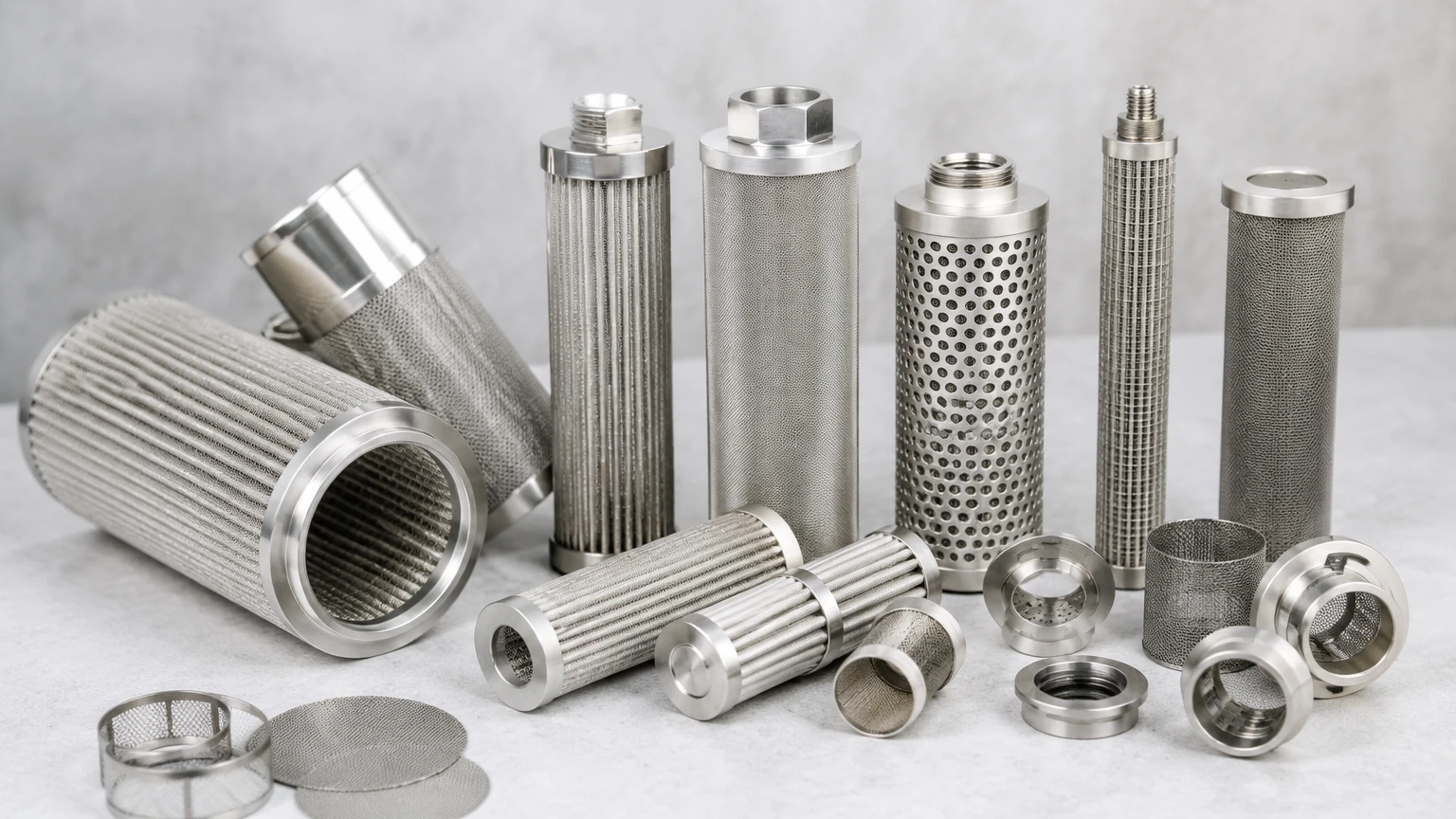
* Pleated vs. Cylindrical Designs: Pleated stainless steel elements offer significantly more surface area than cylindrical ones, leading to longer service life and lower initial pressure drop.
* Housing Integration: For OEM equipment manufacturers, integrating the filter element directly into the machine’s manifold requires precise tolerances and custom sealing surfaces (O-rings or gaskets made from Viton, EPDM, or PTFE).
By working with a manufacturer that specializes in custom stainless steel solutions, companies can ensure their filtration components are perfectly matched to the operational demands of their specific machinery.
Addressing Performance and Durability in Demanding Environments
In sectors such as hydraulic power units or heavy industrial manufacturing, the compressed air system is subjected to vibration, mechanical shock, and oil carryover from the compressor. A standard filter might fail prematurely under these conditions.
A specialized compressed air filter manufacturer focuses on durability. For instance, in oil-injected screw compressor systems, the coalescing filter must effectively separate oil aerosols. If the filter media is too weak, the oil will "blind" the filter, leading to a rapid rise in differential pressure. Stainless steel mesh filters can be designed with multi-layer structures—combining a coarse outer layer for large particle removal and a fine inner layer for precision filtration—to extend the time between maintenance intervals.
Furthermore, in "oil-free" air applications, the filter's role is to catch any desiccant dust or pipe scale. The rigidity of metal filters prevents media migration, ensuring that no fibers from the filter itself enter the clean air stream, which is a common risk with cheaper synthetic media.
Maintenance, Replacement Cycles, and Total Cost of Ownership
While the initial purchase price of a filter is a factor, the total cost of ownership (TCO) is driven by energy consumption and maintenance frequency. Every 100 mbar of pressure drop across a filter typically results in a 1% increase in compressor energy costs.
Cleaning vs. Replacement
One of the primary advantages of stainless steel filters from a reputable compressed air filter manufacturer is their cleanability. Unlike disposable fiber filters, many stainless steel wire mesh and sintered elements can be cleaned using ultrasonic baths, backwashing, or chemical solvents. This capability significantly reduces waste and long-term procurement costs.
Monitoring Differential Pressure
Engineers should confirm that their filter housings are equipped with differential pressure gauges. A manufacturer should provide data on the "clean" pressure drop and the recommended "change-out" or "cleaning" pressure drop. Typically, once the ΔP reaches 0.35 to 0.5 bar, the energy cost of pushing air through the clogged filter begins to outweigh the cost of maintenance.
Conclusion
Selecting a compressed air filter manufacturer is a strategic decision that affects the reliability of the entire industrial utility chain. By focusing on technical factors such as material grade, filtration mechanisms, and custom engineering capabilities, purchasing teams can secure components that offer superior protection and efficiency. Stainless steel filtration solutions, though often requiring a higher initial investment than disposable alternatives, provide the durability and performance necessary for critical industrial applications.
For those seeking reliable OEM or customized filtration components, it is essential to partner with a manufacturer that understands the complexities of industrial environments and can provide the engineering documentation to back up performance claims. High-quality filtration is not just a peripheral requirement; it is a fundamental component of operational excellence in modern manufacturing.
