


Demister Pad in Vessel
In industrial process engineering, the efficiency of gas-liquid separation is a critical factor that directly impacts product purity, equipment longevity, and environmental compliance. A demister pad in vessel applications—often referred to as a mist eliminator—serves as a specialized internal component designed to remove entrained liquid droplets from a gas or vapor stream. These components are essential in various sectors, including chemical processing, petrochemical refining, and pharmaceutical manufacturing, where the carry-over of liquid droplets can lead to equipment corrosion, catalyst poisoning, or product contamination.
Understanding the technical nuances of selecting, installing, and maintaining a demister pad in vessel environments is vital for engineers and procurement teams. This guide explores the engineering principles, material considerations, and design parameters necessary to optimize filtration performance and ensure the reliability of industrial pressure vessels and separators.
The Fundamental Role of a Demister Pad in Vessel Operations
The primary function of a demister pad in vessel systems is to facilitate the separation of liquid phase particles from a continuous gas phase. When a gas stream moves through a liquid, or when gas is generated from a boiling liquid, it inevitably carries away small droplets. These droplets, if not removed, can cause significant operational challenges.
For instance, in a distillation column, liquid entrainment can reduce the efficiency of the separation stages, leading to off-specification products. In a compressor suction drum, the presence of liquid droplets can cause catastrophic mechanical failure of the compressor blades due to liquid impingement. By integrating a high-performance demister pad, facilities can achieve separation efficiencies often exceeding 99%, capturing droplets as small as 2 to 5 microns in diameter.
From a technical perspective, the demister pad acts as a high-voidage coalescer. It provides a large surface area within a relatively small volume, allowing the gas to pass through with minimal resistance while forcing the liquid droplets to collide with the wire surfaces.
Engineering Principles: How Separation Occurs
The operation of a demister pad in vessel applications relies on three primary physical mechanisms: inertial impaction, direct interception, and Brownian diffusion.
Inertial Impaction
Inertial impaction is the dominant mechanism for droplets larger than 5 to 10 microns. As the gas stream navigates the tortuous path created by the knitted wire mesh, the heavier liquid droplets possess too much momentum to follow the gas streamlines. Consequently, they strike the wire surface and adhere to it. Over time, these small droplets coalesce into larger films and eventually into heavy drops that drain away by gravity.
Direct Interception
Direct interception occurs when a droplet follows a gas streamline but passes close enough to a wire that it makes contact and is captured. This is particularly relevant for mid-sized droplets that are influenced by the flow patterns around the individual wires of the mesh.
Brownian Diffusion
For extremely fine sub-micron mists, Brownian diffusion becomes the primary capture mechanism. These tiny particles move erratically due to molecular collisions, increasing the probability that they will eventually contact the mesh surface. While standard knitted mesh pads are primarily designed for inertial impaction, specialized high-density pads can be engineered to enhance capture via diffusion.
Key Design Parameters for Vessel Integration
When specifying a demister pad in vessel designs, engineers must balance several competing factors to ensure the system operates within its intended performance envelope. The following parameters are critical during the selection process:
Gas Velocity and the Souders-Brown Equation
The performance of a demister pad is highly dependent on the gas velocity. If the velocity is too low, the droplets may follow the gas streamlines around the wires without impacting them (low efficiency). If the velocity is too high, the gas flow may re-entrain the collected liquid from the downstream side of the pad (flooding).
Designers typically use the Souders-Brown equation to determine the optimal design velocity ($V_g$):
$$V_g = K \sqrt{\frac{\rho_l – \rho_g}{\rho_g}}$$
Where:
* $K$ is a design constant (typically 0.1 to 0.12 m/s for standard pads).
* $\rho_l$ is the liquid density.
* $\rho_g$ is the gas density.
Pressure Drop (Delta P)
Maintaining a low pressure drop is essential for energy efficiency, especially in vacuum systems or high-volume gas processing. A standard demister pad in vessel operations usually exhibits a pressure drop between 250 and 500 Pa (1 to 2 inches of water column). Factors affecting pressure drop include the wire diameter, the mesh density (surface area per unit volume), and the liquid loading rate.
Pad Thickness and Density
Standard industrial demister pads are typically 100mm to 150mm (4 to 6 inches) thick. Increasing the thickness can improve separation efficiency for smaller droplets but will also increase the pressure drop. Mesh density, measured in kilograms per cubic meter ($kg/m^3$), defines the "tightness" of the knit. A higher density provides more surface area for impaction but increases the risk of fouling in dirty services.
Material Selection for Demanding Environments
The longevity of a demister pad in vessel service depends heavily on the compatibility of the construction material with the process fluid. Since these components are exposed to continuous contact with both gas and liquid phases, corrosion and erosion are primary concerns.
* Stainless Steel (304/316L): The most common choice for general industrial applications. 316L is preferred in environments containing chlorides or organic acids due to its superior pitting resistance.
* Specialty Alloys (Monel, Inconel, Hastelloy): Used in highly corrosive chemical processing, such as sulfuric acid production or sour gas treatment, where standard stainless steels would fail prematurely.
* Polymers (PP, PTFE, PFA): In low-temperature applications involving aggressive acids or bases, plastic demister pads offer excellent chemical inertness. PTFE is particularly valued for its high-temperature resistance compared to other plastics.
* Co-knit Materials: Sometimes, metal wires are knitted together with plastic filaments (like PFA or fiberglass). This hybrid approach combines the structural rigidity of metal with the enhanced surface area and chemical properties of the secondary material.
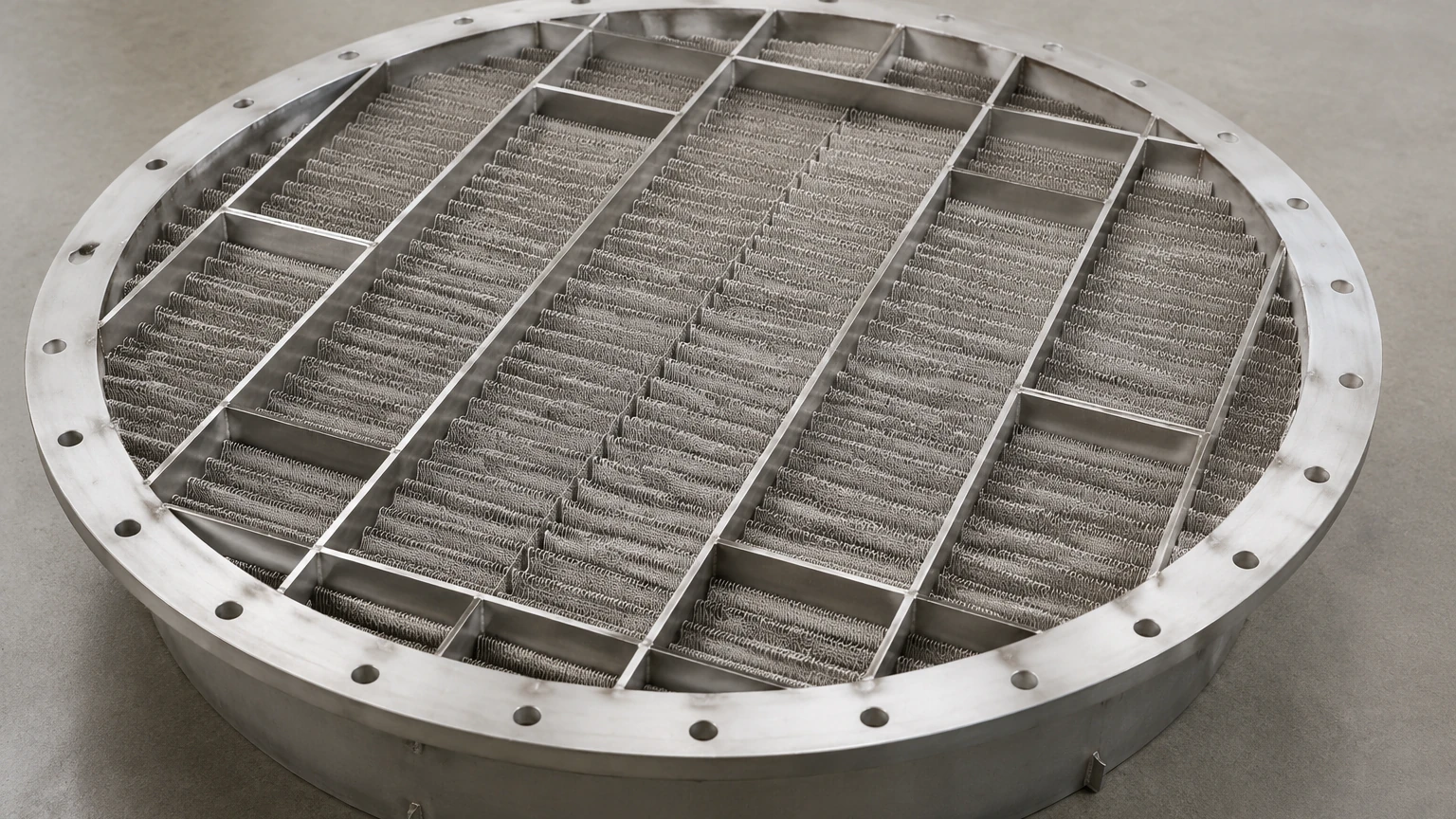
Installation and Structural Configurations
A demister pad in vessel units must be securely installed to prevent bypassing and to withstand the mechanical forces exerted by the gas flow. There are two main installation styles:
Segmented vs. One-Piece Design
For small vessels, a one-piece circular pad may be used. However, for larger industrial vessels, the demister pad is manufactured in segments (strips). This allows the components to be passed through a standard manway for internal assembly. Each segment is carefully sized to fit the vessel's internal diameter with a slight compression fit to prevent gas bypassing at the edges.
Support Grids and Hold-Down Bars
Because the knitted mesh is inherently flexible, it requires structural support. Standard installations include a bottom support grid and a top hold-down grid. These grids are usually constructed from flat bars and round rods welded into a rigid frame. In applications with high gas surges, hold-down bars are bolted or welded to the vessel wall to prevent the pad from being dislodged or "blown out."
Orientation
Most demister pads are installed horizontally for vertical gas flow. However, in horizontal separators, the pad may be installed vertically. The drainage dynamics change depending on the orientation, and the $K$-value in the design equation must be adjusted accordingly to account for the effect of gravity on liquid drainage.
Maintenance, Fouling, and Replacement Cycles
While a demister pad in vessel service is often considered a low-maintenance component, it is not "set and forget." The primary cause of performance degradation is fouling. Solid particles, waxes, or polymerizing substances in the gas stream can accumulate on the wire surfaces, leading to:
1. Increased Pressure Drop: As the void space in the mesh decreases, the resistance to gas flow increases, which can strain upstream equipment.
2. Reduced Efficiency: Fouling changes the wire geometry and can lead to "channeling," where gas bypasses the clogged areas at high velocities, causing re-entrainment.
Cleaning Procedures
In some processes, demister pads can be cleaned in situ using spray nozzles (wash headers) that deliver a solvent or water to the upstream face of the pad. If fouling is severe, the segments must be removed during a turnaround and cleaned via ultrasonic baths or high-pressure steam. However, if the wire mesh is significantly corroded or the knit structure is deformed, replacement is the only viable option.
When to Replace
Engineers should monitor the pressure drop across the vessel internals. A sustained increase in Delta P that does not respond to cleaning usually indicates the end of the pad's service life. Typically, in clean services, a stainless steel demister pad can last 5 to 10 years, whereas in corrosive or high-fouling services, the cycle may be as short as 1 to 2 years.
Customization and OEM Solutions from Kaifil
Every industrial process has unique requirements regarding temperature, pressure, and chemical composition. Standard off-the-shelf solutions often fall short of providing the precision required for specialized chemical or pharmaceutical applications. This is where custom manufacturing becomes essential.
Kaifil specializes in the production of precision metal filtration components, offering extensive OEM capabilities for demister pads and wire mesh filters. By working closely with engineering teams, we can customize wire diameters, mesh densities, and structural support configurations to match the specific hydraulics of your vessel. Whether you require a replacement for an existing unit or a custom-designed solution for a new project, our focus on material quality and manufacturing precision ensures durable performance in demanding environments.
For more information on our technical capabilities and to explore our full range of stainless steel filtration products, please visit our Main Page.
Conclusion: Ensuring Separation Efficiency
The integration of a demister pad in vessel systems is a proven engineering solution for effective gas-liquid separation. By understanding the mechanics of impaction, the importance of gas velocity, and the necessity of proper material selection, engineers can significantly enhance the reliability of their process streams.
When selecting a filtration partner, it is important to consider the manufacturer's ability to provide technical support and customized designs. A well-engineered demister pad not only protects downstream equipment but also contributes to the overall energy efficiency and safety of the industrial facility. Through careful design and regular maintenance, these components provide a cost-effective solution for managing liquid entrainment in the world’s most challenging process environments.
