


Duplex Filtration
In industrial fluid processing, the requirement for continuous operation is often a critical engineering constraint. Systems that cannot afford downtime for maintenance or filter element replacement rely on duplex filtration. A duplex filter, also known as a dual-chamber filter or a duty-and-standby system, consists of two separate filter housings connected by a common valve assembly. This configuration allows one side of the filter to remain in operation while the other is isolated for cleaning or element replacement, ensuring that the process flow remains uninterrupted.
For engineers and procurement professionals, understanding the technical nuances of duplex filtration is essential for optimizing system uptime and protecting downstream equipment. This guide explores the engineering principles, selection criteria, and application-specific considerations for implementing high-performance duplex filtration solutions.
The Engineering Principles of Duplex Systems
The primary mechanical advantage of duplex filtration is the ability to divert flow between two identical filter chambers. This is typically achieved through a change-over valve mechanism. Depending on the flow rate and the viscosity of the fluid, these valves may be ball valves, butterfly valves, or specialized three-way plug valves.
The Change-over Mechanism
In a standard duplex setup, the fluid enters through an inlet manifold. The operator or an automated actuator manages the valve position to direct the fluid into "Chamber A." While Chamber A is active, "Chamber B" is isolated. When the pressure differential across Chamber A reaches a pre-set limit—indicating that the filter element is loaded with contaminants—the valve is shifted to direct the flow into Chamber B.
Crucially, high-quality duplex systems are designed with a "transflow" characteristic. This means that during the transition between chambers, both chambers are momentarily open to the flow. This prevents pressure spikes or flow interruptions that could damage sensitive downstream components like pumps, seals, or instrumentation.
Pressure Equalization
A critical component often overlooked in basic designs is the pressure equalization line. Before switching flow to the standby chamber, the standby chamber must be filled and pressurized. Without equalization, the sudden rush of fluid into an empty, unpressurized chamber can cause a significant pressure drop or a hydraulic shock (water hammer), which may rupture the filter media or damage the housing seals.
Key Components and Material Selection
The performance of a duplex filtration system is largely determined by the quality of its internal components and the materials used in construction. As a manufacturer specializing in stainless steel solutions, Kaifil emphasizes the importance of selecting materials that withstand the chemical and thermal demands of the application.
Filter Housings
Industrial duplex housings are commonly fabricated from carbon steel, 304 stainless steel, or 316L stainless steel. For corrosive environments, such as chemical processing or marine applications, 316L is preferred due to its superior resistance to pitting and crevice corrosion. The housings must be rated for the maximum operating pressure of the system, often following ASME or PED pressure vessel standards.
Filter Media and Cartridges
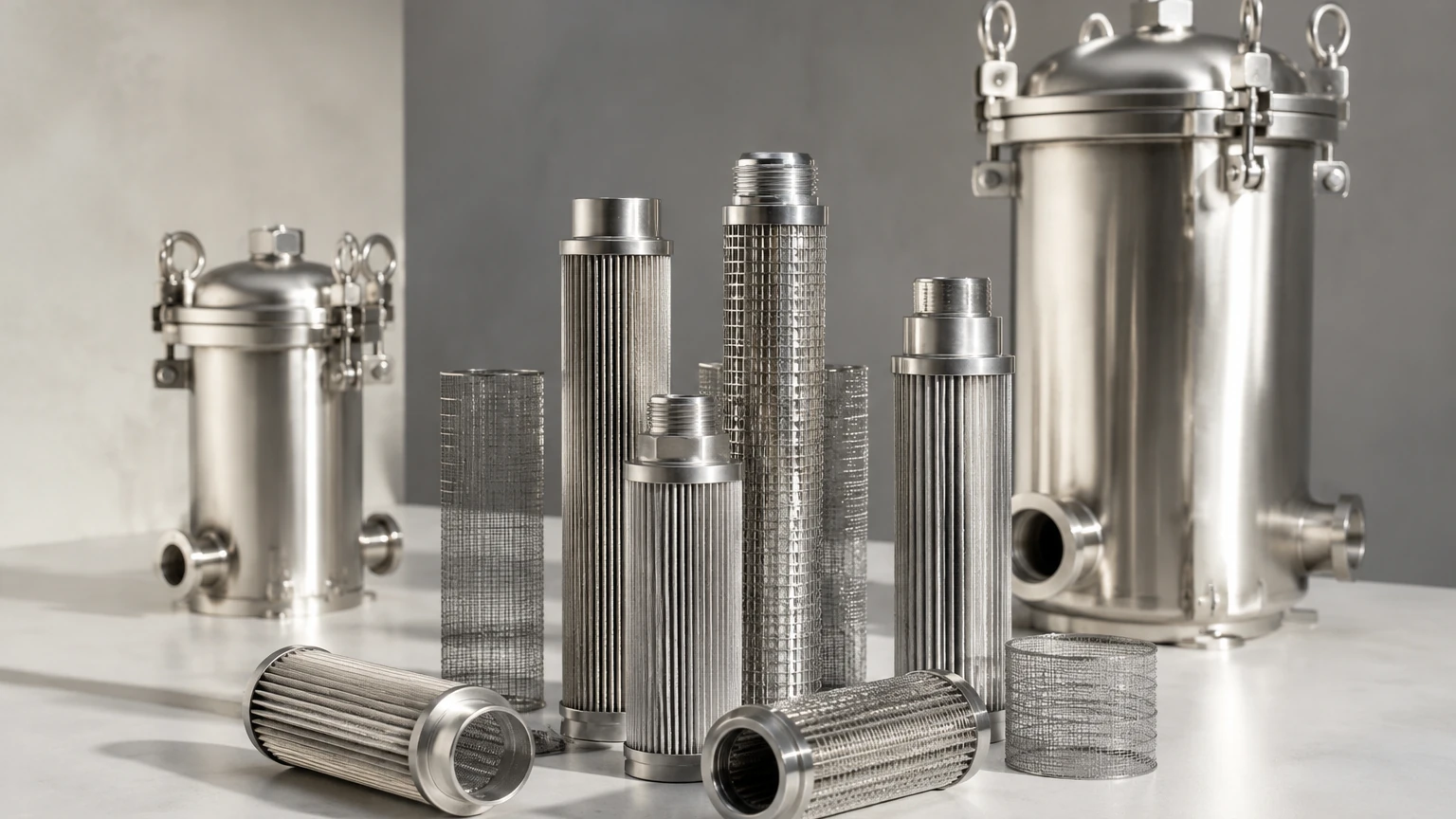
The heart of the duplex system is the filter element. For industrial applications requiring durability and cleanability, stainless steel wire mesh or sintered metal fiber cartridges are the industry standard. Unlike disposable polymer filters, stainless steel elements offer:
- High Temperature Resistance: Capable of operating in environments exceeding 250°C.
- Chemical Compatibility: Resistant to a wide range of solvents, acids, and bases.
- Structural Integrity: Able to withstand high differential pressures without collapsing.
- Cleanability: Elements can be backwashed, ultrasonically cleaned, or chemically cleaned for reuse, reducing the total cost of ownership.
Seals and Gaskets
The choice of sealing material (O-rings and gaskets) must align with the fluid chemistry and temperature. Common options include Nitrile (Buna-N) for general oil and water, Viton (FKM) for high temperatures and chemicals, and EPDM for steam or food-grade applications.
Selection Criteria for Industrial Applications
When specifying a duplex filtration system, several technical parameters must be evaluated to ensure the system meets the process requirements without excessive maintenance or energy loss.
Flow Rate and Viscosity
The physical size of the duplex filter is determined by the maximum flow rate and the fluid's viscosity. Highly viscous fluids (such as heavy oils or polymers) require larger surface areas to maintain a low pressure drop. Engineers should calculate the "clean pressure drop" (the pressure loss across the filter when the elements are new) and ensure it does not exceed 2-5 PSI (0.14-0.34 bar) to allow sufficient room for contaminant loading before a change-over is required.
Filtration Rating (Micron Level)
The micron rating defines the size of particles the filter is intended to remove. It is important to distinguish between "nominal" and "absolute" ratings. An absolute rating signifies that the filter will capture 99.9% of particles at that specific size, whereas a nominal rating is an average efficiency. For precision applications like hydraulic systems or pharmaceutical processing, absolute-rated stainless steel mesh is often required.
Contaminant Loading Capacity
The total surface area of the filter elements within the duplex chambers determines how long the system can run before a switch is necessary. Increasing the surface area—often through pleated wire mesh designs—extends the service cycle and reduces the frequency of manual intervention.
Applications of Duplex Filtration
Duplex systems are utilized across various industries where process continuity is non-negotiable.
Chemical and Petrochemical Processing
In these environments, filters are often used to protect catalysts or prevent clogging in heat exchangers. Because these processes run 24/7, duplex filtration is mandatory. Stainless steel construction is vital here to handle aggressive chemicals and high-temperature hydrocarbon streams.
Food and Beverage Production
For liquid food products, juices, and syrups, duplex filters provide a hygienic way to remove pulp, seeds, or foreign particles. Manufacturers often require polished stainless steel surfaces and "dead-leg" free designs to prevent bacterial growth. The ability to switch chambers allows for cleaning-in-place (CIP) of one side while production continues on the other.
Hydraulic and Lube Oil Systems
Large-scale turbines, compressors, and hydraulic presses rely on clean oil to prevent component wear. A duplex filter ensures that the oil remains clean even during high-debris events, protecting multi-million dollar machinery from catastrophic failure.
Water Treatment and Desalination
In pre-filtration for reverse osmosis (RO) systems, duplex filters remove suspended solids that would otherwise foul expensive membranes. The continuous flow ensures that the RO system maintains constant osmotic pressure.
Operational Best Practices and Maintenance
To maximize the lifespan of a duplex filtration system, technical teams should adhere to standardized operating procedures.
1. Monitor Differential Pressure: Every duplex system should be equipped with a differential pressure gauge or a DP switch. This provides the primary data point for determining when to switch chambers.
2. Venting and Draining: Before opening an isolated chamber for maintenance, it must be properly vented to atmospheric pressure and drained of fluid. Failure to vent can lead to pressurized fluid spray, posing a safety risk to technicians.
3. Element Inspection: When cleaning or replacing elements, technicians should inspect the old media for signs of unusual wear, such as bypass leakage or structural deformation. This can provide early warnings of upstream process upsets.
4. Spare Parts Inventory: Maintaining a stock of replacement O-rings and spare filter cartridges is essential. Even though stainless steel elements are cleanable, having a spare set allows for immediate turnaround while the dirty set is being cleaned.
Customization and OEM Considerations
Many industrial applications have unique spatial or performance constraints that standard off-the-shelf filters cannot meet. Customization is a core strength of manufacturers like Kaifil, where engineering teams can tailor the filtration solution to the specific needs of the project.
Customization options include:
- Non-Standard Connections: Flanged (ANSI, DIN, JIS), threaded (NPT, BSP), or sanitary tri-clamp connections.
- Automated Switch-over: Replacing manual levers with pneumatic or electric actuators integrated into the plant's PLC (Programmable Logic Controller).
- Heating Jackets: For fluids that solidify at room temperature (like waxes or heavy resins), heating jackets can be added to the filter housings to maintain fluid temperature.
- Specialized Media: Layering different types of wire mesh to achieve multi-stage filtration within a single cartridge.
By working closely with a manufacturer, engineers can ensure that the duplex filtration system is not just a component, but a optimized solution integrated into the broader process architecture.
Conclusion
Duplex filtration is a cornerstone of reliable industrial fluid management. By providing a redundant path for fluid flow, these systems eliminate the need for process shutdowns during routine maintenance, thereby increasing productivity and protecting critical assets. When selecting a system, focusing on material quality, valve reliability, and the specific filtration requirements of the fluid will lead to a lower total cost of ownership and higher operational efficiency.
For those looking to explore specific filter configurations or custom stainless steel components, visiting the Main Page provides access to a wide range of technical resources and product specifications. Whether you are designing a new chemical plant or upgrading a hydraulic system, choosing the right duplex filtration partner is the first step toward long-term process stability.
