


Filter Caddy
In industrial fluid management, maintaining the purity of oils, coolants, and chemical solvents is critical to operational longevity and equipment reliability. A filter caddy, often referred to as a mobile filtration unit or a kidney-loop system, serves as a portable solution for offline filtration. These systems are designed to remove contaminants from fluids while the primary machinery remains in operation or during scheduled maintenance intervals. For engineers and procurement specialists, selecting the right filter caddy involves more than just choosing a pump and a cart; it requires a deep understanding of the filtration media, housing integrity, and the specific demands of the industrial environment.
As a professional manufacturer of custom stainless steel filtration solutions, Kaifil provides the precision-engineered components that ensure these mobile units perform under rigorous conditions. Whether the application involves high-viscosity hydraulic oils or corrosive chemical processing, the effectiveness of a filter caddy is fundamentally determined by the quality of its internal filtration elements.
Understanding the Role of a Filter Caddy in Industrial Fluid Management
The primary function of a filter caddy is to provide "kidney-loop" filtration. This process involves drawing fluid from a reservoir, passing it through high-efficiency filter elements, and returning it to the same reservoir. Unlike inline filters, which must handle the full flow and pressure of a system, a filter caddy operates independently. This allows for much finer filtration than might be practical for an inline setup, where high pressure drops could trigger bypass valves or damage sensitive components.
Industrial applications for these units are diverse. In hydraulic systems, they are used to achieve specific ISO 4406 cleanliness codes, preventing the premature wear of valves and actuators. In the food and beverage industry, portable filtration units help maintain the quality of frying oils or process water. In chemical processing, they facilitate the reclamation of expensive solvents. The versatility of the filter caddy makes it an essential tool for proactive maintenance strategies aimed at reducing total cost of ownership (TCO) by extending fluid life and protecting downstream assets.
Key Engineering Specifications for Mobile Filtration Units
When evaluating or designing a filter caddy, several engineering parameters must be prioritized to ensure the unit meets the application's performance requirements. These specifications directly impact the unit's efficiency, durability, and ease of use.
Flow Rate and Pump Selection
The flow rate of a filter caddy must be balanced against the viscosity of the fluid and the surface area of the filter media. If the flow rate is too high for a given micron rating, the differential pressure will increase rapidly, leading to frequent filter changes or potential media migration. Conversely, a flow rate that is too low may not provide enough turnovers of the reservoir to achieve the desired cleanliness level within a reasonable timeframe.
Housing and Structural Integrity
The filter housing is the pressure vessel that contains the filter element. In industrial settings, these housings are typically constructed from stainless steel (SS304 or SS316L) to provide resistance to impact, corrosion, and pressure spikes. For engineers, it is vital to confirm that the housing design allows for easy access to the filter element for replacement or cleaning without requiring specialized tools that could lead to downtime.
Filtration Media: The Core Component
The most critical part of any filter caddy is the filter element itself. While disposable cellulose or synthetic media are common for light-duty applications, industrial-grade caddies often utilize stainless steel wire mesh or sintered metal elements. These materials offer superior structural strength and chemical compatibility. You can Review product options and application support on our Main Page to understand how different metal weaves and structures support various industrial filtration needs.
Material Selection and Chemical Compatibility
Material compatibility is a non-negotiable factor in filter caddy selection. Industrial fluids can range from inert mineral oils to highly aggressive acids or high-temperature polymers. Selecting the wrong material for the filter element, gaskets, or housing can lead to catastrophic failure, fluid contamination, or safety hazards.
Stainless Steel Grades (304 vs. 316L)
* SS304: Suitable for most general industrial applications, including hydraulic oils and non-corrosive fluids. It offers excellent mechanical properties and cost-effectiveness.
* SS316L: Contains molybdenum, which provides enhanced resistance to pitting and crevice corrosion in chloride-rich environments. This is the standard for pharmaceutical, food and beverage, and marine applications.
Seal and Gasket Materials
The seals within the filter caddy must be compatible with the fluid being processed. Common options include:
* Buna-N (Nitrile): Standard for petroleum-based oils and fluids.
* Viton (FKM): Preferred for high temperatures and a wide range of chemicals and fuels.
* EPDM: Ideal for water, steam, and certain polar solvents, though it should not be used with petroleum-based oils.
* PTFE (Teflon): Offers near-universal chemical resistance but has less elasticity than elastomers, requiring specific housing designs to ensure a leak-proof seal.
Filtration Performance and Micron Rating Considerations
Achieving the desired fluid purity requires a precise selection of the micron rating. In the context of a filter caddy, engineers must distinguish between nominal and absolute filtration ratings.
Nominal vs. Absolute Ratings
* Nominal Rating: An indicative value representing the filter's ability to retain a percentage of particles of a certain size. It is often used for coarse pre-filtration.
* Absolute Rating: Refers to the diameter of the largest hard spherical particle that will pass through the filter under specified test conditions. For critical applications like hydraulic servo-valve protection or pharmaceutical processing, absolute-rated stainless steel mesh is often required to ensure consistent performance.
Multi-Stage Filtration
Many high-performance filter caddies utilize a multi-stage approach. A coarse pre-filter (e.g., 40-100 microns) protects the pump and removes large debris, while a fine secondary filter (e.g., 1-10 microns) performs the final polishing. This staged approach prevents the fine filter from blinding prematurely, thereby extending the service life of the more expensive precision elements.
Impact of Viscosity and Temperature
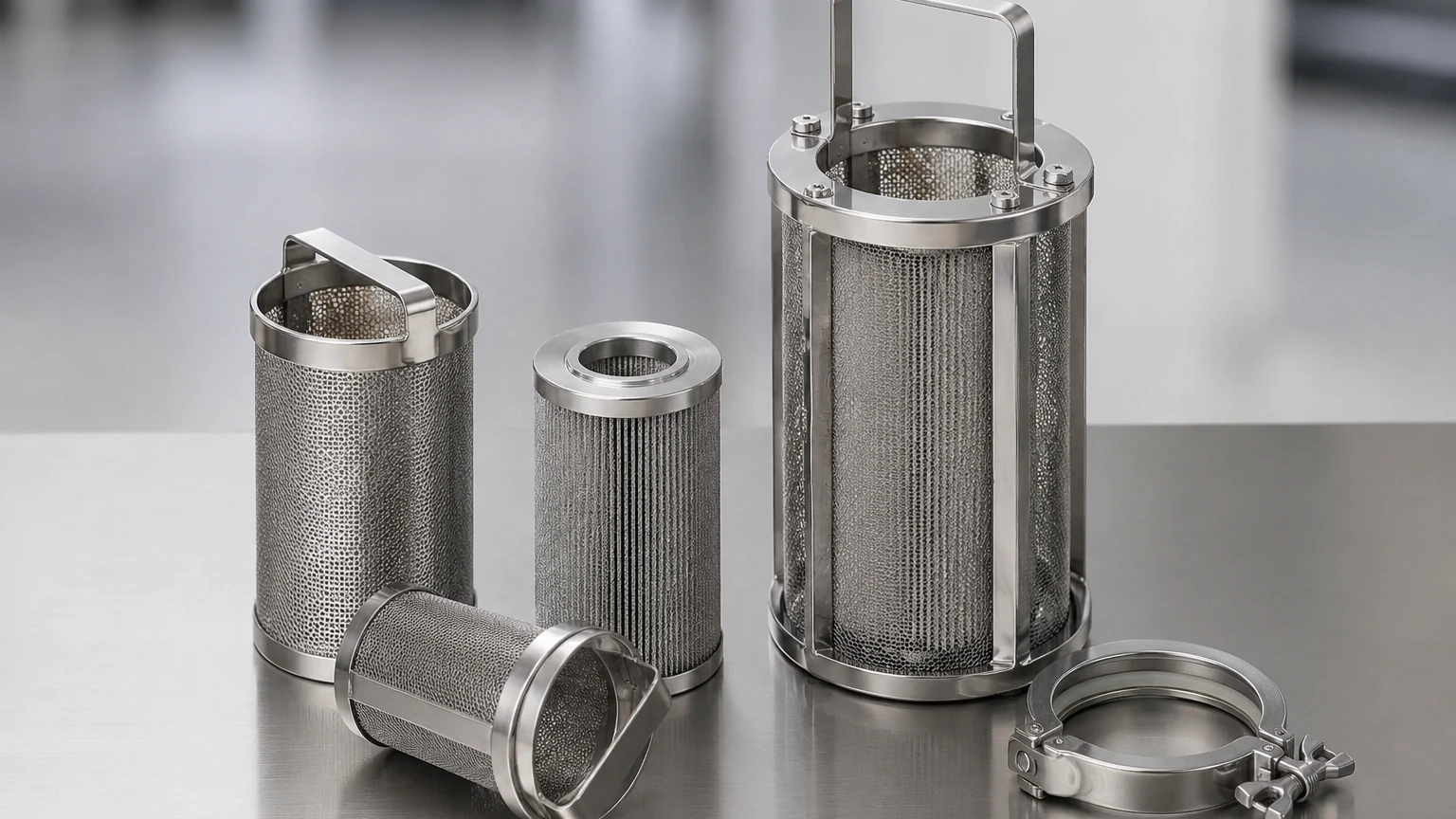
Fluid viscosity is highly temperature-dependent. A filter caddy that works efficiently at operating temperatures may struggle during a cold start. Engineers must calculate the clean pressure drop ($ΔP$) based on the maximum expected viscosity. If the $ΔP$ is too high, it may be necessary to increase the filter surface area by using pleated stainless steel cartridges, which offer significantly more filtration area than cylindrical elements of the same size.
Durability and Reusability of Stainless Steel Filter Elements
One of the primary advantages of using stainless steel filtration components in a filter caddy is their durability. Unlike paper or glass-fiber elements, which are discarded after a single use, stainless steel wire mesh and sintered elements can often be cleaned and reused.
Cleaning and Maintenance
For industries looking to minimize waste and long-term consumable costs, cleanable filters are a strategic choice. Common cleaning methods include:
* Backwashing: Reversing the flow of clean fluid through the filter to dislodge particles from the surface.
* Ultrasonic Cleaning: Using high-frequency sound waves in a cleaning solvent to remove fine particulates trapped deep within the mesh or sintered structure.
* Chemical Cleaning: Using specific solvents or detergents to dissolve organic or mineral deposits.
Structural Integrity under Differential Pressure
As a filter caddy removes contaminants, the differential pressure across the element increases. Stainless steel elements are engineered to withstand high collapse pressures, ensuring that the media does not rupture and release a "slug" of concentrated contaminants back into the clean reservoir. This structural reliability is a key reason why metal filters are preferred in high-stakes industrial environments.
Customization for Specialized Industrial Applications
Standard off-the-shelf filter caddies may not meet the specific requirements of every industrial process. Customization is often necessary to address unique challenges related to space constraints, flow dynamics, or specialized fluid properties.
Sanitary Applications
In the food, beverage, and pharmaceutical sectors, the filter caddy must adhere to strict sanitary standards. This involves using 316L stainless steel with high-polish surface finishes (Ra < 0.8 µm) to prevent bacterial growth and ensure that the equipment can be fully sanitized using CIP (Clean-In-Place) protocols.
High-Pressure Hydraulic Systems
For hydraulic reclamation, the caddy might need to handle high-pressure returns or be equipped with specialized water-removal elements. In these cases, the housing and the filter element must be designed as a matched set to prevent bypass and ensure that the target ISO cleanliness codes are met consistently.
OEM and Precision Components
Many manufacturers of mobile filtration systems partner with specialized component producers like Kaifil to develop proprietary filter designs. Custom end-cap configurations, specialized pleat geometries, and reinforced support cores allow OEM caddy manufacturers to offer superior performance and ensure that only high-quality replacement parts are used in their systems.
Evaluating Total Cost of Ownership (TCO)
When purchasing a filter caddy or the replacement elements for one, procurement teams should look beyond the initial purchase price. The Total Cost of Ownership includes:
1. Consumable Costs: The frequency and price of replacement elements. Reusable stainless steel filters often have a higher upfront cost but significantly lower long-term costs.
2. Labor Costs: The time required for operators to change filters or clean reusable elements.
3. Disposal Costs: The expense associated with disposing of contaminated single-use filters, which can be significant if the fluid is classified as hazardous waste.
4. Equipment Longevity: The value of extended machine life and reduced downtime achieved through superior filtration.
By investing in high-quality stainless steel filtration components, industrial facilities can achieve a more sustainable and cost-effective fluid management program.
Conclusion and Next Steps for Engineering Teams
A filter caddy is a vital asset for maintaining industrial fluid integrity, but its success depends on the technical alignment between the filtration media and the application requirements. Engineers must carefully consider micron ratings, material compatibility, and the structural limits of the filter elements to ensure reliable performance.
When specifying components for a new mobile filtration project or seeking to optimize an existing system, collaborating with a manufacturer that understands the nuances of metal filtration is essential. For detailed technical specifications and support in selecting the right stainless steel filter cartridges or wire mesh components for your application, visit our Main Page and Review product options and application support. Proactive fluid management, supported by precision-engineered filtration, remains one of the most effective ways to ensure industrial operational excellence.
