


Filter Cartridge Manufacturing
Filter cartridge manufacturing is a specialized engineering discipline that bridges the gap between raw material science and fluid dynamics. In industrial environments where precision is non-negotiable—such as chemical processing, pharmaceutical production, and high-pressure hydraulic systems—the integrity of the filter cartridge determines the efficiency and safety of the entire process. For engineers and procurement specialists, understanding the nuances of how these components are designed and fabricated is essential for selecting a solution that balances performance with long-term cost-effectiveness.
Industrial filtration often requires equipment capable of withstanding extreme temperatures, corrosive fluids, and high differential pressures. Consequently, the manufacturing process for stainless steel filter cartridges involves complex metallurgical considerations and advanced assembly techniques. This guide examines the critical stages of filter cartridge manufacturing, from material selection to quality validation.
The Role of Material Selection in Filter Cartridge Manufacturing
The foundation of any high-performance filter cartridge is the material from which it is constructed. In industrial applications, stainless steel is the preferred medium due to its mechanical strength and chemical resistance. The choice between different grades of stainless steel—most commonly 304 and 316L—is dictated by the specific operating environment.
Stainless Steel 304 vs. 316L
Stainless steel 304 offers excellent durability and is suitable for many general industrial applications, including water treatment and basic hydraulic systems. However, for environments involving chlorides, acids, or high-purity requirements, 316L is the industry standard. The addition of molybdenum in 316L provides superior resistance to pitting and crevice corrosion, making it indispensable for the chemical and pharmaceutical sectors.
Filtration Media Types
Filter cartridge manufacturing utilizes several types of metal media depending on the required micron rating and flow characteristics:
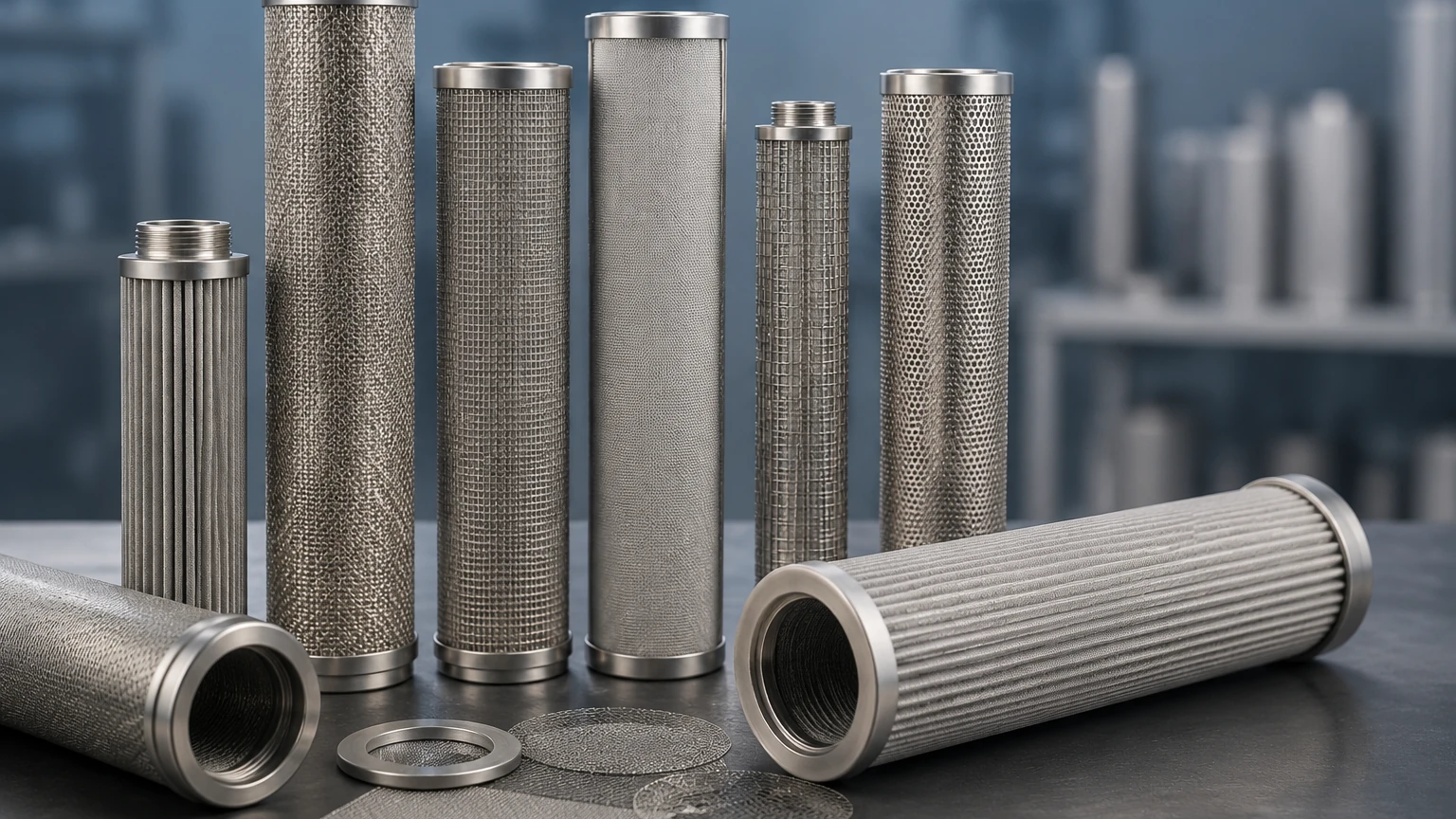
* Woven Wire Mesh: Available in various weaves (plain, twill, or dutch), wire mesh provides precise surface filtration. It is easily cleaned and ideal for applications requiring a specific, consistent pore size.
* Sintered Metal Fiber Felt: This non-woven medium is created by sintering stainless steel fibers into a porous structure. It offers high porosity and excellent dirt-holding capacity, making it suitable for depth filtration in high-viscosity fluid applications.
* Sintered Wire Mesh: By bonding multiple layers of wire mesh through a high-temperature sintering process, manufacturers create a medium with exceptional mechanical strength and stability. This is often used in high-pressure environments where the filter must maintain its shape under stress.
Engineering the Core: Structural Components and Assembly
A filter cartridge is more than just the filtration medium; it is a multi-component assembly designed to survive the rigors of industrial flow. The structural integrity of the cartridge depends on the design of the inner support core, the outer cage, and the end caps.
Support Cores and Cages
The inner core provides the necessary resistance against collapse under high differential pressure. In high-flow applications, the core must be perforated or spirally welded to ensure it does not restrict fluid movement while maintaining structural rigidity. Similarly, an outer cage may be employed to protect the media from back-pressure or physical damage during installation and handling.
End Cap Configurations
End caps serve as the interface between the filter cartridge and the housing. Manufacturing these components requires precision machining to ensure a leak-proof seal. Common configurations include:
* Double Open End (DOE): Features gaskets at both ends, suitable for standard housings.
* Code 7 (226 O-ring): Includes a locking tab and double O-rings for high-purity applications, ensuring the cartridge remains seated even under pressure fluctuations.
* Threaded Connections: Used in high-pressure hydraulic or gas systems where a mechanical lock is required.
In high-quality filter cartridge manufacturing, end caps are typically joined to the media using TIG (Tungsten Inert Gas) or plasma welding. Unlike adhesive bonding, which can fail at high temperatures or leach chemicals into the process stream, all-welded construction ensures a robust, contaminant-free bond.
Advanced Fabrication Techniques: From Pleating to Sintering
The geometry of the filter media significantly impacts its performance. Manufacturers employ different fabrication techniques to optimize the surface area and flow paths within the cartridge.
Pleated vs. Cylindrical Designs
Pleating is a common technique used to increase the effective filtration area of a cartridge without increasing its external dimensions. By folding the media, manufacturers can provide up to 2-3 times the surface area of a standard cylindrical filter. This results in lower initial pressure drops and significantly longer service life, as the dirt-holding capacity is proportional to the surface area. For applications involving high-solids loading, pleated stainless steel cartridges are often the most efficient choice.
The Sintering Process
Sintering is a critical phase in the manufacturing of many metal filters. It involves heating the metal media in a vacuum or controlled-atmosphere furnace to a temperature just below its melting point. This causes the metal contact points to fuse, creating a rigid structure without the use of binders. Sintering enhances the mechanical strength of the media, prevents media migration (the shedding of fibers into the filtrate), and ensures that the pore size remains constant even under high pressure.
Performance Metrics and Selection Criteria
When evaluating filter cartridge manufacturing, engineers must look beyond the physical dimensions and focus on performance metrics that align with their specific application requirements. For more information on specialized metal filtration components and how they can be integrated into your systems, you can review the technical resources on our Main Page.
Micron Ratings: Absolute vs. Nominal
A critical distinction in filtration is the micron rating. A nominal rating indicates the ability of the filter to retain a majority of particles of a certain size, but it does not guarantee 100% efficiency. An absolute rating, however, signifies that the filter will retain 99.9% or more of particles at that specific size. In pharmaceutical or fine chemical applications, absolute-rated cartridges are mandatory to prevent downstream contamination.
Differential Pressure (ΔP)
The pressure drop across a clean filter is a vital indicator of its efficiency. A well-manufactured cartridge should offer low initial differential pressure to maximize the available energy in the system. As the filter accumulates contaminants, the ΔP will rise. Manufacturers provide flow-rate-versus-pressure-drop curves to help engineers size their systems correctly, ensuring that the "terminal pressure drop" (the point at which the filter must be cleaned or replaced) is reached within an acceptable timeframe.
Quality Assurance and Industrial Standards
Reliable filter cartridge manufacturing is underpinned by rigorous quality control protocols. Because these components are often used in critical safety or purity roles, manufacturers must validate their products through standardized testing.
Integrity Testing
One of the most common tests is the Bubble Point Test. This non-destructive test measures the pressure required to force air through a liquid-saturated filter. The results are directly correlated to the maximum pore size of the media, allowing manufacturers to verify that the cartridge meets its specified micron rating. Other tests include pressure decay tests and bacterial challenge tests for cartridges destined for sterile environments.
Compliance and Certification
Depending on the industry, filter cartridges may need to comply with various international standards. For food and beverage applications, materials must often meet FDA or EC 1935/2004 requirements for food contact. In the pharmaceutical industry, USP Class VI plastics (for gaskets/O-rings) and 316L stainless steel are standard. Ensuring that the manufacturer maintains a robust ISO 9001 quality management system provides further assurance of consistency and traceability.
Customization and OEM Capabilities in Filtration
Standard off-the-shelf filters often fall short in specialized industrial environments. Custom filter cartridge manufacturing allows for the optimization of every variable—from the alloy used to the specific pleat density and end-cap geometry.
Tailoring to Process Conditions
Customization might involve designing a filter to fit an existing, non-standard housing, or selecting a specific wire mesh weave to handle a unique particle shape. For example, in the oil and gas industry, filters may need to be reinforced to withstand extreme surges in pressure. In the food industry, "easy-to-clean" designs with smooth surfaces are prioritized to prevent bacterial growth.
OEM Partnerships
Original Equipment Manufacturers (OEMs) often require proprietary filter designs to integrate into their larger systems. A manufacturer with strong OEM capabilities can provide white-label solutions, customized packaging, and technical support that extends from the design phase through to after-sales maintenance. This collaborative approach ensures that the filtration component is perfectly matched to the system’s performance specifications.
Evaluating Total Cost of Ownership (TCO)
In the B2B procurement process, the initial purchase price of a filter cartridge is only one component of the total cost. A cheaper, lower-quality cartridge may lead to frequent replacements, increased downtime, and potential damage to downstream equipment.
Durability and Cleanability
One of the primary advantages of stainless steel filter cartridges is their ability to be cleaned and reused. Unlike disposable polymer cartridges, metal filters can be backwashed, ultrasonically cleaned, or chemically treated to restore their original flow characteristics. This longevity significantly reduces the long-term cost per gallon of filtrate processed.
Maintenance and Replacement Cycles
Understanding the replacement cycle is crucial for operational planning. A high-quality manufactured cartridge with superior dirt-holding capacity will require fewer interventions. Engineers should evaluate the "total dirt-holding capacity" (TDHC) as a key metric for determining the expected service life between cleaning cycles. By investing in a robustly manufactured product, facilities can minimize labor costs and maximize system uptime.
Conclusion
Filter cartridge manufacturing is a technical field that requires a deep understanding of metallurgy, fluid mechanics, and precision fabrication. From the initial selection of 316L stainless steel to the final bubble point integrity test, every step in the process is designed to ensure that the final product can withstand the demanding conditions of modern industry. By focusing on quality assembly, absolute micron ratings, and structural integrity, manufacturers provide the essential components that keep industrial processes running efficiently and safely. For those seeking reliable filtration solutions, focusing on these technical benchmarks is the surest path to achieving optimized performance and a lower total cost of ownership.
