


Filter Lube
In industrial filtration, the integrity of a system relies not only on the precision of the filter media but also on the security of the seals and connections. Filter lube, a specialized lubricant applied to O-rings, gaskets, and threaded components, plays a critical role in ensuring leak-free operation and extending the service life of filtration hardware. For engineers and maintenance professionals working with high-performance stainless steel filter cartridges and wire mesh systems, understanding the technical nuances of lubricant selection is essential for maintaining process purity and mechanical reliability.
While the filter element itself—such as those manufactured by Kaifil—is responsible for removing contaminants, the interface between the filter and the housing is where bypass risks are most prevalent. Proper application of filter lube ensures that seals seat correctly without friction-induced damage, which is a common cause of premature failure in high-pressure or high-temperature industrial environments.
Understanding the Role of Filter Lube in Industrial Systems
Filter lube serves several distinct functions within an industrial filtration assembly. Its primary purpose is to reduce friction during the installation of seals. When a filter cartridge is pushed into a housing head or a bowl is threaded onto a base, the O-rings are subjected to compressive and shear forces. Without lubrication, an O-ring may "bunch up," twist, or suffer from surface abrasions known as "scuffing." These minor physical defects can create micro-channels that allow unfiltered fluid to bypass the filter media.
Beyond installation, filter lube acts as a secondary sealing agent. It fills microscopic voids on the surface of the elastomer and the metal mating surfaces, enhancing the airtight or watertight nature of the connection. In vacuum applications or high-pressure hydraulic systems, this secondary seal is vital for preventing cavitation or external leakage.
Furthermore, lubrication prevents "stiction" (static friction), which occurs when an elastomer bonds to a metal surface over time due to heat or chemical exposure. Without a protective layer of filter lube, removing a spent filter cartridge can become a destructive process, potentially damaging the housing or leaving elastomeric residue that is difficult to clean. For systems requiring frequent filter changes, such as those in the food and beverage or pharmaceutical sectors, consistent lubrication reduces downtime and protects the investment in high-quality stainless steel hardware.
Material Compatibility: O-Rings and Process Fluids
The most critical engineering consideration when selecting a filter lube is compatibility. An incompatible lubricant can cause elastomers to swell, shrink, or become brittle, leading to immediate seal failure. Industrial filters typically utilize O-rings made from materials such as Nitrile (Buna-N), EPDM, Viton (FKM), or Silicone.
Elastomer Compatibility
1. EPDM (Ethylene Propylene Diene Monomer): EPDM is widely used in steam and water applications but is highly sensitive to petroleum-based products. Using a standard mineral oil or grease on an EPDM seal will cause it to swell and degrade rapidly. For EPDM, silicone-based lubricants are the industry standard.
2. Viton (FKM): Known for its high chemical and temperature resistance, Viton is compatible with a wider range of lubricants, including many synthetic and petroleum-based options. However, for high-purity or high-temperature applications, fluorinated lubricants (PFPE) are often preferred to match the chemical inertness of the Viton itself.
3. Buna-N (Nitrile): This common material is compatible with petroleum-based greases but can be affected by certain synthetic esters.
Process Fluid Interference
Engineers must also ensure the lubricant does not contaminate the process fluid. In the chemical processing industry, a lubricant that dissolves into the solvent being filtered can ruin a batch of product. Similarly, in hydraulic systems, the filter lube must be compatible with the hydraulic oil to prevent the formation of sludge or the breakdown of the oil's additive package. When designing custom filtration solutions, as seen on the Kaifil Main Page, specifying the correct seal and lubricant combination is a fundamental step in the engineering phase.
Selection Criteria for Industrial Filter Lubricants
When evaluating filter lube for a specific application, technical teams should look beyond basic slipperiness. The following criteria define a high-quality industrial lubricant:
Temperature Stability
Industrial filtration often occurs at extreme temperatures. A lubricant used in a steam filtration system must maintain its viscosity and not carbonize at high temperatures. Conversely, in cryogenic or cold-storage applications, the lube must not freeze or become excessively tacky, which would make filter replacement impossible.
Chemical Inertness
In aggressive chemical environments, the lubricant must resist oxidation and chemical attack. If the lube reacts with the process fluid, it may produce byproducts that clog the precision wire mesh of the filter or contaminate the downstream flow. Fluorinated greases are often selected for their near-total chemical inertness in the presence of strong acids, bases, and oxidizers.
Regulatory Compliance (NSF and FDA)
For the food, beverage, and pharmaceutical industries, the lubricant must meet strict safety standards. NSF H1 registered lubricants are required where there is a possibility of incidental food contact. These products are formulated from specific base oils and additives that are non-toxic and tasteless. In pharmaceutical manufacturing, USP Class VI compliance may also be required to ensure biocompatibility.
Outgassing and Volatility
In vacuum systems or semiconductor manufacturing, the volatility of the lubricant is a concern. Low-outgassing lubricants are necessary to prevent vapors from migrating into sensitive areas of the process, where they could condense and cause contamination or equipment interference.
Application Techniques for Stainless Steel Filter Cartridges
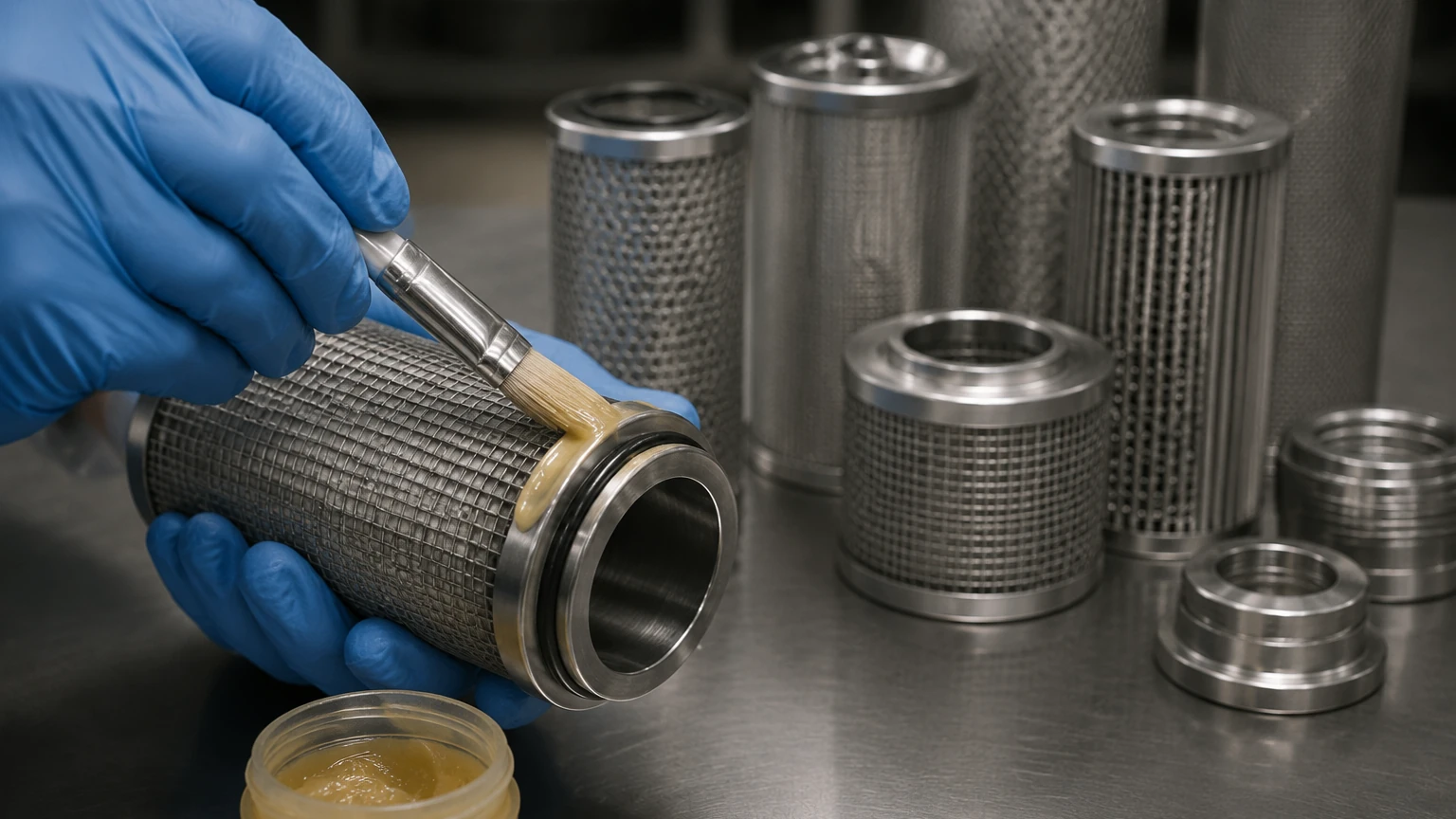
Applying filter lube is a precision task that requires cleanliness and moderation. Over-application can be as detrimental as under-application, particularly if excess grease migrates into the filter media and reduces the effective filtration area.
1. Preparation: Ensure the O-ring and the groove in the filter end cap or housing are clean. Any grit or old lubricant residue can act as an abrasive. For stainless steel components, check for any signs of galling on threaded connections.
2. Thin Film Application: Apply a thin, uniform film of lubricant to the O-ring. The goal is to make the surface appear shiny, not to have visible globs of grease. A common technique is to place a small amount of lube on gloved fingers and pull the O-ring through them.
3. Seating the Seal: Carefully place the O-ring into its groove. Ensure it is not twisted. If the filter design uses a double O-ring seal (common in 222 or 226 plug-in styles), ensure both rings are lubricated.
4. Insertion: When inserting the cartridge into the housing, use a steady, straight-line force. If resistance is felt, do not force it; remove the cartridge and check for seal alignment. For threaded housings, the lubricant on the threads helps prevent the stainless steel from seizing (galling), which is a common issue with high-grade alloys.
Common Risks of Improper Lubrication
Failure to use the correct filter lube, or neglecting its use entirely, leads to several predictable failure modes in industrial environments:
* Seal Extrusion: A dry O-ring may be dragged out of its groove during installation. This results in the seal being crushed between the metal surfaces rather than sitting within the designed sealing gap.
* Contamination Leaks: If the lubricant is not compatible with the process fluid, it may wash away, leaving the seal dry and prone to leaking under pressure fluctuations.
* System Contamination: Using a non-food-grade lubricant in a food processing line can lead to regulatory non-compliance and product recalls. Similarly, using a silicone-based lube in a paint-spraying application can cause "fish-eyes" and other surface finish defects.
* Galling of Stainless Steel: In filtration systems where the housing lid or the filter itself is threaded, the absence of an anti-seize lubricant can lead to cold welding of the metal surfaces. This often results in the permanent destruction of the housing during attempted disassembly.
Engineering Considerations for Custom Filtration Solutions
For engineers specifying custom filtration hardware, the choice of seal and lubricant should be integrated into the initial design. When working with manufacturers like Kaifil, providing detailed information about the operating temperature, chemical composition of the fluid, and cleaning protocols (such as SIP/CIP) allows for the selection of the most robust sealing system.
In many cases, a specialized coating or a specific grade of stainless steel can be paired with high-performance lubricants to solve complex sealing challenges. For instance, in high-viscosity oil filtration, the pressure drop across the filter is significant; ensuring the seals can withstand these pressures without bypass requires a lubricant that maintains its film strength under heavy loads.
Furthermore, the total cost of ownership (TCO) of a filtration system is influenced by maintenance efficiency. Using a high-quality, long-lasting filter lube reduces the frequency of seal replacements and prevents damage to expensive stainless steel filter elements. While the lubricant is a small component of the overall system, its impact on operational reliability is disproportionately large.
Conclusion
Filter lube is a vital auxiliary component in the world of industrial filtration. It bridges the gap between the rigid precision of stainless steel filter elements and the flexible requirements of elastomeric seals. By selecting a lubricant based on material compatibility, temperature requirements, and industry regulations, maintenance teams can ensure that their filtration systems—whether standard or custom-designed solutions found on the Kaifil Main Page—operate at peak efficiency.
Proper lubrication practices protect the integrity of the process, prevent costly downtime, and ensure that the high-performance filtration media can perform its primary task without the risk of bypass or mechanical failure. For any technical professional, the small step of applying the correct filter lube is a fundamental part of industrial best practices.
