


Filter Mesh Stainless Steel
In industrial processing, the reliability of a filtration system often hinges on the material integrity and geometric precision of the media used. Filter mesh stainless steel has emerged as the industry standard for demanding applications due to its exceptional mechanical strength, thermal stability, and resistance to corrosive environments. Unlike synthetic or cellulose-based media, stainless steel mesh offers a permanent or semi-permanent solution that can be cleaned and reused, significantly impacting the total cost of ownership in large-scale operations.
As a professional manufacturer specializing in custom filtration solutions, Kaifil provides a deep technical understanding of how different alloys and weave structures influence process efficiency. Whether for chemical processing, food and beverage production, or high-pressure hydraulic systems, selecting the correct filter mesh stainless steel requires a balance of micron ratings, flow requirements, and environmental constraints. This guide explores the engineering considerations necessary for optimizing industrial filtration performance.
Material Grades and Chemical Compatibility
The performance of filter mesh stainless steel begins with the selection of the base alloy. In industrial environments, the chemical composition of the fluid being filtered dictates the longevity of the mesh. While many grades are available, three primary categories dominate the market:
1. AISI 304: The most common grade, offering good corrosion resistance and excellent forming properties. It is suitable for water treatment, food processing, and general industrial applications where high concentrations of chlorides or acids are not present.
2. AISI 316 and 316L: Containing molybdenum, these grades provide superior resistance to pitting and crevice corrosion, particularly in chloride-rich environments. 316L (low carbon) is preferred for welded components to prevent carbide precipitation during the welding process, ensuring the structural integrity of custom-fabricated filter cartridges.
3. Specialty Alloys: For extreme environments involving high-temperature oxidation or highly aggressive chemicals, alloys such as 904L, Monel, or Inconel may be utilized. These are typically reserved for specialized chemical reactors or aerospace applications where standard stainless steel would fail prematurely.
Engineers must confirm the pH levels, temperature fluctuations, and chemical concentrations of their process before finalizing material selection. Failure to match the alloy to the environment can lead to stress corrosion cracking or localized pitting, which compromises filtration accuracy and risks downstream contamination.
The Impact of Weave Patterns on Filtration Performance
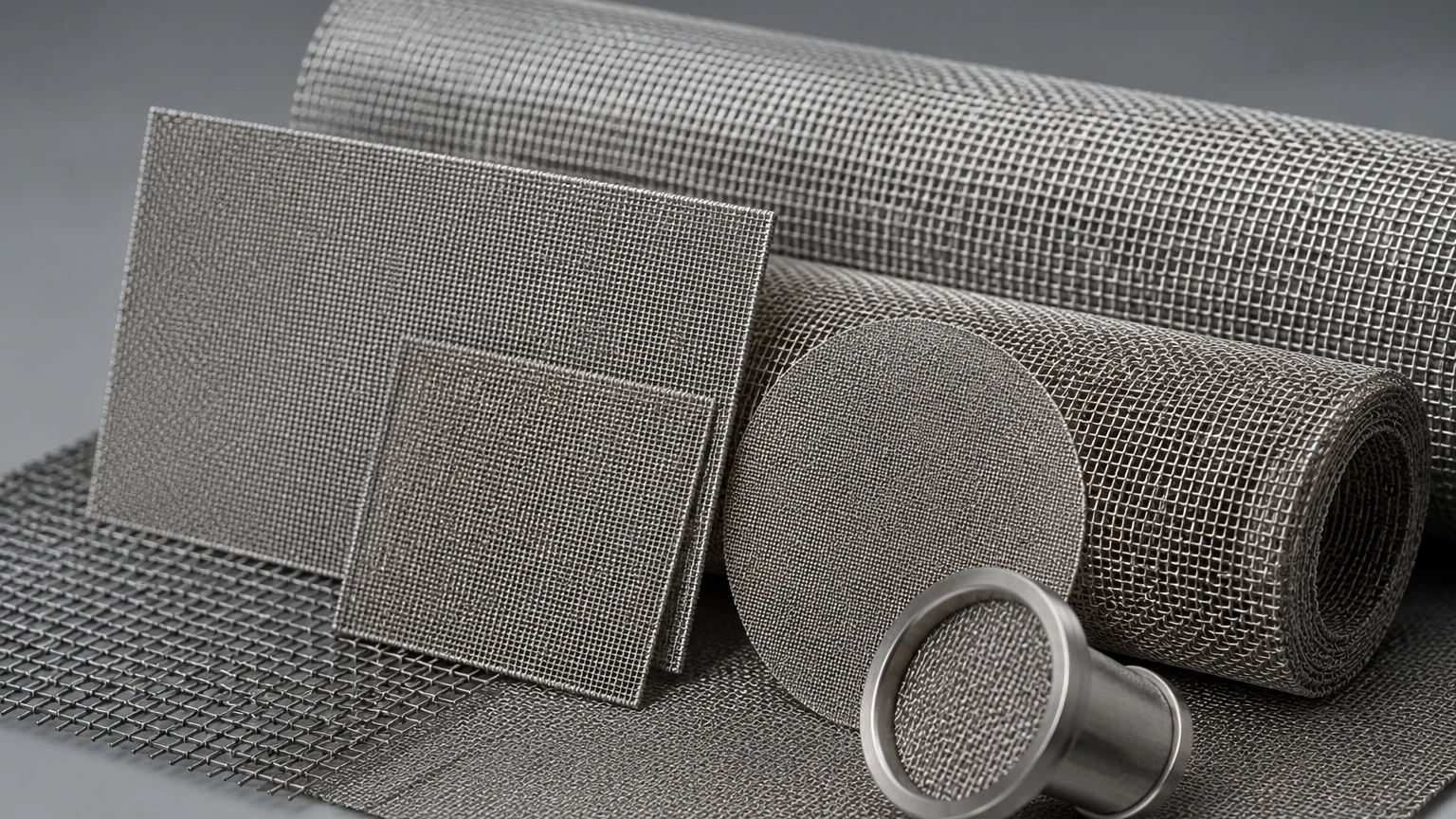
Filter mesh stainless steel is not a monolithic product; its performance is defined by the way the wires are interlaced. The weave pattern determines the pore size (micron rating), mechanical strength, and flow resistance of the mesh.
* Plain Weave: The simplest pattern where each warp wire crosses over and under each shute wire. This provides a high percentage of open area and low pressure drop, making it ideal for coarse filtration and high-flow applications.
* Twill Weave: Each shute wire passes over and under two warp wires. This allows for a heavier wire diameter for a given mesh count, increasing the mechanical strength and durability of the filter for high-pressure environments.
* Dutch Weave (Plain and Twill): These weaves utilize different wire diameters for the warp and shute. The shute wires are driven close together, creating a "tortuous path" for the fluid. Dutch weaves are essential for fine filtration (down to 5-10 microns) because they provide high density and strength while maintaining precise pore sizes.
* Sintered Mesh: For the most demanding applications, multiple layers of mesh are sintered—diffusion-bonded under high heat and pressure. This creates a rigid, integrated structure that combines the fine filtration of a Dutch weave with the mechanical support of a coarse mesh, preventing media migration even under extreme pressure surges.
Engineering Considerations for Custom Filter Components
When transitioning from raw mesh to a finished filtration component, several engineering factors must be addressed to ensure the product meets the specific needs of the application. Kaifil specializes in translating these technical requirements into functional hardware.
Structural Integrity and Support
In high-pressure hydraulic or gas systems, the filter mesh stainless steel may be subjected to significant differential pressure. Without proper support, the mesh can deform or rupture. Engineers often incorporate perforated metal cores or outer shrouds to provide the necessary rigidity. Pleating the mesh is another common technique; it increases the effective filtration area within a compact footprint, which reduces the face velocity of the fluid and extends the time between cleaning cycles.
Customization and OEM Integration
Industrial equipment often requires non-standard dimensions or unique end-cap configurations. Customization involves more than just sizing; it includes the selection of joining methods—such as TIG welding, plasma welding, or epoxy bonding—that are compatible with the process fluid. For organizations looking to integrate these components into proprietary systems, reviewing product options and application support on the Kaifil Main Page can provide insights into available manufacturing capabilities.
Evaluating Performance: Flow Rate, Pressure Drop, and Micron Ratings
The efficiency of a filter is measured by its ability to remove contaminants while allowing the fluid to pass with minimal resistance. There is an inherent trade-off between filtration fineness and flow capacity.
1. Micron Rating (Absolute vs. Nominal): It is critical to distinguish between these two. A nominal rating refers to the ability of the mesh to retain a certain percentage of particles, while an absolute rating indicates the size of the largest spherical particle that can pass through the mesh. For critical pharmaceutical or food safety applications, absolute ratings are mandatory.
2. Clean Pressure Drop: This is the initial resistance the filter offers to the fluid flow. A high open area in the filter mesh stainless steel minimizes this drop, which in turn reduces the energy consumption of the pumps or compressors driving the system.
3. Dirt Holding Capacity: This refers to the amount of contaminant a filter can retain before the pressure drop reaches a terminal level. Increasing the surface area through pleating or using multi-layered sintered structures can significantly improve this metric, leading to longer service intervals.
Maintenance Strategies and Extending Service Life
One of the primary advantages of filter mesh stainless steel over disposable media is its cleanability. However, the cleaning method must be matched to the type of contaminant and the mesh structure to avoid damaging the delicate wires.
* Backwashing: Many automated systems use a reverse flow of clean fluid to dislodge particles from the surface of the mesh. This is highly effective for surface-loading weaves like plain or twill mesh.
* Ultrasonic Cleaning: For depth-loading weaves like Dutch weave or sintered mesh, ultrasonic baths use high-frequency sound waves to create cavitation bubbles that penetrate deep into the pore structure, removing fine particulates that backwashing might miss.
* Chemical Cleaning: In industries like food and beverage, CIP (Clean-In-Place) systems use caustic or acidic solutions to dissolve organic buildup. The chemical resistance of 316L stainless steel is vital here, as it allows for aggressive cleaning without degrading the mesh.
Regular inspection of the mesh for signs of mechanical fatigue or wire displacement is essential. Even small gaps in the weave can lead to "bypass," where contaminants circumvent the filter, potentially damaging sensitive downstream equipment like high-pressure pumps or spray nozzles.
Selecting the Right Filtration Partner
Choosing a provider for filter mesh stainless steel involves evaluating both manufacturing capacity and engineering expertise. A reliable partner does not simply supply a commodity; they act as a technical resource to help solve complex filtration challenges. Factors to consider include:
* Quality Control: Does the manufacturer use calibrated equipment to verify mesh counts and wire diameters? For high-precision applications, bubble point testing or glass bead testing may be required to verify the absolute micron rating.
* Material Traceability: In the pharmaceutical and food industries, material certifications (MTRs) are necessary to prove that the stainless steel meets the required standards and is free from contaminants.
* Application Experience: A manufacturer with a broad portfolio across different industries can offer cross-sector insights. For instance, techniques used to handle high-viscosity resins in the chemical industry might be adapted to improve the filtration of heavy oils in hydraulic systems.
Kaifil’s commitment to quality and durability ensures that every custom stainless steel filtration component is engineered for the specific rigors of its environment. By focusing on precise filtration performance and robust construction, Kaifil helps global customers optimize their processes and reduce operational downtime.
In summary, filter mesh stainless steel is a sophisticated engineering material that requires careful selection of alloy, weave, and structural design. By understanding the technical nuances of these components, engineers can specify filtration solutions that provide the best balance of performance, longevity, and cost-effectiveness. For those seeking to develop or source high-performance filtration components, visiting the Main Page offers a starting point for exploring technical specifications and customized design services.
