


Filter Meshes
In the landscape of industrial processing, the efficiency of a filtration system is fundamentally determined by the quality and configuration of the filter media employed. Filter meshes serve as the primary barrier in separating solids from liquids or gases, playing a critical role in protecting downstream equipment, ensuring product purity, and maintaining process consistency. For engineers and procurement specialists, selecting the appropriate mesh involves a complex evaluation of material science, hydraulic performance, and mechanical durability.
As a professional manufacturer specializing in custom stainless steel filtration solutions, Kaifil provides a comprehensive range of high-performance components designed for demanding industrial environments. Understanding the nuances of different filter meshes is essential for optimizing filtration systems across chemical processing, food and beverage, pharmaceutical, and hydraulic applications. You can explore our full range of engineering capabilities and product specifications on our Main Page.
Understanding the Structural Variations of Filter Meshes
Filter meshes are not monolithic; they are engineered structures designed with specific weave patterns to meet diverse filtration requirements. The choice of weave affects the mesh’s pore size, mechanical strength, and flow resistance.
Plain Weave
The most common and straightforward design, plain weave features wires that cross over and under each other alternately. This provides a high level of transparency and a consistent aperture size, making it ideal for general-purpose screening and low-pressure filtration where high flow rates are prioritized over extreme precision.
Twill Weave
In a twill weave, each shute wire passes successively over and under two warp wires. This pattern allows for the use of heavier wires than a plain weave of the same mesh count, resulting in a more durable structure. Twill weaves are often used when a combination of fine filtration and high mechanical strength is required.
Dutch Weave (Plain and Twill)
Dutch weaves utilize a combination of different wire diameters for the warp and shute. This results in a dense, firm mesh with small, triangular openings. Plain Dutch weaves offer high filtration accuracy and are easy to clean, while Twill Dutch weaves provide even finer filtration levels, often down to the low micron range, by layering the wires more densely. These are the preferred choice for high-pressure hydraulic systems and fuel filtration.
Material Engineering: Why Stainless Steel Dominates
The environment in which filter meshes operate often involves corrosive chemicals, high temperatures, and significant mechanical stress. Stainless steel is the industry standard due to its exceptional resistance to these factors. Kaifil utilizes several grades of stainless steel to match specific application needs:
* AISI 304: The standard grade for general industrial use, offering good corrosion resistance and excellent formability. It is suitable for water treatment and basic food processing.
* AISI 316/316L: Containing molybdenum, these grades offer superior resistance to chlorides and pitting. 316L (low carbon) is specifically used for components requiring welding, as it prevents carbide precipitation that can lead to corrosion in the heat-affected zone. These are essential for chemical processing and marine environments.
* 904L and Specialty Alloys: For environments involving high concentrations of sulfuric acid or extreme temperatures, specialized alloys provide the necessary longevity that standard stainless steels cannot match.
Selecting the right material is not just about corrosion resistance; it also impacts the total cost of ownership by extending the replacement cycle and reducing the risk of process contamination due to material degradation.
Key Performance Indicators: Micron Rating and Open Area
When evaluating filter meshes, engineers must balance two often-competing metrics: filtration fineness and flow capacity.
Micron Rating (Absolute vs. Nominal)
The micron rating defines the size of particles the mesh can intercept. An *absolute* rating refers to the diameter of the largest hard spherical particle that will pass through the mesh under specified test conditions. A *nominal* rating is an indicative value representing the mesh's ability to retain a percentage of particles of a certain size. For critical applications in the pharmaceutical or aerospace sectors, absolute ratings are mandatory to ensure safety and compliance.
Percentage of Open Area
The open area is the ratio of the total area of the apertures to the total area of the mesh. A higher open area results in a lower pressure drop ($ΔP$) and higher flow rates, which reduces the energy consumption of pumps and increases the time between cleaning cycles. However, increasing the open area often requires thinner wires, which can compromise the structural integrity of the filter under high-pressure differentials.
Sintered Filter Meshes for High-Pressure Applications
For applications where standard woven meshes might deform or fail, sintered metal mesh provides an advanced solution. Sintering is a process where multiple layers of woven wire mesh are bonded together through heat and pressure (diffusion bonding) without the use of binders or filler metals.
This creates a porous metal plate that retains the precise filtration characteristics of the inner mesh layers while gaining the mechanical strength and rigidity of the outer support layers. Sintered filter meshes are exceptionally durable, resistant to high-pressure spikes, and can be cleaned repeatedly via backwashing or ultrasonic treatment, making them a cost-effective long-term investment for heavy-duty industrial processes.
Customization and OEM Manufacturing Capabilities
Industrial filtration systems rarely follow a one-size-fits-all approach. Customization is often required to integrate a filter into existing machinery or to meet unique process parameters. Kaifil specializes in providing OEM solutions that go beyond standard mesh rolls.
Customization options include:
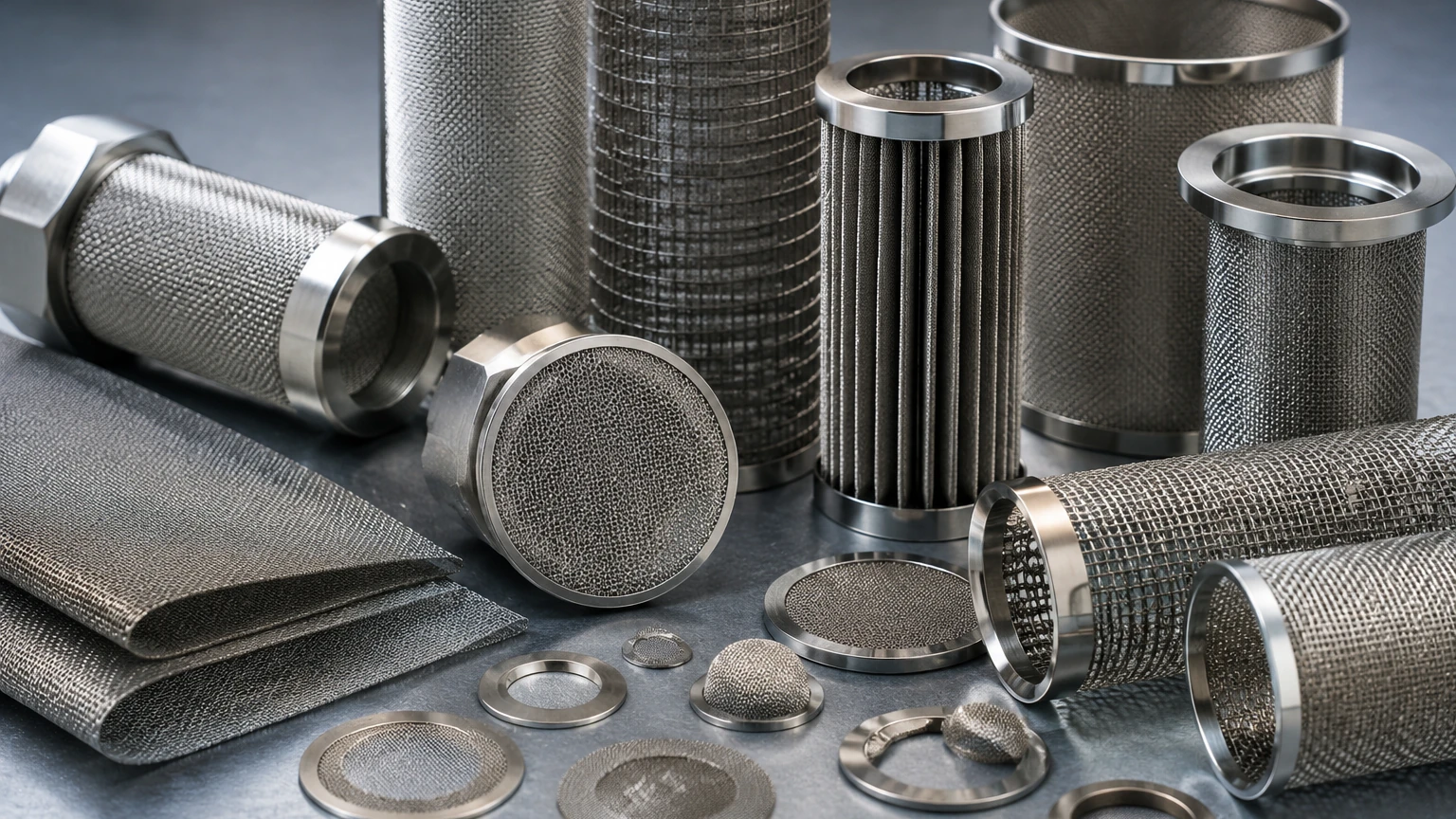
* Geometric Shaping: Precision cutting, stamping, and forming of mesh into discs, cones, cylinders, or pleated cartridges.
* Multi-Layer Configurations: Combining different mesh counts to create a graduated filtration effect, which increases dirt-holding capacity.
* Edge Treatments: Welding, framing, or resin-bonding edges to prevent fraying and ensure a bypass-free seal within the filter housing.
* Surface Finishes: Electropolishing or specialized coatings to improve cleanability and reduce protein binding in food and pharmaceutical applications.
By working closely with a manufacturer during the design phase, engineers can ensure that the filtration component is optimized for both performance and manufacturability.
Technical Selection Guide: What Engineers Must Confirm
Before finalizing a purchase order for industrial filter meshes, several technical variables must be confirmed to avoid premature failure or process inefficiency. Engineers should evaluate the following:
1. Fluid Compatibility: Does the mesh material react with the process fluid or cleaning agents? (e.g., pH levels, chloride concentration).
2. Operating Temperature: Will the mesh maintain its structural integrity at the maximum process temperature? Consider the thermal expansion coefficients if the mesh is housed in a different material.
3. Pressure Differential (ΔP): What is the maximum allowable pressure drop before the filter must be cleaned or replaced? Does the mesh have the mechanical strength to withstand a "plugged" condition without collapsing?
4. Particle Characteristics: Are the particles deformable, abrasive, or needle-like? This influences the choice between a surface filtration mesh and a depth filtration media.
5. Cleaning Protocol: Is the system designed for CIP (Clean-In-Place)? If so, the mesh must be robust enough to handle high-pressure backpulsing or chemical sterilization.
Maintenance and Total Cost of Ownership
The initial purchase price of filter meshes is only one component of the total cost of ownership (TCO). High-quality stainless steel meshes, while more expensive initially than synthetic alternatives, offer significantly lower TCO due to their durability and cleanability.
Cleaning Methods
* Backwashing: Reversing the flow to dislodge accumulated cake.
* Ultrasonic Cleaning: Using high-frequency sound waves in a solvent bath to remove fine particles trapped deep within the mesh pores.
* Chemical Cleaning: Using acids or alkalis to dissolve organic or inorganic scaling.
Proper maintenance schedules, informed by pressure drop monitoring, ensure that the filter operates within its design parameters, preventing unplanned downtime and protecting expensive downstream components like high-pressure pumps and spray nozzles.
Conclusion
Filter meshes are indispensable components in the pursuit of industrial precision and efficiency. Whether it is a simple 304 stainless steel screen for water intake or a complex multi-layer sintered cartridge for chemical synthesis, the choice of mesh dictates the success of the entire filtration process. By focusing on material integrity, precise weave patterns, and customized engineering, Kaifil helps global industries achieve reliable and cost-effective filtration performance.
For technical assistance in selecting the right mesh for your specific application, or to request a quote for custom OEM components, please visit our Main Page and connect with our engineering team.
