


Filter Strainers
In industrial fluid handling systems, the protection of sensitive downstream equipment is a primary engineering concern. Filter strainers serve as the first line of defense, capturing solid contaminants from liquid or gas streams to prevent damage to pumps, valves, meters, and heat exchangers. Unlike fine filtration systems designed to remove microscopic particles, strainers are typically used for coarser separation, yet they require precise engineering to balance filtration efficiency with system flow requirements. For professionals seeking comprehensive technical data on these components, visiting the Main Page of a specialized manufacturer provides insight into the material science and manufacturing tolerances required for high-performance industrial applications.
Selecting the correct filter strainers involves more than matching a pipe size. It requires a deep understanding of fluid dynamics, material compatibility, and the specific nature of the contaminants being managed. This guide explores the technical considerations necessary for specifying, installing, and maintaining stainless steel filtration components in demanding industrial environments.
Understanding the Role of Filter Strainers in Industrial Systems
Filter strainers are mechanical devices installed in a piping system to remove solids from flowing fluids. While the terms "filter" and "strainer" are often used interchangeably, in an industrial context, a strainer is generally defined as a device that removes larger particles (typically 40 microns and above) using a reusable metal screen or perforated element. Filters, by contrast, often utilize disposable media to remove much smaller particles.
The primary function of a strainer is to protect the mechanical integrity of the system. In chemical processing or hydraulic applications, even a small amount of debris can cause catastrophic failure in high-speed pumps or precision valves. By integrating robust filter strainers into the process line, engineers ensure that the fluid reaching critical components meets the necessary cleanliness standards without causing excessive pressure drops that could compromise system efficiency.
Nominal vs. Absolute Filtration
When evaluating filter strainers, engineers must distinguish between nominal and absolute ratings. A nominal rating indicates the ability of the mesh to retain a majority of particles of a specific size, but it does not guarantee 100% capture. An absolute rating, common in precision wire mesh filters, refers to the diameter of the largest hard spherical particle that will pass through the mesh under specified test conditions. For critical industrial applications, understanding these ratings is essential for preventing downstream contamination.
Material Engineering: Why Stainless Steel is Essential
Industrial environments often subject filtration components to extreme temperatures, high pressures, and corrosive chemicals. Consequently, the material of construction is a critical factor in the longevity and reliability of filter strainers. Stainless steel, particularly grades 304 and 316L, is the industry standard for several reasons.
Corrosion Resistance and Chemical Compatibility
Grade 304 stainless steel offers excellent resistance to a wide range of atmospheric environments and many corrosive media. However, in more aggressive environments—such as those involving chlorides or high-salinity fluids—Grade 316L is preferred. The addition of molybdenum in 316L enhances its resistance to pitting and crevice corrosion. For pharmaceutical and food and beverage applications, the non-reactive nature of stainless steel ensures that the filtration process does not introduce impurities into the product stream.
Thermal and Mechanical Stability
Unlike plastic or synthetic filter media, stainless steel filter strainers maintain their structural integrity at elevated temperatures. They can withstand thermal shock and high differential pressures without deforming. This mechanical strength is vital in hydraulic systems where pressure spikes are common, or in steam applications where temperature fluctuations can cause lesser materials to fail.
Key Design Configurations for Industrial Strainers
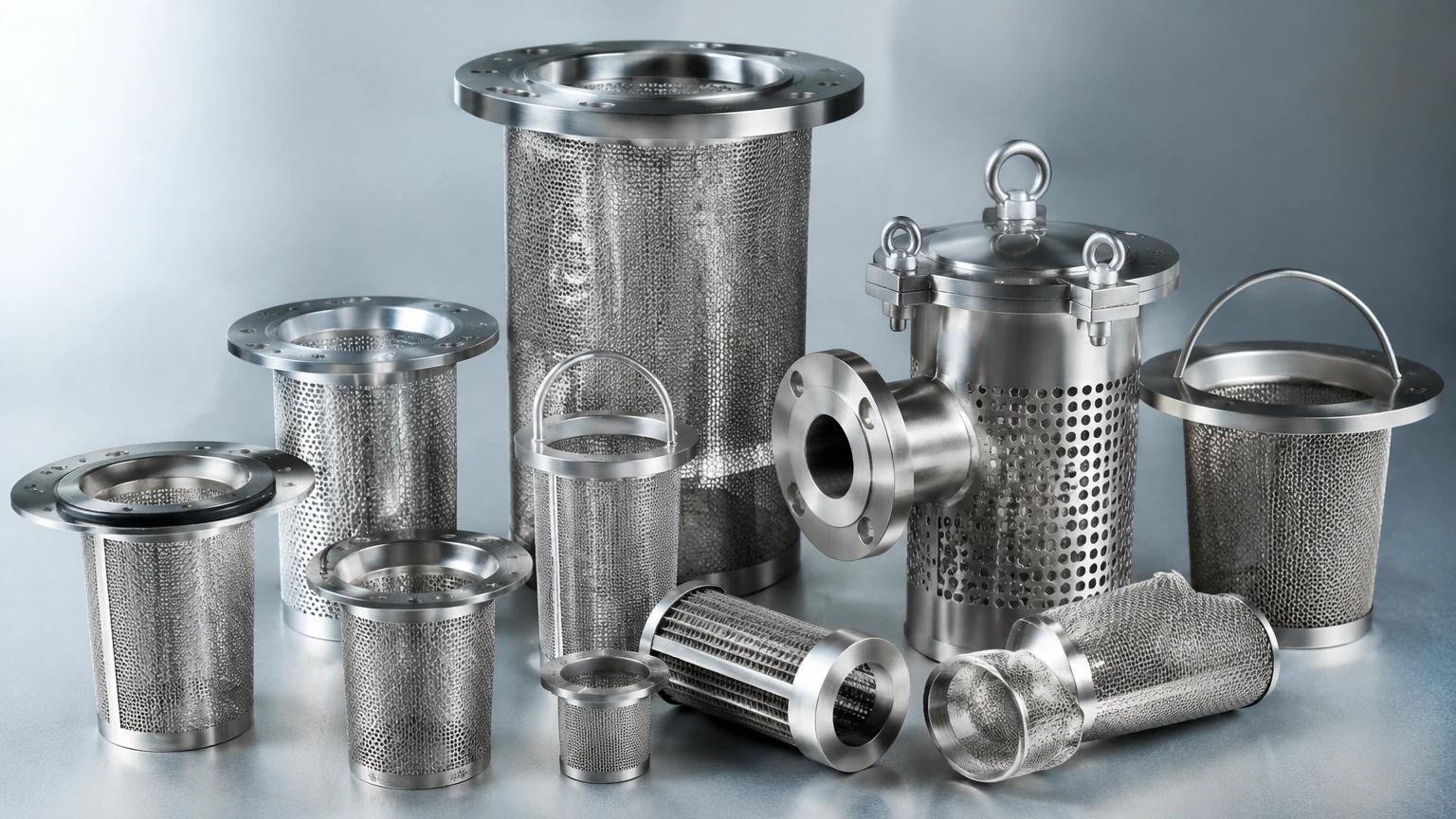
The physical configuration of a strainer dictates its ease of maintenance and its impact on the system's flow profile. There are several common designs utilized in industrial settings:
1. Y-Strainers: Named for their shape, these are typically used for pressurized lines, either liquid or gas. They have a compact design and are ideal for applications where the amount of material to be removed is relatively small. They are often used in steam or high-pressure gas lines.
2. Basket (Simplex) Strainers: These feature a basket-shaped element that can hold a larger volume of debris than a Y-strainer. They are generally used in liquid applications where the flow can be temporarily interrupted to clean the basket.
3. Duplex Strainers: For processes that cannot be shut down for maintenance, duplex strainers consist of two separate strainer baskets connected by a valve. This allows the flow to be diverted to one side while the other is being cleaned, ensuring continuous operation.
4. Custom Wire Mesh Elements: In many OEM applications, standard housings are not sufficient. Custom-engineered wire mesh filters and cartridges are designed to fit specific machinery, providing tailored filtration surface areas and flow paths.
Evaluating Performance: Flow Rate and Pressure Drop
One of the most critical engineering considerations when selecting filter strainers is the relationship between filtration accuracy and pressure drop (Delta P). Every strainer introduces some resistance to the flow. As the mesh becomes finer (smaller micron rating), the resistance increases.
Calculating the Open Area Ratio
The "Open Area Ratio" (OAR) is the ratio of the total open area of the strainer element to the internal cross-sectional area of the inlet pipe. A higher OAR generally results in a lower initial pressure drop and a longer service interval before cleaning is required. For most industrial applications, an OAR of 4:1 is considered standard, though high-viscosity fluids may require a higher ratio to maintain efficient flow.
Managing Differential Pressure
As filter strainers capture debris, the pressure drop across the element increases. Monitoring this differential pressure is the most effective way to determine when a strainer needs cleaning. If the pressure drop exceeds the design limits of the element, the mesh may collapse or "bypass," allowing contaminants to flow downstream. Engineers must specify the maximum allowable differential pressure based on the structural limits of the stainless steel mesh and the requirements of the pump system.
Maintenance and Cleaning Strategies for Longevity
One of the primary advantages of stainless steel filter strainers is their reusability. Unlike disposable cartridges, metal mesh elements can be cleaned and returned to service, significantly reducing the total cost of ownership. However, the cleaning method must be appropriate for the type of contaminant and the mesh structure.
* Mechanical Cleaning: For coarse debris, manual brushing or high-pressure water jets can be effective. Care must be taken not to damage the wire mesh or distort the pore geometry.
* Ultrasonic Cleaning: For fine mesh filters used in pharmaceutical or chemical applications, ultrasonic cleaning is often the most effective method. It uses high-frequency sound waves to create cavitation bubbles that dislodge microscopic particles from deep within the mesh weave.
* Chemical Cleaning: In cases where the contaminant is a polymer, resin, or organic buildup, chemical baths may be necessary to dissolve the material without affecting the stainless steel substrate.
Establishing a regular maintenance schedule based on differential pressure readings ensures that the filtration system operates at peak efficiency and prevents the premature wear of downstream components.
Customization and Specification for OEM Applications
Standard off-the-shelf solutions often fall short in specialized industrial equipment. Manufacturers like Kaifil specialize in providing customized filtration solutions that meet exact engineering specifications. When ordering custom filter strainers, several factors must be confirmed to ensure performance:
* Micron Rating and Mesh Count: The specific size of the particles that must be removed.
* Fluid Properties: Viscosity, temperature, and chemical composition.
* Operating Pressure: Both the normal operating pressure and the maximum potential surge pressure.
* Dimensional Constraints: The physical space available within the machinery for the filtration element.
* End Fittings: Custom flanges, threads, or specialized seals required for integration into the existing system.
By working closely with a manufacturer that understands both the metallurgy and the fluid dynamics involved, engineering teams can develop filtration components that optimize the balance between protection and performance.
Conclusion
Filter strainers are indispensable components in the industrial landscape, providing essential protection for high-value equipment across the chemical, food and beverage, and hydraulic sectors. By selecting high-quality stainless steel materials and carefully considering the flow dynamics and maintenance requirements of the application, engineers can ensure long-term system reliability. Whether utilizing standard Y-strainers or custom-engineered wire mesh cartridges, the goal remains the same: efficient, durable, and cost-effective removal of contaminants. For those ready to specify components for their next project, reviewing technical options on the Main Page is the first step toward achieving optimized filtration performance.
