


#filteredbeer
In the competitive landscape of the global beverage industry, the production of #filteredbeer represents a critical intersection of traditional craft and modern engineering. Achieving the clarity, biological stability, and shelf-life expected by consumers requires a rigorous approach to filtration. For brewery engineers and production managers, selecting the right filtration media is not merely a matter of clarity; it is a complex decision involving fluid dynamics, material science, and cost-efficiency. This guide examines the technical requirements and engineering considerations for implementing high-performance stainless steel filtration systems in the brewing process.
The Engineering Significance of Filtration in Brewing
Filtration in the context of #filteredbeer serves two primary purposes: clarification and stabilization. Clarification involves the removal of suspended solids, such as yeast cells and hop particles, to achieve a brilliant, transparent appearance. Stabilization, particularly cold stabilization, focuses on removing haze-forming proteins and polyphenols, as well as ensuring microbiological safety by eliminating spoilage organisms.
From an industrial perspective, the transition from traditional diatomaceous earth (DE) filters to stainless steel membrane and cartridge systems has been driven by the need for more sustainable, hygienic, and automated processes. Stainless steel filter elements offer superior mechanical strength and chemical resistance, allowing them to withstand the rigorous Cleaning-in-Place (CIP) cycles necessary to maintain food-grade hygiene standards. For those exploring comprehensive filtration hardware, the Main Page of specialized manufacturers provides a technical baseline for available component architectures.
Technical Requirements for #filteredbeer Production
To produce high-quality #filteredbeer, the filtration system must meet specific performance metrics tailored to the beer style and production volume. These metrics include:
1. Micron Ratings and Filtration Efficiency
Filtration is typically divided into stages: primary (coarse), secondary (fine), and final (sterile).
- Primary Filtration: Usually targets particles in the 5 to 20-micron range. This stage removes the bulk of yeast and larger aggregates.
- Secondary Filtration: Targets 1 to 5 microns to achieve high clarity.
- Final Filtration: For non-pasteurized #filteredbeer, a sterile grade filter (typically 0.45 to 0.65 microns) is required to remove bacteria and residual yeast, ensuring biological stability.
2. Flow Rate and Differential Pressure
Engineers must balance the flow rate (flux) with the differential pressure (ΔP). As the filter cake builds up or the mesh pores become partially occluded, ΔP increases. High-quality stainless steel wire mesh filters are designed to maintain structural integrity under high pressure, preventing "bypass"—where unfiltered liquid escapes through deformed media.
3. Thermal and Chemical Resistance
Brewery filtration components are subjected to extreme temperatures during Steam-in-Place (SIP) sterilization and aggressive caustic or acidic solutions during CIP. 316L stainless steel is the industry standard due to its resistance to pitting and stress corrosion cracking in the presence of chlorides and cleaning agents.
Types of Stainless Steel Filters for Breweries
When designing a system for #filteredbeer, several types of metal filtration media are commonly utilized, each offering distinct advantages based on the stage of production.
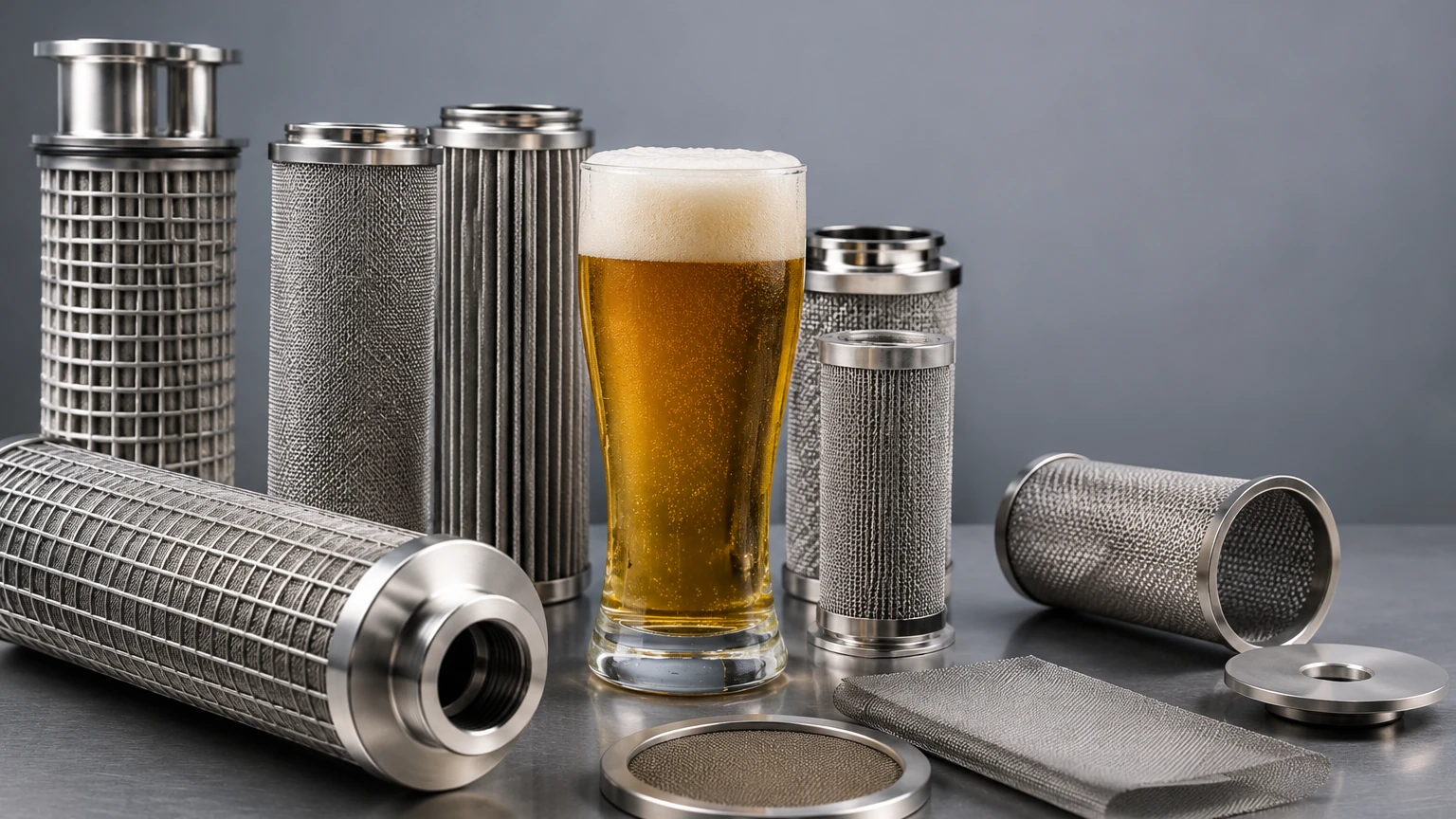
Sintered Metal Filter Cartridges
Sintered metal filters are created by fusing metal powders or fibers under high heat and pressure. This creates a porous, rigid structure with high depth-filtration capabilities. They are ideal for high-pressure applications where fine particulate removal is required. Their robust nature allows for frequent backwashing, extending the service life of the filter element significantly compared to polymer alternatives.
Stainless Steel Wire Mesh Filters
Wire mesh filters, often used in multi-layer configurations, provide precise surface filtration. The geometry of the weave (such as plain, twilled, or Dutch weave) determines the filtration accuracy. In the production of #filteredbeer, pleated wire mesh cartridges are frequently used to maximize the surface area within a compact housing, allowing for higher flow rates and lower initial pressure drops.
Wedge Wire Screens
Commonly found in the lauter tun or as trap filters after DE systems, wedge wire provides a non-clogging surface. The V-shaped profile of the wire ensures that only two-point contact is made with particles, making it exceptionally easy to clean via backflushing.
Engineering Considerations for Filter Selection
Selecting a filter for #filteredbeer requires a deep dive into the specific variables of the brewery's operation. Engineers should evaluate the following criteria before procurement:
Material Compatibility and Surface Finish
In the food and beverage sector, the surface finish of filtration components is as important as the material itself. Electropolished surfaces reduce the risk of microbial attachment and biofilm formation. When reviewing options on a manufacturer's Main Page, it is essential to confirm that the components meet FDA or equivalent food-safety standards.
Total Cost of Ownership (TCO)
While stainless steel filter elements have a higher initial capital expenditure (CAPEX) than disposable depth filters, their TCO is often lower. This is due to their durability and cleanability. A high-quality stainless steel cartridge can last for years if maintained correctly, whereas disposable filters represent a recurring operational expense (OPEX) and contribute to waste streams.
Scalability and Integration
For growing breweries, the filtration system must be scalable. Modular housing designs allow for the addition of more cartridges as production volume increases. Furthermore, the compatibility of the filter housings with existing piping (DIN, SMS, or Tri-clamp fittings) must be verified to ensure seamless integration into the production line.
Common Risks and Mitigation in Beer Filtration
Producing #filteredbeer is not without technical challenges. Understanding these risks allows engineers to implement preventative measures.
* Oxygen Pickup: Any point in the filtration train where the beer is exposed to air can lead to oxidation, which ruins the flavor profile. Systems must be fully enclosed and purged with CO2 or nitrogen before use.
* Shear Stress: Excessive pump speeds or restrictive filter media can cause shear stress on the beer, potentially affecting head retention by breaking down proteins. Proper sizing of the filter area is critical to maintain low-velocity flow.
- Blinding and Fouling: This occurs when proteins and beta-glucans coat the filter media. This can be mitigated by proper enzymatic treatment in the brewhouse and selecting the appropriate mesh pore geometry that facilitates effective CIP.
Custom OEM Solutions for Specialized Requirements
Every brewery has unique constraints, from floor space to specific water chemistry. Standard off-the-shelf filters may not always provide the optimal balance of flux and clarity. Custom OEM filtration solutions allow for the development of bespoke filter elements that match the exact dimensions of existing housings or address specific particulate challenges unique to a particular recipe.
Customization options often include:
* Variable Mesh Layers: Combining different mesh counts to create a graduated density filter.
* Custom End-Cap Configurations: Ensuring compatibility with proprietary housing designs.
* Reinforced Cores: For applications involving high-viscosity liquids or extreme pressure surges.
By working closely with a manufacturer that understands the nuances of industrial filtration, brewing teams can optimize their #filteredbeer production for both quality and throughput. For detailed specifications on customized metal filter components, visiting the manufacturer's Main Page is the recommended first step for technical consultation.
Conclusion: Making Informed Purchasing Decisions
The path to a perfect #filteredbeer is paved with precise engineering decisions. By prioritizing high-grade materials like 316L stainless steel, understanding the relationship between micron ratings and flow dynamics, and considering the long-term TCO, breweries can ensure a consistent, high-quality product.
Before finalizing a filtration strategy, engineers should confirm the following with their suppliers:
1. Validation Data: Request technical data sheets that confirm absolute vs. nominal ratings.
2. Cleaning Protocols: Ensure the filter media is compatible with the brewery's specific CIP chemicals and temperatures.
3. Lead Times and Support: Confirm the availability of replacement elements and technical support for system optimization.
Investing in robust, cleanable, and precisely engineered filtration components is a foundational requirement for any modern brewery aiming to deliver the clarity and stability that defines professional-grade #filteredbeer.
