


Filtering Flask Chemistry
In the realm of analytical and synthetic chemistry, the filtering flask—often referred to as a Büchner flask or vacuum flask—serves as a fundamental tool for liquid-solid separation. While the basic principles of filtering flask chemistry are taught in introductory laboratories, the engineering requirements for industrial-scale filtration are significantly more complex. Understanding the transition from laboratory-scale glass apparatus to high-performance industrial filtration systems is essential for engineers and purchasing teams focused on chemical processing, pharmaceuticals, and food production.
At its core, filtering flask chemistry relies on the creation of a pressure differential to accelerate the movement of a liquid through a porous medium. This process, known as vacuum filtration, is preferred over gravity filtration when speed is critical or when the solid residue needs to be thoroughly dried. As processes scale from the benchtop to the production line, the materials and structural designs must evolve to handle higher pressures, corrosive chemicals, and rigorous cleaning protocols.
Fundamentals of Vacuum Filtration in Chemistry
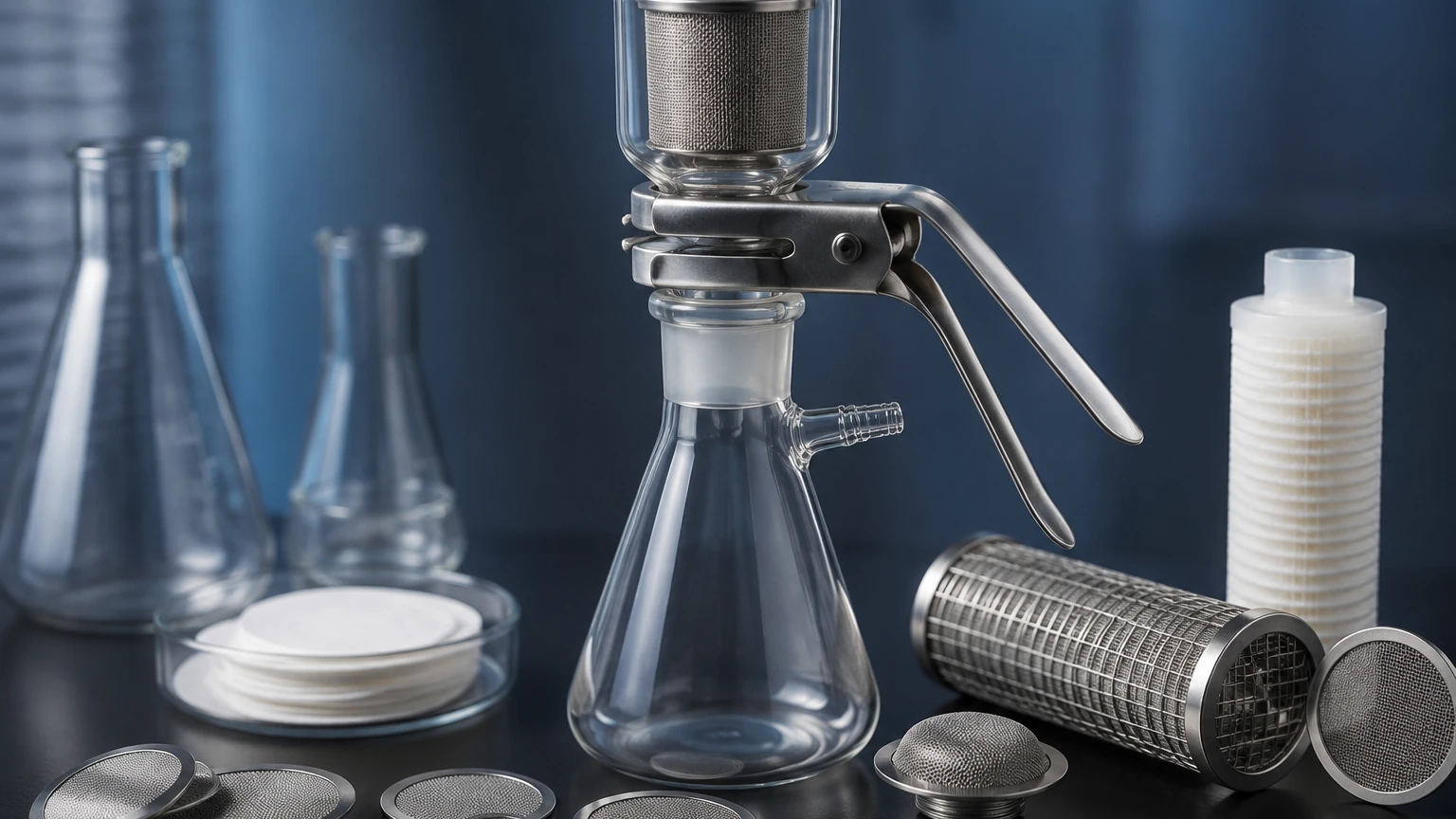
The standard filtering flask is characterized by its heavy-walled construction and a side-arm (nipple) designed to connect to a vacuum source, such as a water aspirator or a vacuum pump. In a typical setup, a Büchner funnel is seated atop the flask using a rubber bung or adapter. The vacuum reduces the pressure inside the flask, creating a suction effect that pulls the filtrate through the filter paper or mesh.
From a technical perspective, the efficiency of this process is governed by several variables:
1. Pressure Differential (ΔP): The difference between atmospheric pressure and the pressure inside the flask. A higher vacuum increases the flow rate but also increases the mechanical stress on the filter medium and the vessel.
2. Filter Media Resistance: The physical barrier provided by the filter paper, wire mesh, or sintered metal. The pore size must be small enough to retain the target solids while allowing the liquid to pass with minimal resistance.
3. Cake Resistance: As solids accumulate on the filter surface, they form a "filter cake" that adds further resistance to the flow. Managing this cake is a primary concern in industrial filtering flask chemistry.
Material Compatibility and Engineering Considerations
In laboratory settings, filtering flasks are almost exclusively made from borosilicate glass due to its transparency and thermal shock resistance. However, when applying filtering flask chemistry principles to industrial environments, material selection becomes a critical engineering decision.
Chemical Resistance
Industrial fluids often contain aggressive solvents, high-concentration acids, or strong bases that can etch or weaken glass over time. In these scenarios, stainless steel (specifically 304 or 316L grades) is the industry standard. Stainless steel offers superior resistance to a wide range of chemicals and does not risk the catastrophic shattering associated with glass under high vacuum or thermal stress.
Temperature and Pressure Limits
Vacuum filtration often occurs at elevated temperatures to reduce the viscosity of the liquid and improve flow rates. While borosilicate glass has a high melting point, its structural integrity under vacuum decreases as temperatures rise. Stainless steel filtration components, such as those manufactured by Kaifil, are designed to maintain their mechanical properties across a much broader temperature range, ensuring safety and consistency in demanding applications.
From Laboratory Flasks to Industrial Scale Filtration
While the term "filtering flask chemistry" originates in the lab, the industrial equivalent involves pressure vessels and specialized filter housings. When a process moves from a 1-liter glass flask to a 1,000-liter production run, the "flask" effectively becomes a stainless steel housing containing high-surface-area filter cartridges.
Kaifil specializes in this transition, providing custom stainless steel filtration solutions that mirror the functionality of the filtering flask but with industrial-grade durability. Instead of simple filter paper, these systems utilize multi-layered wire mesh or sintered metal components. These materials provide precise filtration accuracy and can be cleaned and reused, significantly reducing the total cost of ownership compared to disposable lab media.
For those looking to scale their operations or replace fragile glass setups with robust metal alternatives, visiting the Main Page provides a comprehensive overview of available technologies and customization options.
Key Components of an Industrial Filtration System
To achieve the precision required in modern chemical processing, the components of the filtration system must be engineered with tight tolerances. In an industrial setup, the "filtering flask" concept is expanded into several integrated parts:
1. Sintered Wire Mesh Filters
Unlike the single-use paper used in lab flasks, industrial systems often employ sintered wire mesh. This material consists of multiple layers of stainless steel wire cloth bonded together through a heat-treatment process. This results in a filter medium that is mechanically strong, highly permeable, and capable of maintaining its pore structure even under high differential pressure.
2. Filter Cartridges and Elements
In industrial filtering flask chemistry, the filter element is typically a cylindrical cartridge. This design maximizes the filtration surface area within a compact footprint. Engineers must select the appropriate cartridge length and diameter to match the flow requirements of their specific process.
3. Seals and Gaskets
Vacuum integrity is paramount. While a lab flask uses a rubber stopper, industrial housings use high-performance elastomers like Viton, EPDM, or PTFE. These materials must be compatible with the process chemistry to prevent leaks that would compromise the vacuum and the purity of the filtrate.
Performance Evaluation and Selection Criteria
When purchasing filtration components for chemical applications, engineers should evaluate products based on objective performance metrics rather than generic marketing claims. The following criteria are essential for optimizing filtering flask chemistry at scale:
* Filtration Rating (Micron Level): Determine whether the application requires absolute or nominal filtration. Absolute filtration ensures that 99.9% of particles above a certain size are captured, which is critical for pharmaceutical and high-purity chemical production.
* Flow Rate vs. Pressure Drop: A high-quality filter should allow for the required flow rate with a minimal initial pressure drop. A steep pressure drop indicates high resistance, which increases energy consumption and reduces the lifespan of the vacuum pump.
* Structural Integrity: The filter element must withstand the maximum possible differential pressure of the system without collapsing or bypassing. This is particularly important in vacuum systems where the external pressure can be significant.
* Cleanability: For many industrial processes, the ability to perform Clean-in-Place (CIP) or Steam-in-Place (SIP) is a requirement. Stainless steel components are ideal for these protocols, as they can withstand high-pressure washdowns and sterilization temperatures.
Common Risks in Vacuum Filtration
Implementing filtering flask chemistry—whether in the lab or the factory—comes with inherent risks that must be managed through proper engineering and operational procedures.
1. Implosion: The most significant risk in vacuum filtration is the failure of the vessel. In glass systems, even a small scratch can lead to an implosion under vacuum. Transitioning to stainless steel housings virtually eliminates this risk, providing a much safer environment for operators.
2. Foaming: Certain chemical reactions or surfactants can cause the filtrate to foam when subjected to a vacuum. If foam enters the vacuum line, it can damage the pump. This is managed by using larger "knock-out" pots or specialized baffle designs within the filtration housing.
3. Media Migration: In inferior filter products, fibers or metal fragments may break off and contaminate the filtrate. High-quality sintered mesh and precision-welded components from reputable manufacturers like Kaifil are designed to prevent media migration, ensuring the purity of the final product.
Maintenance and Operational Longevity
The total cost of a filtration system is not just the purchase price but the ongoing maintenance and replacement costs. In industrial filtering flask chemistry, the goal is to maximize the time between filter changes (on-stream time).
Regular monitoring of the differential pressure is the most effective way to determine when a filter needs cleaning or replacement. As the filter cake builds up, the pressure drop will increase. In many stainless steel systems, the filter elements can be backwashed or ultrasonically cleaned to restore their original flow characteristics. This sustainability is a major advantage over disposable glass and paper setups.
Conclusion: Optimizing Your Filtration Workflow
Whether you are conducting small-scale filtering flask chemistry in a research lab or managing a large-scale chemical manufacturing plant, the principles of vacuum-assisted separation remain the same. The key to success lies in selecting the right materials, understanding the mechanical limits of your equipment, and choosing components that offer both precision and durability.
For engineers and procurement professionals, the move toward customized stainless steel filtration solutions represents a significant upgrade in process reliability and safety. By focusing on technical specifications such as micron ratings, material grades, and structural integrity, organizations can achieve more efficient separations and higher product quality. To explore how custom metal filter components can be integrated into your specific chemical or industrial process, visit the Main Page for detailed technical resources and application support.
