


Filtri a Cestello
In industrial fluid handling and processing, the protection of downstream equipment is a primary engineering concern. Filtri a cestello, commonly known as basket filters or basket strainers, serve as a critical line of defense. These components are designed to remove solid contaminants from liquids or gases, ensuring that pumps, valves, heat exchangers, and nozzles remain free from debris that could cause mechanical failure or process contamination.
For engineers and procurement professionals, selecting the right filtration solution involves more than just matching a pipe size. It requires a deep understanding of material compatibility, flow dynamics, and the specific mechanical stresses of the application. As a specialized manufacturer, Kaifil provides high-performance stainless steel filtration components that address these technical requirements through precision engineering and custom manufacturing.
The Engineering Principles of Basket Filtration
At its core, a basket filter is a closed vessel with a removable screen or basket that collects particles as fluid passes through it. Unlike Y-strainers, which are typically used for smaller amounts of debris, filtri a cestello are designed for systems where a high volume of solids is expected or where the filter requires frequent cleaning.
Structural Components
The performance of a basket filter depends on the integrity of its internal components. A standard industrial basket typically consists of two main parts:
1. The Support Cylinder (Perforated Plate): This provides the structural skeleton. It is usually made from a perforated stainless steel sheet, designed to withstand the differential pressure (ΔP) generated as the filter accumulates debris.
2. The Filter Media (Wire Mesh): For finer filtration requirements, a layer of stainless steel wire mesh is sintered or welded to the inside or outside of the perforated support. The mesh count determines the filtration accuracy, measured in microns.
When evaluating a Main Page for filtration solutions, engineers must consider the "open area ratio." This is the ratio between the total area of the holes in the basket and the cross-sectional area of the inlet pipe. A higher ratio typically results in a lower initial pressure drop and longer intervals between cleaning cycles.
Material Selection: SS304 vs. SS316L
Material science is the foundation of reliable filtration. In industrial environments, stainless steel is the preferred material due to its mechanical strength and resistance to corrosion.
* Stainless Steel 304: Suitable for general industrial applications, water treatment, and non-corrosive chemical processes. It offers excellent durability and cost-effectiveness.
* Stainless Steel 316L: Specified for more demanding environments, such as pharmaceutical production, food and beverage processing, and highly acidic chemical lines. The addition of molybdenum and a lower carbon content (in the 'L' grade) provides superior resistance to pitting and chloride-induced corrosion.
In specialized applications, such as those involving seawater or high-temperature steam, other alloys may be required. However, for the majority of B2B industrial needs, precision-welded SS316L components provide the most reliable service life.
Technical Criteria for Specifying Filtri a Cestello
Specifying a basket filter requires a quantitative approach to ensure the component does not become a bottleneck in the system. Key parameters include:
1. Flow Rate and Viscosity
The velocity of the fluid impacts the efficiency of the filter. High-viscosity fluids (such as oils, resins, or syrups) require larger surface areas and coarser mesh to maintain an acceptable flow rate without exceeding the collapse pressure of the basket.
2. Filtration Rating (Micron Size)
Engineers must define the particle size that needs to be captured. A common mistake is over-specifying (choosing a mesh that is too fine). While a finer mesh captures more particles, it also increases the frequency of maintenance and the risk of rapid pressure spikes. The goal is to select a micron rating that protects downstream equipment without unnecessarily restricting flow.
3. Differential Pressure (ΔP)
This is the difference in pressure between the inlet and the outlet of the filter. A clean basket should have a minimal ΔP. As the basket fills with contaminants, the ΔP increases. Industrial systems should be equipped with differential pressure gauges to alert operators when the basket reaches its "dirty" threshold—typically between 5 to 10 psi (0.35 to 0.7 bar), depending on the system design.
Customization and OEM Capabilities
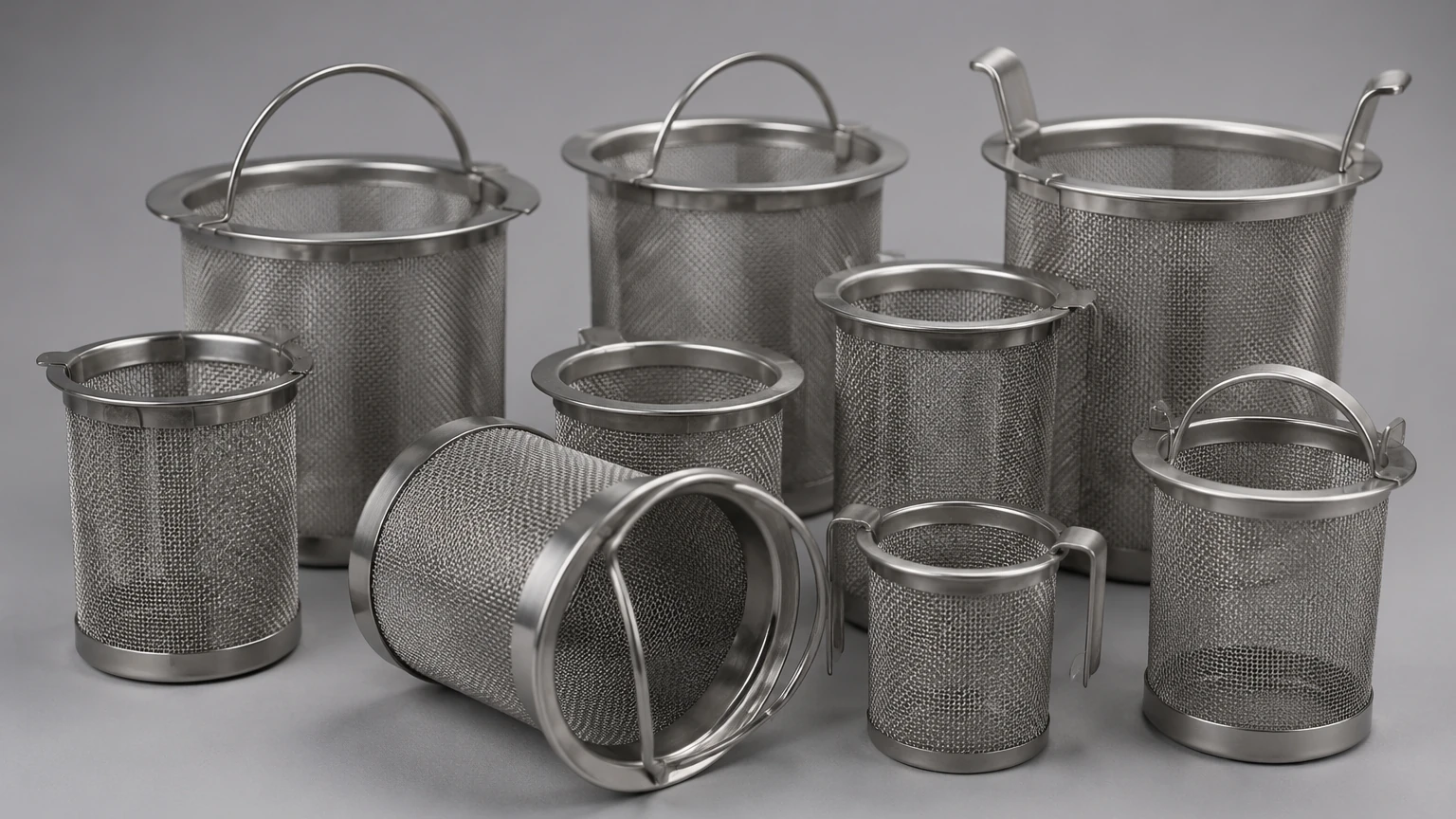
Off-the-shelf filtration components rarely meet the exact needs of complex industrial machinery. Customization is often necessary to integrate the filter into existing footprints or to handle unique process conditions. Kaifil specializes in providing OEM solutions where the filtri a cestello are tailored to specific dimensions, handle configurations, and sealing methods.
Customization options often include:
* Reinforced Structures: Adding longitudinal ribs or heavy-duty rings to the basket to prevent deformation under high-pressure surges.
* Handle Designs: Incorporating bail handles, rod handles, or slanted tops to facilitate easy removal and ergonomic handling during maintenance.
* Specialized Sealing: Integrating O-ring grooves or machined flanges to ensure a bypass-free seal within the housing.
* Multi-Layer Sintering: Combining multiple layers of mesh to increase depth filtration capabilities and structural rigidity.
Maintenance and Operational Longevity
The total cost of ownership (TCO) for a filtration system is heavily influenced by maintenance requirements. Filtri a cestello are favored in many industries because they allow for top-access cleaning. When the housing is opened, the basket can be lifted out, cleaned, and replaced without disturbing the piping.
Cleaning Procedures
In most industrial settings, stainless steel baskets are cleaned using high-pressure water jets, ultrasonic baths, or chemical cleaning agents. The durability of the welds is paramount here; low-quality spot welding can fail during high-pressure cleaning, leading to mesh detachment and potential downstream damage.
Replacement Cycles
While stainless steel filters are designed for long-term use, they are not infinite. Fatigue from pressure cycling and erosion from abrasive particles will eventually necessitate replacement. Engineers should inspect baskets for:
* Mesh blinding (permanent clogging that cannot be cleaned).
* Deformation of the perforated support.
* Corrosion at the weld points.
Applications Across Industrial Sectors
The versatility of filtri a cestello makes them indispensable across various sectors:
* Chemical Processing: Protecting flow meters and sensitive instrumentation from undissolved solids or catalysts.
* Food and Beverage: Ensuring product purity by removing larger particles in dairy, juice, and brewing processes. This often requires sanitary-grade finishes and 316L materials.
* Water Treatment: Acting as a pre-filter for reverse osmosis (RO) membranes or UV sterilization systems to remove sand and scale.
* Hydraulic Systems: Filtering return lines to protect reservoirs and pumps from metallic wear particles.
Selecting a Manufacturing Partner
When sourcing filtri a cestello, the choice of manufacturer impacts the reliability of the entire process line. A professional manufacturer like Kaifil brings technical expertise to the table, moving beyond simple fabrication to provide engineering support. This includes advising on the best mesh-to-perforation ratio and ensuring that all components meet the rigorous standards required for industrial durability.
Before finalizing a purchase, technical teams should confirm:
1. Material Certification: Verification that the stainless steel grade matches the specification.
2. Welding Quality: Ensuring that TIG or plasma welding is used for clean, strong joints that won't harbor bacteria or fail under stress.
3. Dimensional Accuracy: Confirming that the basket will fit the existing housing with a proper seal to prevent fluid bypass.
For those seeking reliable, custom-engineered filtration components, reviewing technical capabilities and product options is the first step toward optimizing system performance. Detailed information on custom mesh and filter configurations can be found on the Main Page of our technical resource center.
By focusing on precision manufacturing and application-specific designs, industrial operations can significantly reduce downtime and protect their most valuable mechanical assets. Whether for a new installation or a replacement for an existing system, high-quality filtri a cestello are a fundamental investment in process integrity.
