


Foam Air Filter Material
In the landscape of industrial filtration, selecting the appropriate media requires a deep understanding of fluid dynamics, particle retention requirements, and environmental constraints. Foam air filter material, specifically reticulated polyurethane foam, serves as a critical component in diverse applications ranging from HVAC systems and small engine intakes to sophisticated medical devices and industrial compressors. While metal-based solutions like those found on the Main Page of specialized manufacturers offer extreme durability, foam provides a unique set of characteristics suitable for high-airflow, low-pressure-drop scenarios.
This guide examines the technical specifications, engineering considerations, and performance metrics of foam air filter material to assist engineers and procurement teams in making informed selection decisions.
Understanding the Structure of Reticulated Foam
Foam air filter material is primarily characterized by its "reticulated" structure. Unlike standard sponge foam, which may have closed or partially closed cells, reticulated foam undergoes a manufacturing process—often thermal or chemical—that removes the cell membranes (windows), leaving only the skeletal strands (struts). This creates a three-dimensional, open-cell dodecahedron structure.
Pores Per Inch (PPI)
The primary metric for defining foam air filter material is Pores Per Inch (PPI). This measurement dictates both the filtration efficiency and the resistance to airflow. Common industrial grades include:
* 10 to 30 PPI: Coarse filtration used for large particle capture or as a pre-filter to protect more sensitive secondary stages. These grades offer minimal resistance and high dust-holding capacity.
* 45 to 60 PPI: Medium-grade filtration often found in power equipment and industrial machinery where a balance between airflow and protection is required.
* 80 to 100+ PPI: Fine filtration used in applications requiring high efficiency for smaller particulates, though these grades necessitate more frequent maintenance due to faster loading.
For engineers, the choice of PPI is a trade-off between the "tortuosity" of the path (the complexity of the route air must take through the foam) and the allowable pressure drop across the filter element.
Chemical and Thermal Properties of Filter Media
Not all foam air filter materials are chemically identical. The two most common polymers used are polyester and polyether. Selecting the wrong base material can lead to premature structural failure in specific industrial environments.
Polyester-Based Foam
Most standard foam air filter material is polyester-based. It offers superior resistance to hydrocarbons, making it the preferred choice for applications involving oils, fuels, and many industrial solvents. However, polyester foam is susceptible to hydrolysis—a process where the material degrades when exposed to high humidity and high temperatures over extended periods.
Polyether-Based Foam
Polyether foams are engineered for environments where moisture and heat are prevalent. They exhibit excellent resistance to microbial growth and do not break down in water-rich environments. While they are more resilient in humid conditions, they generally offer lower resistance to oils and fuels compared to polyester variants.
Thermal Limits
Typically, polyurethane foam air filter material can operate in temperatures ranging from -40°C to 120°C (-40°F to 250°F). Beyond these limits, the polymer struts may soften, leading to cell collapse and a total loss of filtration function. In high-heat industrial processes, engineers often transition from foam to stainless steel wire mesh or sintered metal media to ensure structural integrity.
Performance Metrics: Efficiency and Pressure Drop
In B2B procurement and engineering design, the performance of a foam air filter material is evaluated through its initial pressure drop and its fractional efficiency.
Initial Pressure Drop
Pressure drop (ΔP) is the resistance offered by the filter to the air flowing through it. Because reticulated foam has a high void volume (often exceeding 95%), the initial pressure drop is significantly lower than that of paper or felt media. This allows for higher face velocities without taxing the fan or motor driving the system.
Dust Holding Capacity (DHC)
One of the primary advantages of foam is its depth-loading capability. Unlike surface-loading media (like certain membranes or fine meshes), foam captures particles throughout its entire thickness. This results in a high Dust Holding Capacity (DHC), meaning the filter can accumulate a significant mass of contaminants before reaching its terminal pressure drop. This characteristic is vital for reducing the frequency of maintenance cycles in dusty industrial environments.
Engineering Considerations for Custom Integration
When integrating foam air filter material into a custom OEM product, several design factors must be addressed to ensure the component performs as intended throughout its service life.
Compression and Sealing
Foam is inherently compressible, which can be leveraged to create an airtight seal within a housing without the need for additional gaskets. However, over-compression can distort the cell structure, effectively increasing the PPI in the compressed zone and causing localized high-pressure spots. Engineers should typically aim for a 10% to 15% compression set for sealing purposes.
Bonding and Lamination
Foam can be bonded to other materials, such as expanded metal for structural support or different PPI layers to create a gradient-density filter. Lamination using flame-bonding or pressure-sensitive adhesives (PSA) allows the filter to be easily installed into equipment frames. When selecting adhesives, it is critical to confirm that the outgassing properties do not interfere with the application, particularly in sensitive electronics or medical environments.
Face Velocity Calculations
To prevent "blow-through," where particles are forced through the media by high-velocity air, engineers must calculate the appropriate face velocity. For most reticulated foam applications, maintaining a face velocity between 250 and 500 feet per minute (fpm) ensures optimal capture efficiency while preventing particle migration.
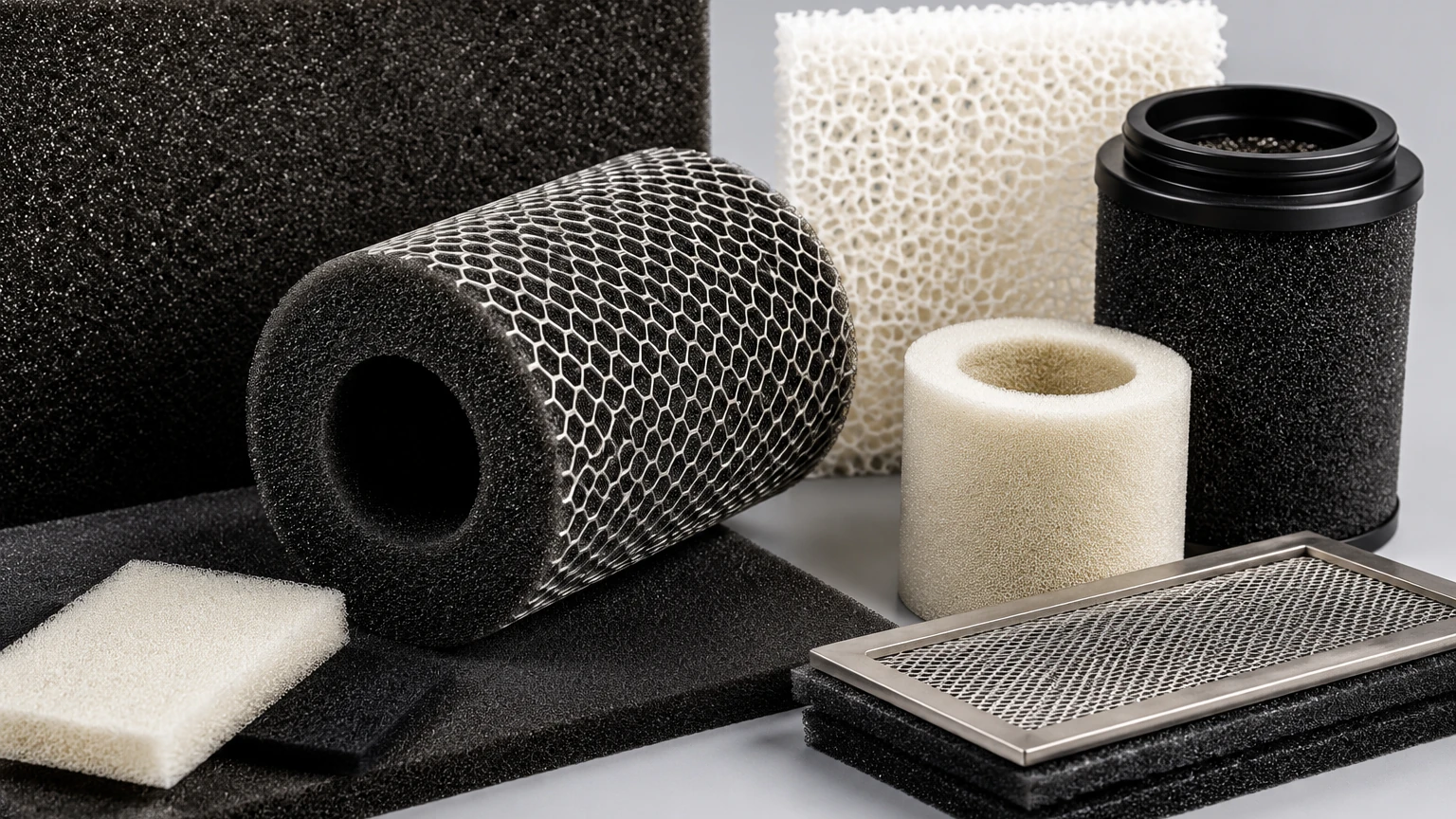
Comparing Foam and Stainless Steel Filtration Media
While foam air filter material is highly effective for many B2B applications, it is often compared against stainless steel wire mesh, particularly in demanding industrial sectors. Understanding the boundaries of each material is essential for technical teams.
| Feature | Reticulated Foam | Stainless Steel Mesh |
| :— | :— | :— |
| Durability | Moderate; susceptible to UV and heat | High; resistant to mechanical stress |
| Cleanability | Washable (limited cycles) | Fully regenerable (ultrasonic/backwash) |
| Temperature | Up to 120°C | Up to 800°C+ (depending on alloy) |
| Precision | Nominal (range-based) | Absolute (precise micron ratings) |
| Cost | Low initial cost | Higher initial investment |
For applications requiring absolute precision or operation in corrosive chemical environments, stainless steel components—such as those detailed on the Main Page—are often the standard. However, foam remains the superior choice for lightweight, cost-effective pre-filtration where high-volume airflow is the priority.
Maintenance, Replacement, and Total Cost of Ownership
From a purchasing perspective, the total cost of ownership (TCO) for foam air filter material includes not just the unit price, but the labor and downtime associated with maintenance.
Cleaning Protocols
Many industrial foam filters are designed to be reusable. They can be cleaned using compressed air, vacuuming, or washing with water and mild detergents. However, it is important to note that each cleaning cycle slightly degrades the polymer struts. After multiple washes, the foam may begin to "friable" (crumble), at which point it must be replaced to prevent foam particles from entering the downstream airflow.
Replacement Indicators
Engineers should specify replacement based on a predetermined pressure drop threshold. Utilizing differential pressure sensors is the most reliable method to signal when a foam filter has reached its terminal load. Relying solely on visual inspection is often misleading, as the depth-loading nature of foam means the interior can be saturated while the surface appears relatively clean.
Environmental Impact
Unlike metal filters, which are 100% recyclable, polyurethane foam is a petroleum-based product that typically ends up in landfills. For organizations with strict ESG (Environmental, Social, and Governance) targets, transitioning to permanent metal filtration solutions can reduce the long-term waste stream, despite the higher upfront cost.
Technical Confirmation Before Procurement
Before finalizing a specification for foam air filter material, technical professionals should confirm the following data points with their supplier:
1. PPI Verification: Ensure the PPI is measured according to industry standards (e.g., NIST traceable standards) to maintain consistency across batches.
2. UL 94 Flammability Rating: Many industrial applications require foam to meet specific flame retardancy standards, such as UL 94 HF-1.
3. Hydrolysis Resistance: For outdoor or high-humidity applications, confirm if the material is polyether-based to prevent premature crumbling.
4. Dimensional Tolerances: Foam is flexible; however, for automated assembly, tight tolerances on thickness and die-cut dimensions are necessary to prevent assembly line jams.
By carefully evaluating these factors, engineers can ensure that the selected foam air filter material provides the necessary protection for their equipment while optimizing airflow and minimizing maintenance costs. For more complex filtration challenges involving high pressures or extreme temperatures, exploring advanced metal-based alternatives remains a prudent step in the design process.
