


Frilter
In the landscape of industrial manufacturing, the term "frilter" represents a critical component in maintaining process purity, protecting downstream equipment, and ensuring the consistency of the final product. Industrial filtration is not merely a utility but a precise engineering discipline that balances flow dynamics, material science, and mechanical structural integrity. For engineers and procurement specialists, selecting the correct stainless steel filtration solution requires a deep understanding of how specific media interact with various fluids under high-pressure and high-temperature conditions.
As a specialized manufacturer, Kaifil provides high-performance stainless steel filter cartridges, wire mesh filters, and precision metal components designed for the most demanding applications. This guide examines the technical parameters, selection criteria, and operational considerations necessary for optimizing industrial filtration systems.
Technical Fundamentals of Stainless Steel Filtration
Stainless steel is the preferred material for industrial filtration due to its inherent resistance to corrosion, thermal stability, and mechanical strength. Unlike polymer-based filters, stainless steel components can withstand extreme pressure differentials and are cleanable, offering a significantly longer service life in harsh environments.
Material Selection and Alloy Properties
The choice of alloy is the first step in engineering a reliable frilter. The chemical composition of the fluid determines the necessary grade of stainless steel:
* Grade 304/304L: The standard choice for general industrial applications, providing good corrosion resistance and excellent formability. It is widely used in food and beverage processing where high-acid environments are not present.
* Grade 316/316L: Contains molybdenum, which enhances resistance to chlorides and pitting. This is the industry standard for pharmaceutical and chemical processing where sterilization and chemical compatibility are paramount.
* 904L and Hastelloy: For highly aggressive chemical environments involving sulfuric or phosphoric acids, specialty alloys are utilized to prevent premature failure of the filter mesh.
Filtration Media Structures
Industrial filters utilize different media structures depending on the required micron rating and the nature of the contaminants:
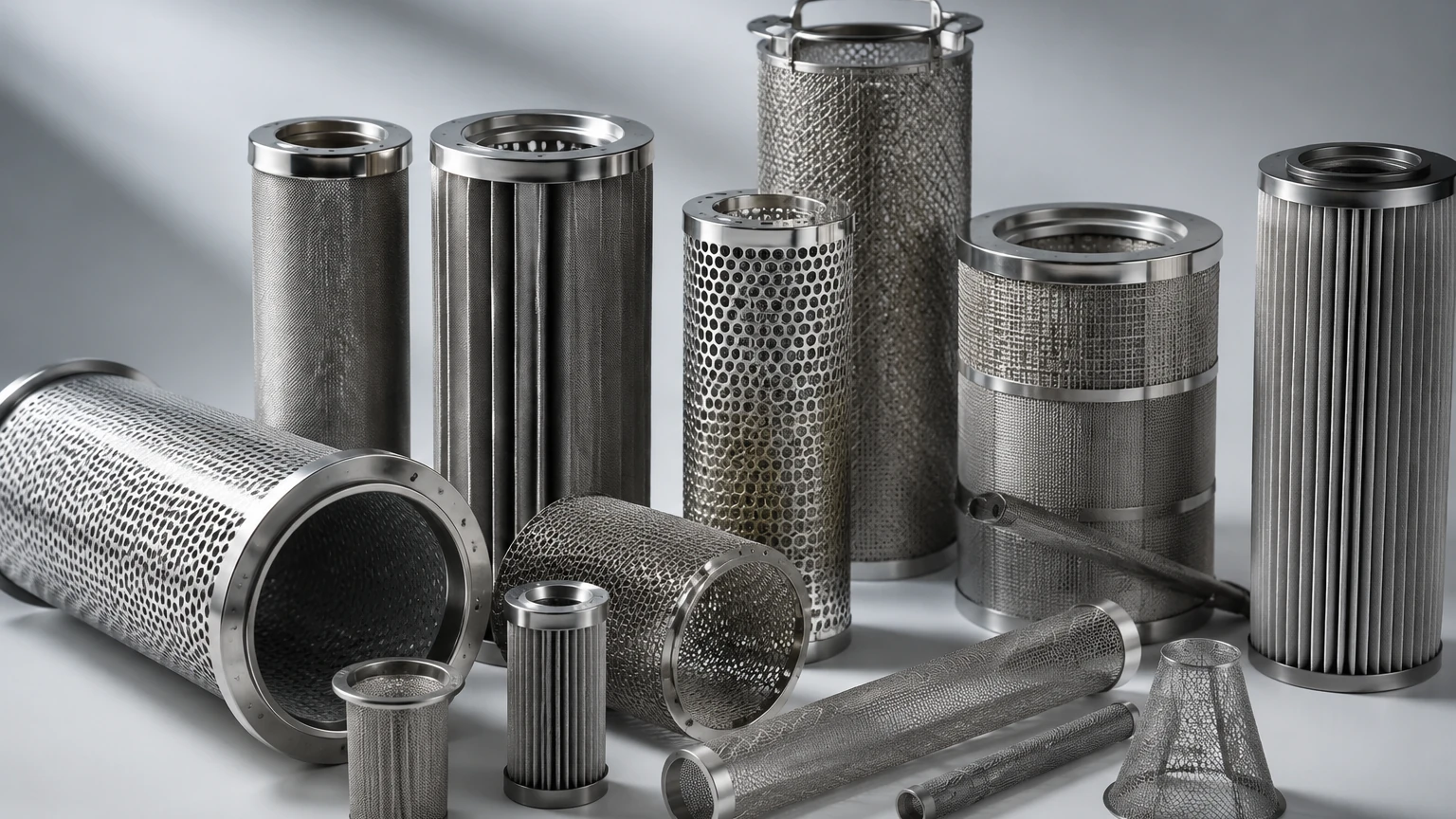
1. Woven Wire Mesh: Available in various weaves (plain, twill, dutch), wire mesh provides precise surface filtration. It is ideal for applications requiring high flow rates and easy cleaning.
2. Sintered Metal Mesh: Multiple layers of wire mesh are bonded together through a diffusion-bonding process (sintering). This creates a robust, porous structure that combines high mechanical strength with precise filtration accuracy.
3. Perforated Metal: Often used as a support core or a coarse pre-filter, perforated sheets provide the structural backbone for finer mesh layers.
Engineering Considerations for Filter Selection
When specifying a frilter for a new or existing system, engineers must evaluate several performance metrics to ensure the component meets the application's operational demands.
Micron Rating: Absolute vs. Nominal
Understanding the difference between absolute and nominal ratings is vital for process integrity. A nominal rating refers to the ability of the filter to retain a certain percentage (usually 60% to 90%) of particles of a specific size. In contrast, an absolute rating indicates that 99.9% of particles above a specific micron size will be captured. For critical pharmaceutical or hydraulic applications, absolute-rated stainless steel cartridges are typically required to prevent system contamination.
Pressure Drop and Flow Rate
The clean pressure drop ($ΔP$) is the resistance the filter medium offers to the fluid flow. A high initial pressure drop reduces the available energy for the process and shortens the time between cleaning cycles. Factors influencing $ΔP$ include:
* Fluid Viscosity: Higher viscosity fluids require larger surface areas or coarser mesh to maintain flow.
* Effective Filtration Area (EFA): Increasing the EFA through pleating can significantly reduce the pressure drop and increase the dirt-holding capacity of the cartridge.
* Face Velocity: The speed at which the fluid hits the filter surface. Lower velocities generally improve filtration efficiency and extend the life of the media.
Mechanical Integrity and Differential Pressure
Industrial filters must be designed to withstand the maximum differential pressure expected during a "blinded" or fully clogged state. If the structural core or the mesh pleats collapse under pressure, bypass can occur, leading to catastrophic downstream contamination. Kaifil engineers custom support structures to ensure that every filter maintains its shape even under high-pressure surges common in hydraulic and steam applications.
Customization and OEM Solutions
Standard off-the-shelf filters often fail to meet the unique spatial or performance constraints of specialized industrial equipment. This is where custom manufacturing becomes essential. For an OEM (Original Equipment Manufacturer), a tailored frilter solution ensures that the filtration component is perfectly integrated into the machine’s design.
Design for Manufacturability (DFM)
Customization involves more than just changing dimensions. It includes:
* End Cap Configurations: Designing specific fittings such as DOE (Double Open End), SOE (Single Open End) with 222 or 226 O-rings, or threaded connections (NPT/BSP) to match existing housing hardware.
* Reinforced Cores: For high-viscosity polymer filtration, internal support cores are thickened to prevent deformation.
* Pleat Geometry: Optimizing the number and depth of pleats to maximize surface area without restricting flow in the pleat valleys.
Prototyping and Technical Support
Working with a manufacturer like Kaifil allows engineering teams to move from CAD drawings to functional prototypes rapidly. Technical support during the design phase helps identify potential issues, such as galvanic corrosion between dissimilar metals or flow dead zones within the filter housing, before mass production begins.
Maintenance and Total Cost of Ownership
While the initial cost of a stainless steel frilter is higher than that of a disposable plastic or paper filter, the Total Cost of Ownership (TCO) is often significantly lower. This is due to the durability and cleanability of metal media.
Cleaning Protocols
Stainless steel filters can be restored to near-original performance levels through various cleaning methods:
* Backwashing: Reversing the flow of the fluid to dislodge particles from the surface of the mesh.
* Ultrasonic Cleaning: Using high-frequency sound waves in a cleaning solvent to remove fine particles embedded deep within the sintered layers.
* Chemical Cleaning: Using acids or alkalis to dissolve organic or mineral scaling, provided the chemical is compatible with the stainless steel grade.
* Burn-off/Pyrolysis: For polymer filtration, heating the filter in a controlled environment to carbonize and remove plastic residues.
Replacement Cycles
The decision to replace a filter should be based on the "terminal pressure drop." Once a filter reaches a point where cleaning no longer restores the pressure drop to an acceptable level, or if the mesh shows signs of mechanical fatigue or wire shifting, the component must be replaced to protect the system.
Industry-Specific Applications
Different sectors have unique regulatory and functional requirements for their filtration components.
Food and Beverage
Filters used in this sector must adhere to FDA and 3-A Sanitary Standards. The primary focus is on cleanability and the absence of "dead spots" where bacteria could proliferate. Stainless steel wire mesh is used for straining juices, filtering syrups, and protecting bottling lines from particulates.
Chemical and Petrochemical
In these environments, the frilter must resist aggressive solvents and high temperatures. Sintered metal cartridges are frequently used to recover catalysts or to remove impurities from corrosive chemical streams, where polymer filters would melt or degrade.
Pharmaceuticals
Filtration in pharmaceutical manufacturing requires high precision and traceability. Filters are often used for vent applications on storage tanks or for the clarification of active pharmaceutical ingredients (APIs). The ability to withstand repeated SIP (Steam-in-Place) and CIP (Clean-in-Place) cycles is a mandatory requirement for any metal filter used in this industry.
Confirming Requirements Before Purchase
Before initiating a purchase or a custom design project, engineering teams should confirm the following data points to ensure the final product performs as expected:
1. Fluid Characteristics: Temperature, pressure, viscosity, and chemical composition.
2. Contaminant Profile: Particle size distribution, concentration, and whether the particles are rigid or deformable.
3. Operational Constraints: Maximum allowable pressure drop, required flow rate, and available space for the filter housing.
4. Compliance Needs: Requirements for material certifications (e.g., 3.1 certs), FDA compliance, or specific industry standards.
By addressing these factors early in the procurement process, companies can avoid costly downtime and ensure their filtration systems operate at peak efficiency. For more detailed technical specifications and to explore the full range of custom metal filtration components, visit the Main Page to review product options and application support.
Conclusion
The role of a high-quality frilter in industrial processes cannot be overstated. Whether it is protecting a high-pressure hydraulic pump or ensuring the clarity of a pharmaceutical product, the performance of the stainless steel filter is central to operational success. By focusing on material integrity, precise engineering, and a clear understanding of application-specific needs, manufacturers can achieve reliable, long-term filtration performance that minimizes waste and maximizes productivity. Kaifil remains committed to delivering these technical solutions through advanced manufacturing and dedicated engineering support for global industrial partners.
