


Fuel Gas Filters
In industrial power generation, chemical processing, and large-scale heating systems, the purity of fuel gas is a critical factor in determining the operational lifespan and efficiency of downstream equipment. Fuel gas filters serve as the primary line of defense, removing solid particulates and liquid contaminants that can cause catastrophic failure in gas turbines, internal combustion engines, and high-precision burners. For engineers and procurement specialists, selecting the appropriate filtration solution requires a deep understanding of gas dynamics, material compatibility, and the specific demands of the application environment.
As a specialized manufacturer of stainless steel filtration solutions, Kaifil provides precision-engineered components designed to withstand the rigorous conditions of industrial gas processing. This guide examines the technical considerations essential for the selection, implementation, and maintenance of high-performance fuel gas filters.
The Role of Filtration in Gas Systems
Fuel gas, whether natural gas, syngas, or biogas, is rarely pure at the point of delivery. It often carries a variety of contaminants picked up during extraction, processing, or transport through aging pipeline infrastructure. These contaminants generally fall into two categories: solids and liquids.
Solid Particulates
Solid contaminants include pipe scale (iron oxide), sand, silt, and welding slag. In high-velocity gas streams, these particles act as abrasive media. When they enter a gas turbine, they can cause erosion of the compressor blades and nozzle vanes, leading to a loss of aerodynamic efficiency and potential mechanical failure. In smaller engines or burners, solids can clog fuel injectors and orifices, resulting in uneven combustion and increased emissions.
Liquid Contaminants
Liquids often appear in the form of aerosols or droplets, including water, heavy hydrocarbons (condensate), and compressor lube oils. If these liquids reach the combustion chamber, they can cause "slugging," leading to flame instability or thermal shock. Furthermore, the presence of moisture combined with carbon dioxide or hydrogen sulfide can lead to internal corrosion of the fuel system components.
Engineering Fundamentals: Filtration Mechanisms
Effective fuel gas filters utilize several physical mechanisms to capture contaminants. The choice of filter media—often stainless steel wire mesh or sintered metal for industrial applications—depends on which mechanism is most critical for the specific gas flow characteristics.
1. Inertial Impaction: This occurs when larger particles, unable to follow the gas streamlines around a filter fiber due to their inertia, strike the fiber and become trapped. This is the primary mechanism for particles larger than 10 microns.
2. Interception: Smaller particles that follow the gas streamlines may still come within one particle radius of a fiber. If they touch the fiber, they are captured. This is effective for mid-range particulates.
3. Diffusion (Brownian Motion): For extremely small particles (sub-micron), the random motion caused by gas molecule collisions increases the likelihood that the particle will contact a filter fiber. While less common in standard fuel gas filtration than in high-purity air filtration, it remains a factor in fine aerosol removal.
Material Selection for Industrial Fuel Gas Filters
In industrial environments, the durability of the filter element is as important as its filtration efficiency. While disposable paper or polymer filters are common in light-duty applications, heavy industrial processes rely on stainless steel for several technical reasons.
Corrosion Resistance
Fuel gases often contain corrosive elements, such as hydrogen sulfide ($H_2S$) in sour gas applications. Stainless steel grades like 304 and 316L offer excellent resistance to chemical attack. 316L, in particular, contains molybdenum, which provides enhanced resistance to pitting and crevice corrosion in chloride-rich or acidic environments.
Thermal and Pressure Stability
Industrial gas systems often operate at high pressures (exceeding 100 bar in some transmission lines) and varying temperatures. Stainless steel filter elements maintain their structural integrity under these stresses. Unlike synthetic media, metal filters will not soften, shrink, or bypass gas when subjected to thermal fluctuations or high differential pressures.
Structural Integrity and Pleating
To maximize surface area and extend service life, filter media is often pleated. Stainless steel wire mesh can be pleated with high precision, providing a large filtration area within a compact housing. For high-pressure applications, sintered wire mesh—where multiple layers of mesh are bonded together through heat and pressure—offers a rigid, fixed-pore structure that prevents media migration, ensuring that no part of the filter itself breaks off and enters the gas stream.
Technical Specifications and Selection Criteria
When evaluating fuel gas filters on the Main Page or through technical datasheets, engineers must confirm several key parameters to ensure system compatibility.
Micron Rating: Absolute vs. Nominal
It is vital to distinguish between nominal and absolute micron ratings. A nominal rating indicates the filter's ability to retain the majority of particles of a certain size, whereas an absolute rating (determined through the glass bead test) specifies the size of the largest particle that can pass through the media. For critical turbine protection, absolute-rated stainless steel mesh is typically required to ensure no damaging particulates reach the combustion stage.
Differential Pressure ($ΔP$)
Differential pressure is the difference in pressure between the upstream and downstream sides of the filter. A high initial $ΔP$ indicates that the filter is either too small for the flow rate or the media is too dense. Engineers must balance filtration efficiency with the allowable pressure drop to maintain system performance. As the filter accumulates contaminants, $ΔP$ increases; therefore, the system must be designed to handle the maximum allowable differential pressure before the element requires cleaning or replacement.
Flow Rate and Velocity
Gas velocity through the filter media must be controlled to prevent "re-entrainment," where captured contaminants are pushed through the media by the force of the gas. Sizing the filter housing and element correctly based on the actual cubic feet per minute (ACFM) at operating pressure is essential for maintaining filtration efficiency.
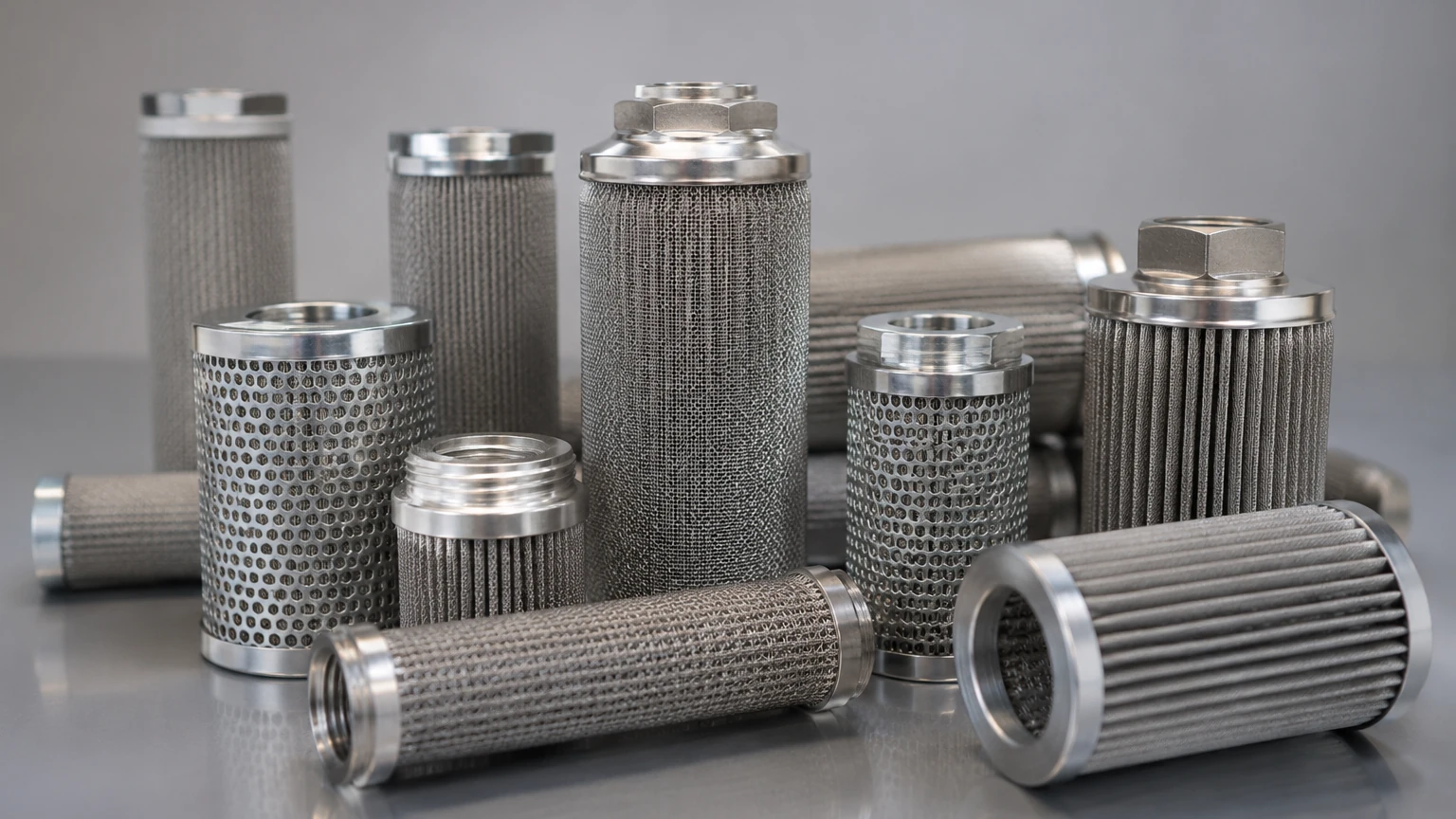
Customization and OEM Integration
Every industrial gas system has unique constraints, from space limitations in skid-mounted units to specific flange connections required by regional standards. Customization is often a necessity rather than a luxury in fuel gas filtration.
Kaifil specializes in OEM solutions, allowing for the customization of:
* End Cap Configurations: Including threaded, flanged, or specialized gasket seats (Viton, PTFE, or EPDM) to ensure a leak-proof seal.
* Reinforcement Layers: Adding internal or external support cores (perforated metal) to withstand high collapse pressures.
* Multi-Stage Filtration: Combining different mesh counts in a single element to provide both coarse pre-filtration and fine final filtration, thereby extending the total service life.
Maintenance and Total Cost of Ownership (TCO)
While the initial cost of a stainless steel fuel gas filter may be higher than that of a disposable alternative, the Total Cost of Ownership is often significantly lower. This is primarily due to the cleanability of metal media.
Cleaning Procedures
Unlike disposable filters, stainless steel elements can be cleaned and reused multiple times. Common methods include:
* Ultrasonic Cleaning: Using high-frequency sound waves in a chemical bath to dislodge fine particulates from deep within the mesh pores.
* Backwashing: Reversing the flow of a clean fluid through the filter to flush out accumulated debris.
* Chemical Cleaning: Using specific solvents to dissolve organic deposits or scales without damaging the stainless steel substrate.
Replacement Cycles
Even with cleaning, filter elements eventually reach a point where the permanent pressure drop (the $ΔP$ after cleaning) is too high. However, the interval between replacements for a high-quality stainless steel element is measured in years rather than months, reducing both material costs and the labor associated with frequent system shutdowns.
Conclusion
Fuel gas filters are essential for the reliable operation of modern industrial machinery. By removing damaging particulates and liquids, these components prevent costly downtime and extend the life of high-value assets. When selecting a filtration solution, engineers must look beyond simple micron ratings and consider the structural integrity, material compatibility, and long-term maintainability of the filter element.
Kaifil’s expertise in custom stainless steel filtration ensures that industrial operators receive components tailored to their specific technical requirements. Whether for high-pressure natural gas lines or specialized chemical processing, precision-engineered metal filters provide the reliability necessary for demanding B2B environments. To explore specific configurations and technical support for your filtration needs, visit the Main Page to review product options and application support.
