


How to Clean Filter Socks
In industrial filtration, filter socks—often referred to as bag filters—serve as a primary line of defense for removing suspended solids from liquid streams. Whether utilized in chemical processing, water treatment, or food and beverage production, these components eventually accumulate a cake of debris that restricts flow and increases internal pressure. Understanding how to clean filter socks effectively is essential for maintaining system efficiency, reducing downtime, and managing the total cost of ownership (TCO) for filtration hardware.
While many low-cost synthetic socks are designed for single-use disposal, high-performance industrial variants, particularly those constructed from specialized mesh or stainless steel, are engineered for multiple cleaning cycles. This guide examines the technical protocols for cleaning filter media, the engineering considerations for different material types, and the criteria for determining when a filter has reached the end of its functional life.
Understanding the Mechanics of Filter Clogging
Before addressing the cleaning process, engineers must identify the type of loading occurring within the filter sock. Filtration typically follows one of two mechanisms: depth filtration or surface filtration.
1. Depth Filtration: Common in felt filter socks (polypropylene or polyester), where particles are trapped throughout the thickness of the material. Cleaning these is significantly more difficult because particles become embedded deep within the fiber matrix.
2. Surface Filtration: Common in monofilament mesh or stainless steel filters. Particles are captured on the surface of the media, forming a "filter cake." These are much easier to clean through mechanical or chemical means.
When determining how to clean filter socks, the first step is identifying the nature of the contaminant. Organic biofilms, mineral scales, and oily residues each require a different approach to ensure the pore structure is restored without damaging the integrity of the media.
Indicators for Cleaning and Maintenance
Operating a filtration system blindly leads to either premature replacement or catastrophic failure. Technical professionals rely on specific metrics to trigger a cleaning cycle:
Differential Pressure ($ΔP$)
The most reliable indicator is the pressure drop across the filter housing. As the sock captures debris, the resistance to flow increases. Most industrial bag filter housings are equipped with upstream and downstream pressure gauges. A clean filter typically shows a $ΔP$ of 1–3 PSI. Once the differential pressure reaches 12–15 PSI, the filter is considered fouled. Allowing $ΔP$ to exceed 20–25 PSI risks "blow-through," where the pressure forces contaminants through the media, or physical collapse of the filter basket.
Flow Rate Degradation
In constant-pressure systems, a noticeable drop in the effluent flow rate indicates that the effective filtration area has been reduced by debris. If the pump must work harder to maintain the same output, the energy costs may soon outweigh the cost of cleaning or replacing the filter.
Step-by-Step Guide: How to Clean Filter Socks
The cleaning protocol varies based on the material of the sock. Below are the standard industrial procedures for synthetic and metallic filter elements.
1. Preparation and Safety
Before any cleaning begins, the filtration system must be isolated. This involves closing the inlet and outlet valves, depressurizing the housing, and draining the residual liquid. Proper Personal Protective Equipment (PPE) is mandatory, especially if the filtered media contains hazardous chemicals or biological agents.
2. Initial Mechanical Rinsing
For both synthetic and stainless steel socks, the first step is a high-volume, low-pressure rinse. Using a hose, spray the filter from the "clean side" to the "dirty side" (backwashing). This dislodges the loose surface cake. Avoid using high-pressure power washers on felt socks, as this can tear the fibers and enlarge the pore size, effectively ruining the micron rating.
3. Chemical Soaking
If mechanical rinsing does not restore the filter, chemical cleaning is required. The choice of agent depends on the contaminant:
* Organic Matter/Biofilms: A solution of 1–3% hydrogen peroxide or a mild bleach solution can break down organic bonds. Ensure the filter material (e.g., polypropylene) is compatible with the oxidant.
* Mineral Scale (Calcium/Magnesium): A mild acid wash, such as citric acid or dilute phosphoric acid, is effective for dissolving scale. This is common in water treatment applications.
* Oils and Greases: Industrial-grade surfactants or alkaline cleaners are used to emulsify hydrocarbons.
4. Ultrasonic Cleaning (For Stainless Steel Mesh)
For precision metal filters, such as those featured on the Main Page of specialized manufacturers, ultrasonic cleaning is the gold standard. The filter is submerged in a tank where high-frequency sound waves create cavitation bubbles. These bubbles implode on the surface of the mesh, stripping away microscopic particles from the tightest weaves that manual scrubbing cannot reach.
5. Final Rinse and Inspection
After chemical or ultrasonic treatment, the filter must be thoroughly rinsed with deionized or filtered water to remove any residual cleaning agents. Once dry, inspect the sock for thinning spots, holes, or frayed seams. For stainless steel elements, check for signs of corrosion or mechanical deformation.
Engineering Risks: When Cleaning Fails
While learning how to clean filter socks can save money, there are inherent risks that engineers must manage. Improper cleaning can lead to several failure modes:
* Media Migration: In felt socks, aggressive cleaning can cause fibers to break loose and enter the filtrate. This is unacceptable in pharmaceutical or food-grade applications.
* Pore Enlargement: Over time, the physical stress of cleaning can stretch the weave of a mesh sock. A 50-micron filter may effectively become a 70-micron filter after several cleanings, allowing oversized particles to pass through.
* Permanent Blinding: Some contaminants, particularly sticky polymers or fine silts, can become permanently lodged in the media. If the $ΔP$ remains high even after a thorough cleaning, the filter is "blinded" and must be replaced.
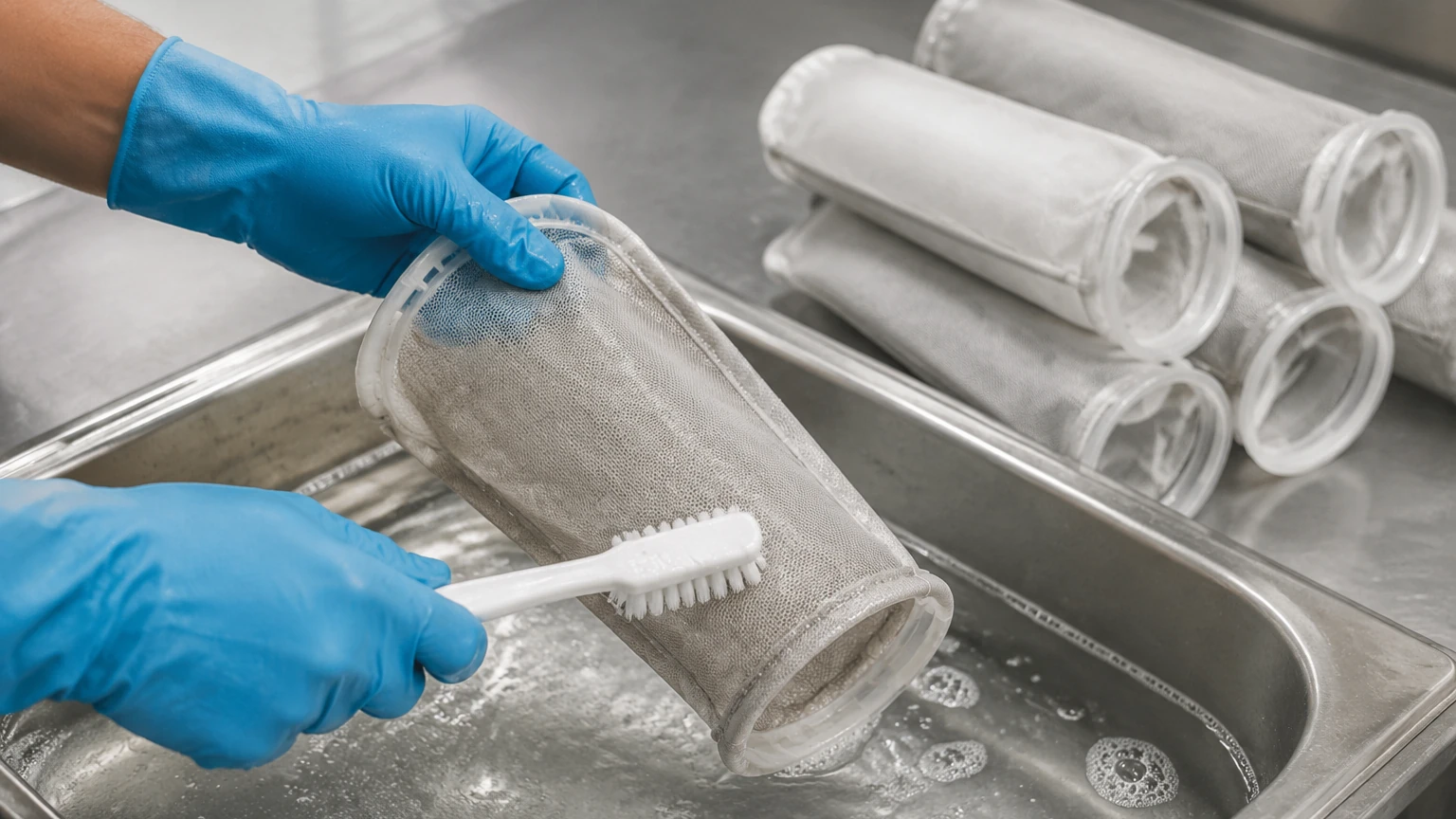
Comparing Synthetic vs. Stainless Steel Cleanability
When selecting filtration hardware, the ease of cleaning is a primary engineering consideration.
Synthetic Socks (Polypropylene/Polyester): These are generally considered semi-disposable. While they can be rinsed a few times, the depth-loading nature of felt means that each cleaning is less effective than the last. They are susceptible to chemical degradation and fiber fatigue.
Stainless Steel Filter Socks/Elements: Manufacturers like Kaifil specialize in stainless steel solutions because of their superior durability. Stainless steel mesh can withstand high-temperature cleaning, aggressive chemical solvents, and high-pressure backpulsing. Although the initial capital expenditure is higher, the ability to clean and reuse the element hundreds of times often results in a lower total cost over the project’s lifecycle.
Best Practices for Extending Filter Life
To minimize the frequency of cleaning and maximize the lifespan of your filter socks, consider the following technical strategies:
* Pre-Filtration: Use a coarse strainer or a higher-micron "sacrificial" sock upstream to capture the largest particles. This prevents the primary fine-micron filter from overloading too quickly.
* Optimized Flow Velocity: Running a system at the maximum rated flow rate increases the force with which particles are driven into the media, making them harder to remove. Reducing flow velocity can lead to a looser filter cake that is easier to wash away.
* Automated Backwashing: For high-volume industrial applications, consider switching to an automated system that performs a backwash cycle based on $ΔP$ sensors. This ensures the filter is cleaned at the optimal moment before deep blinding occurs.
Conclusion
Mastering how to clean filter socks is a balance between chemical knowledge and mechanical care. For standard felt bags, cleaning is often a temporary measure to extend life by a few cycles. However, for precision industrial processes, investing in high-quality, cleanable media—such as stainless steel mesh—provides a more sustainable and predictable filtration performance.
Engineers should always verify chemical compatibility and structural integrity before implementing a cleaning regimen. By monitoring differential pressure and employing the correct cleaning technology, such as ultrasonic baths or targeted chemical soaks, industrial facilities can significantly reduce waste and maintain peak process efficiency. For those seeking durable, custom-engineered filtration components designed for longevity and ease of maintenance, exploring professional manufacturing options is the next logical step in optimizing a filtration system.
