


Lube Filter
In industrial machinery, the lubrication system is the lifeline of rotating equipment. A lube filter is not merely a consumable; it is a critical engineering component designed to maintain fluid cleanliness, reduce friction, and prevent premature component failure. For engineers and maintenance professionals, selecting the right filtration solution requires a deep understanding of fluid dynamics, contaminant characteristics, and the operational environment.
Whether used in high-speed turbines, heavy-duty hydraulic systems, or large-scale industrial engines, the performance of the lube filter directly impacts the reliability and longevity of the entire system. This article explores the technical nuances of industrial lubrication filtration, focusing on material selection, engineering parameters, and the advantages of custom-engineered stainless steel solutions.
The Role of Filtration in Industrial Lubrication Systems
Lubricating oils serve multiple functions: they reduce friction between moving parts, dissipate heat, inhibit corrosion, and transport contaminants to a central location for removal. Without an effective lube filter, these contaminants—ranging from microscopic metal wear particles and silica to carbon soot and moisture—would circulate through the system, leading to accelerated abrasive wear and potential catastrophic failure.
Industrial environments present unique challenges. Contaminants can be internally generated (wear debris) or externally introduced (ingested through seals or breathers). A high-quality filter must be capable of capturing these particles without significantly impeding the flow of the lubricant. As oil circulates, the filter media must maintain its structural integrity under varying pressures and temperatures to ensure that the fluid returning to the sensitive components meets the required ISO cleanliness standards.
For those evaluating high-performance filtration components for demanding industrial applications, the Main Page of a specialized manufacturer offers insights into how precision engineering can be applied to custom filtration needs.
Technical Parameters: Micron Ratings and Beta Ratios
When specifying a lube filter, engineers primarily look at two metrics: the micron rating and the Beta ratio. Understanding the difference between these is essential for ensuring the protection of downstream components.
Micron Rating: Nominal vs. Absolute
A micron rating indicates the size of particles the filter is designed to trap. However, a "10-micron filter" can mean different things depending on whether it is rated nominally or absolutely.
- Nominal Rating: This is an arbitrary value indicating the filter's ability to trap a percentage of particles of a given size. It is often inconsistent between manufacturers and does not guarantee a specific level of cleanliness.
- Absolute Rating: This refers to the diameter of the largest hard spherical particle that will pass through the filter under specific test conditions. For critical industrial applications, absolute-rated filters are preferred as they provide a predictable performance baseline.
Beta Ratio ($β$)
The Beta ratio is a more precise measure of filtration efficiency, derived from the Multi-Pass Test (ISO 16889). It is calculated by dividing the number of particles of a specific size upstream of the filter by the number of particles of the same size downstream. For example, a $β_{10} = 200$ means that for every 200 particles of 10 microns entering the filter, only one passes through. This equates to a 99.5% efficiency. In high-stakes industrial environments, a high Beta ratio is often more important than the micron rating alone.
Material Science: The Shift Toward Stainless Steel Media
Traditional lube filters often utilize cellulose (paper) or synthetic glass fiber media. While these are cost-effective for light-duty applications, they have limitations in industrial settings involving high temperatures, chemically aggressive lubricants, or high differential pressures. This is where stainless steel wire mesh and sintered metal filters become the engineering standard.
Durability and Structural Integrity
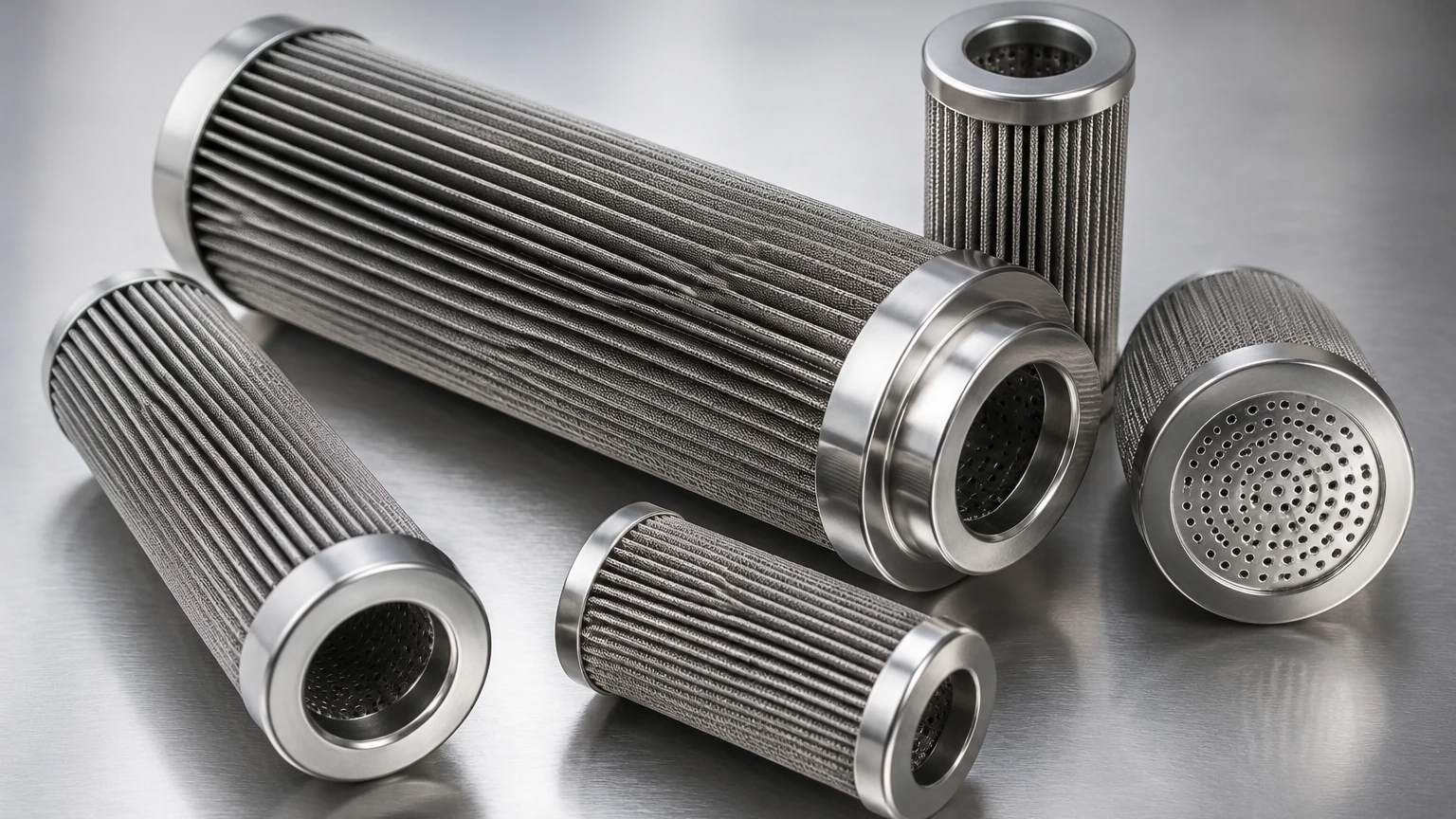
Stainless steel filters, such as those manufactured by Kaifil, offer superior mechanical strength. Unlike paper media, which can pleat-collapse or migrate fibers into the fluid stream under pressure surges, stainless steel wire mesh maintains its geometry. This is particularly vital in hydraulic lube systems where pressure pulsations are common.
Thermal and Chemical Resistance
Industrial lubricants often contain additives that can degrade synthetic fibers over time. Furthermore, high-temperature applications (exceeding 120°C) can cause standard filter media to become brittle. Stainless steel is inherently resistant to a wide range of chemicals and can operate in extreme temperature ranges without loss of filtration efficiency.
Reusability and Sustainability
One of the most significant advantages of stainless steel lube filters is that they are cleanable and reusable. Through ultrasonic cleaning or backwashing, the accumulated contaminants can be removed, restoring the filter's original pressure drop characteristics. This reduces the total volume of industrial waste and provides a lower long-term cost of ownership compared to disposable cartridges.
Engineering Factors for Filter Selection
Selecting a lube filter is not a "one size fits all" process. Engineers must consider several interconnected factors to ensure the filter performs optimally throughout its service life.
Viscosity and Temperature
The viscosity of the lubricant significantly affects the pressure drop ($ΔP$) across the filter media. At lower temperatures (e.g., during a cold start), oil viscosity is high, which can lead to a high initial pressure drop. If the filter is not sized correctly, this may trigger the bypass valve, allowing unfiltered oil to circulate. Engineers must size the filter based on the maximum viscosity expected at the lowest operating temperature.
Flow Rate and Flux
The flux—the volume of fluid passing through a unit area of filter media—must be carefully managed. High flux rates can lead to premature clogging and may force particles through the media. By increasing the surface area through pleated designs, manufacturers can lower the flux, thereby increasing the dirt-holding capacity and extending the interval between cleanings or replacements.
Clean Pressure Drop vs. Terminal Pressure Drop
The "clean" pressure drop is the resistance offered by the filter when it is new. As it captures contaminants, the resistance increases until it reaches the "terminal" pressure drop, at which point the filter must be cleaned or replaced. A well-engineered lube filter balances initial efficiency with a slow rate of $ΔP$ increase to maximize uptime.
Customization and OEM Solutions in Filtration
In many industrial contexts, off-the-shelf filters fail to meet specific spatial or performance requirements. Customization is often necessary to integrate the filtration system into complex machinery.
Tailored Mesh Configurations
Different applications require different weaving patterns. Plain weave mesh might suffice for coarse filtration, while Twilled Dutch Weave is often utilized for fine filtration in lube systems due to its high strength and precise pore size. Manufacturers like Kaifil work with engineers to determine the optimal layer configuration—often laminating multiple layers of mesh together through sintering to provide both fine filtration and structural support.
Specialized End-Caps and Fittings
The interface between the filter element and the housing is a common point of failure. Custom OEM solutions allow for the design of specialized end-caps (e.g., threaded, bayonet, or O-ring seals) made from compatible metals to ensure a leak-proof bypass-free fit. This level of customization ensures that the lube filter can be seamlessly integrated into existing industrial infrastructure.
Maintenance, Monitoring, and Total Cost of Ownership (TCO)
For a B2B procurement team, the initial purchase price of a lube filter is only one part of the equation. The Total Cost of Ownership (TCO) includes the cost of replacement elements, labor for maintenance, disposal costs for contaminated filters, and the potential cost of machinery downtime.
Differential Pressure Monitoring
Modern industrial systems utilize differential pressure sensors to monitor the health of the lube filter. By tracking the $ΔP$ trend, maintenance teams can move from reactive to predictive maintenance. A sudden spike in pressure may indicate a primary component failure upstream (releasing large amounts of wear debris), while a sudden drop could indicate a ruptured filter media or a stuck-open bypass valve.
Cleaning Protocols for Stainless Steel Filters
To maintain the performance of reusable stainless steel filters, a standardized cleaning protocol is essential. Ultrasonic cleaning is the most effective method, as it uses high-frequency sound waves to create cavitation bubbles that dislodge particles from deep within the mesh pores. When performed correctly, a stainless steel lube filter can be returned to service multiple times, significantly offsetting its higher initial capital expenditure.
Technical Checklist for Filter Procurement
Before finalizing a lube filter specification, engineers and purchasing teams should confirm the following technical details with their supplier:
1. Fluid Compatibility: Is the filter media and housing material compatible with the specific lubricant and its additive package?
2. Operating Conditions: What are the maximum operating pressure, temperature, and flow rate?
3. Target Cleanliness: What is the target ISO 4406 cleanliness code for the system?
4. Bypass Settings: At what pressure differential will the system bypass, and is the filter designed to handle that pressure without collapsing?
5. Environment: Will the filter be exposed to vibration, cyclic flow, or external corrosive elements?
By addressing these questions, organizations can ensure they are investing in a filtration solution that provides reliable protection and optimized performance. For customized industrial filtration components that meet these rigorous standards, exploring the capabilities of a specialized manufacturer like Kaifil is a logical next step in the engineering process.
In conclusion, the lube filter is a foundational component of industrial reliability. By prioritizing high-quality materials like stainless steel and focusing on precise engineering metrics like Beta ratios and pressure drop management, industrial operations can significantly reduce wear, extend oil life, and ensure the continuous operation of their most valuable assets.
