


Lube Oil Filtration
In industrial machinery, lubrication is often described as the lifeblood of the system. Whether in a high-speed turbine, a heavy-duty hydraulic press, or a complex gearbox, the primary function of lube oil is to reduce friction, dissipate heat, and prevent wear between moving surfaces. However, the effectiveness of any lubrication system is fundamentally limited by the purity of the fluid. Lube oil filtration is the critical technical process of removing solid particles, moisture, and chemical degradation products from the oil to maintain its lubricating properties and protect sensitive mechanical components.
Effective filtration is not merely about removing visible debris; it is about managing microscopic contaminants that can cause catastrophic failure or accelerated wear over time. For engineers and maintenance professionals, understanding the technical nuances of lube oil filtration is essential for optimizing equipment uptime and extending the service life of both the lubricant and the machinery.
The Impact of Contamination on Lubrication Systems
Contamination in lube oil systems typically falls into three categories: particulate matter, moisture, and chemical by-products. Each presents unique challenges to the mechanical integrity of the system.
Particulate Contamination
Solid particles are the most common threat. These can be "built-in" contaminants from the manufacturing process (such as casting sand or metal shavings), "ingressed" contaminants from the environment (dust and silica), or "generated" contaminants resulting from internal wear. When particles enter the clearance between moving parts—often as small as 1 to 5 microns—they act as abrasives, leading to three-body abrasion, surface fatigue, and component scoring. Without precise lube oil filtration, these particles circulate repeatedly, creating a chain reaction of wear.
Moisture and Water Ingress
Water can enter lube systems through seal leaks or condensation. It promotes oxidation of the oil, depletes additives, and causes corrosion on metal surfaces. In high-pressure systems, water can also lead to cavitation, where the sudden collapse of vapor bubbles causes localized physical damage to metal components.
Varnish and Sludge
As oil ages and is subjected to thermal stress, it undergoes oxidation. This process produces insoluble sub-micron particles known as varnish or sludge. These soft contaminants are particularly problematic because they can coat internal surfaces, sticking to valve spools and heat exchanger tubes, which reduces thermal efficiency and causes mechanical sticking.
Technical Parameters for Evaluating Filter Performance
When selecting a solution for lube oil filtration, engineers must look beyond simple micron ratings. A comprehensive evaluation requires an understanding of efficiency, capacity, and structural integrity.
The Beta Ratio ($\beta$)
The industry standard for measuring filter efficiency is the Beta Ratio, determined through multi-pass testing (ISO 16889). A micron rating alone is insufficient because it does not specify the percentage of particles captured. The Beta Ratio is expressed as $\beta_x = y$, where $x$ is the particle size in microns and $y$ is the ratio of particles upstream versus downstream. For example, a $\beta_{10} = 200$ rating means that for every 200 particles of 10-micron size entering the filter, only one passes through. This equates to 99.5% efficiency.
Dirt Holding Capacity (DHC)
The DHC defines how much solid contaminant a filter can retain before the pressure drop reaches a terminal level. In industrial lube oil filtration, a higher DHC translates to longer service intervals and lower total cost of ownership. This is influenced by the surface area of the filter media and the depth of the filtration layers.
Pressure Drop (Differential Pressure)
As oil flows through the filter media, it encounters resistance, resulting in a pressure drop ($ΔP$). This value is highly sensitive to the oil's viscosity. In lube oil systems, viscosity fluctuates significantly with temperature. A filter must be engineered to handle "cold start" conditions where high viscosity can lead to high differential pressure, potentially triggering a bypass valve and allowing unfiltered oil to reach the machinery.
Material Selection: The Case for Stainless Steel Filtration
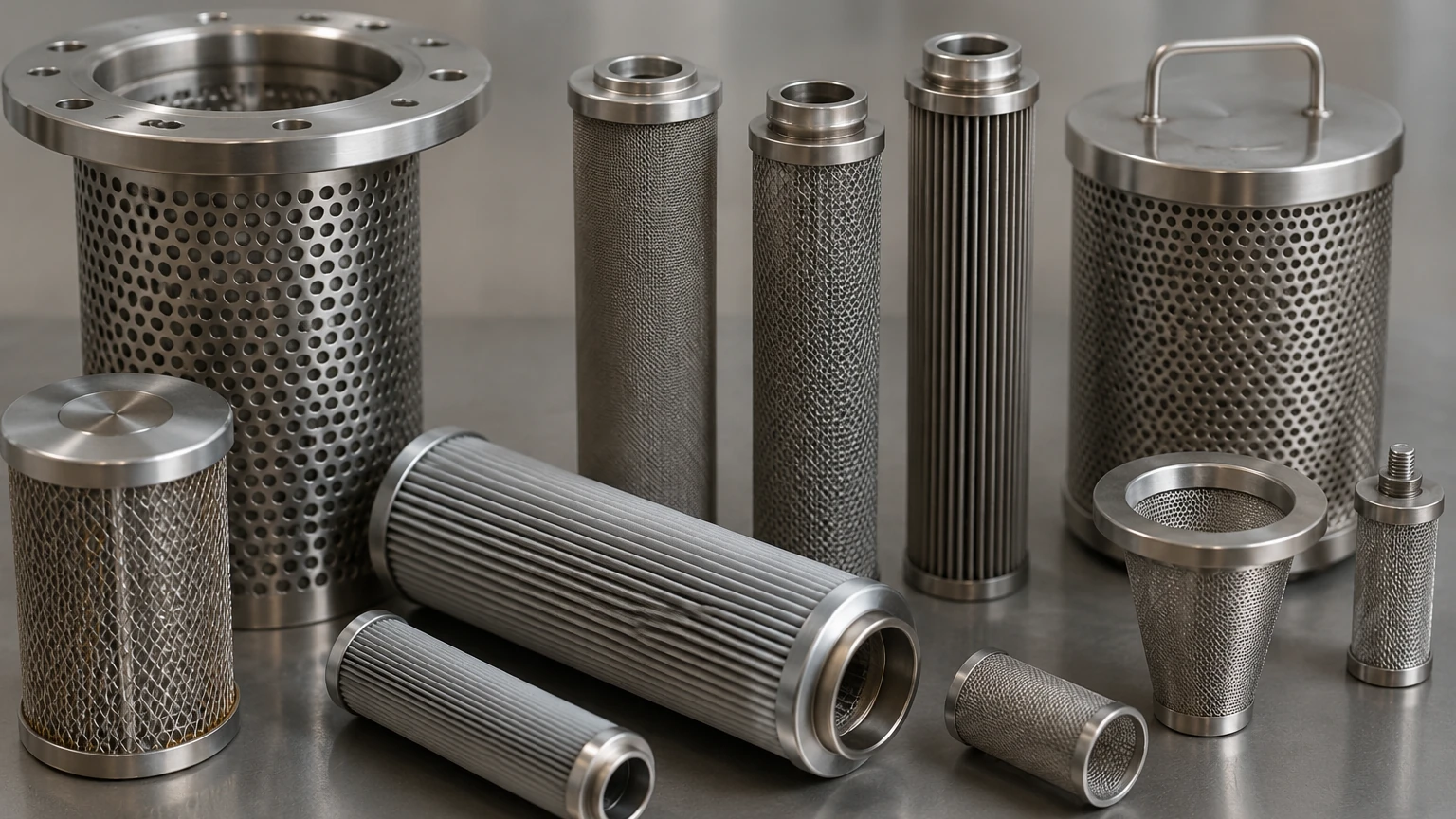
While disposable cellulose or synthetic fiber filters are common, demanding industrial applications often require the durability and precision of stainless steel. Stainless steel wire mesh and sintered metal components offer several technical advantages in lube oil filtration.
1. Thermal and Chemical Stability: Industrial lubricants often contain complex additive packages or may operate at elevated temperatures. Stainless steel (typically grades 304 or 316L) is chemically inert to most additives and maintains structural integrity at temperatures that would degrade polymer-based media.
2. Structural Strength: In high-pressure hydraulic or lubrication circuits, filter elements must withstand significant pressure differentials without collapsing. Metal mesh filters provide the mechanical strength necessary to resist fatigue and pressure surges.
3. Cleanability and Reusability: Unlike disposable cartridges, stainless steel filter elements can often be cleaned and returned to service. This is particularly valuable in remote industrial sites or applications where waste reduction is a priority.
4. Precise Pore Geometry: Advanced manufacturing techniques allow for highly controlled pore sizes in stainless steel mesh, ensuring consistent filtration performance and predictable flow characteristics.
For more information on customized metal filtration components and material specifications, you can visit the Main Page of the Kaifil website.
Engineering Considerations for System Integration
Integrating an effective lube oil filtration system requires a holistic view of the machinery's operating environment. Engineers should confirm several variables before finalizing a filter design.
Viscosity and Flow Rate
The relationship between flow rate and viscosity is the primary driver of filter sizing. High-viscosity oils (such as ISO VG 320 or 460 gear oils) require larger surface areas to maintain an acceptable pressure drop. If the filter is undersized, the resulting high velocity through the media can cause "particle migration," where captured contaminants are forced through the mesh by fluid pressure.
Placement: Full-Flow vs. Kidney Loop
* Full-Flow Filtration: The filter is placed directly in the main lubrication line. Every drop of oil passing to the bearings or gears must pass through the filter. This provides maximum protection but requires the filter to handle the full system flow and pressure.
* Kidney Loop (Off-line) Filtration: A separate pump and motor circulate oil from the reservoir through a filter and back. This allows for continuous filtration even when the main machine is offline and enables the use of finer media without affecting the main system's pressure balance.
Seal and Gasket Compatibility
It is a common oversight to focus solely on the filter media while neglecting the seals. Industrial lubricants, especially synthetic esters or fluids with high detergent levels, can cause certain elastomers to swell or brittle. Fluoroelastomers (Viton) or PTFE seals are frequently required for high-performance lube oil filtration systems to prevent external leakage.
Maintenance and Total Cost of Ownership (TCO)
The real cost of lube oil filtration is not the purchase price of the filter element, but the total cost of maintaining fluid cleanliness over the life of the equipment. A low-cost, low-efficiency filter may save money upfront but lead to frequent oil changes, increased component wear, and unplanned downtime.
Monitoring Pressure Differential
Most industrial filter housings are equipped with differential pressure indicators. These devices signal when the media is loaded with contaminants and requires cleaning or replacement. Relying on a fixed calendar schedule for filter changes is often inefficient; condition-based monitoring ensures that the filter is used to its full capacity without risking a bypass event.
Oil Analysis
Filtration and oil analysis go hand-in-hand. Regular laboratory analysis of the oil (measuring ISO particle counts, water content, and additive depletion) provides empirical evidence of the filtration system's performance. If particle counts remain high despite frequent filter changes, it may indicate that the filtration grade is too coarse or that there is an internal source of excessive wear.
Customization in Lube Oil Filtration
Every industrial application has unique constraints, from space limitations in a nacelle to extreme environmental conditions in a chemical plant. Standard off-the-shelf filters often fall short of meeting these specific engineering requirements. Customization allows for the optimization of:
* End Cap Configurations: Ensuring a perfect fit within existing housings to prevent bypass leakage.
* Reinforcement Layers: Adding internal support cores or external shrouds to handle high-pressure pulses.
* Multi-Layer Mesh Designs: Combining different mesh counts to create a gradient-density effect, which improves dirt-holding capacity by capturing larger particles on the outer layers and finer particles toward the center.
By working with a manufacturer experienced in custom stainless steel filtration, engineering teams can develop solutions that are precisely matched to their flow rates, target ISO cleanliness codes, and maintenance cycles. This collaborative approach ensures that the filtration system is a robust contributor to the overall reliability of the machinery, rather than a recurring maintenance headache.
In conclusion, lube oil filtration is a sophisticated engineering discipline that requires a balance of fluid dynamics, material science, and mechanical design. By prioritizing high-quality materials like stainless steel and adhering to rigorous selection criteria based on Beta ratios and viscosity profiles, industrial operators can significantly reduce wear, lower maintenance costs, and ensure the long-term health of their most critical assets.
