


Lubricating Oil Filtration
In the context of industrial machinery, lubricating oil serves as the lifeblood of mechanical systems, performing critical functions such as friction reduction, heat dissipation, and corrosion prevention. However, the effectiveness of these functions is directly tied to the purity of the lubricant. Lubricating oil filtration is the process of removing contaminants—ranging from microscopic wear particles to moisture and chemical byproducts—to maintain the physical and chemical properties of the oil. For engineers and maintenance professionals, selecting the correct filtration system is not merely a maintenance task but a strategic decision to ensure equipment reliability and extend the service life of high-value assets.
Industrial environments present harsh conditions where standard filtration solutions often fall short. Whether in chemical processing, hydraulic power units, or large-scale food production, the demand for durable, high-precision filtration components is paramount. This guide explores the technical nuances of lubricating oil filtration, focusing on material selection, engineering parameters, and the advantages of stainless steel filtration media in demanding applications.
Understanding the Critical Role of Lubricating Oil Filtration
The primary goal of lubricating oil filtration is to maintain the oil's cleanliness level within the limits specified by equipment manufacturers, often defined by the ISO 4406 standard. When oil circulates through a system, it inevitably picks up contaminants. Without an effective filtration mechanism, these particles act as abrasive agents, leading to a self-propagating cycle of wear known as the "chain reaction of wear."
Effective filtration provides several key benefits:
* Reduction in Abrasive Wear: By capturing hard particles like silica and metal shavings, filters prevent the scoring of bearings, gears, and cylinder walls.
* Prevention of Component Sticking: Fine silting can cause high-tolerance components, such as servo valves in hydraulic systems, to seize or respond sluggishly.
* Extended Oil Life: Removing oxidation catalysts (like copper and iron particles) and moisture helps maintain the oil's chemical stability, reducing the frequency of oil changes.
* Thermal Management: Clean oil transfers heat more efficiently than contaminated, sludge-heavy oil, preventing localized overheating in high-speed machinery.
For those seeking high-performance components to integrate into these systems, reviewing professional manufacturing capabilities at the Main Page of a specialized supplier is a critical step in procurement.
Common Contaminants and Their Impact on Machinery
Contaminants in a lubricating system are generally classified into three categories: solid particles, moisture, and chemical degradation products. Understanding these is essential for designing an effective lubricating oil filtration strategy.
Solid Particulate Matter
Solid contaminants are the most frequent cause of mechanical failure. These include environmental dust (silica), metal wear debris from the machinery itself, and soot in combustion engines. The size of these particles is measured in microns (µm). Particles in the 2µm to 20µm range are often the most damaging because they are small enough to enter the tight clearances between moving parts but large enough to bridge the lubricant film and cause direct surface-to-surface contact.
Moisture and Water Contamination
Water can enter a system through seal leaks or atmospheric condensation. It exists in three states: dissolved, emulsified, and free water. Water promotes rust, increases the rate of oil oxidation, and can lead to the depletion of essential additives. In some cases, water can cause "hydrogen embrittlement" in high-strength steels, leading to sudden component failure.
Varnish and Sludge
As oil ages and is subjected to high temperatures, it undergoes oxidation. This process creates soft contaminants known as varnish or sludge. While these may not be abrasive, they coat internal surfaces, insulating them against heat transfer and clogging fine mesh filters or small orifices.
Key Engineering Parameters for Selecting Oil Filters
When specifying a filter for lubricating oil filtration, engineers must look beyond simple dimensions. Several technical metrics dictate whether a filter will perform adequately under operating conditions.
Micron Rating and Beta Ratio
The micron rating indicates the size of particles the filter can trap. However, a "nominal" rating is often misleading. Engineers prefer the "absolute" rating or the Beta Ratio ($\beta$). The Beta Ratio is calculated by comparing the number of particles of a specific size upstream of the filter to the number downstream. For example, a $\beta_{10} = 200$ means that for every 200 particles of 10 microns entering the filter, only one passes through, indicating 99.5% efficiency.
Pressure Drop (ΔP)
Pressure drop is the difference in oil pressure between the inlet and outlet of the filter. Every filter media creates some resistance to flow. If the initial pressure drop is too high, the system may trigger a bypass valve prematurely, allowing unfiltered oil to circulate. Factors affecting ΔP include oil viscosity (which changes with temperature), flow rate, and the surface area of the filter media.
Flow Fatigue and Structural Integrity
In systems with pulsating flows, such as those driven by reciprocating pumps, the filter media is subjected to constant mechanical stress. A high-quality filter must maintain its structural integrity and pore size under these conditions to prevent "media migration," where parts of the filter itself break off and enter the downstream flow.
Advantages of Stainless Steel Media in Oil Filtration
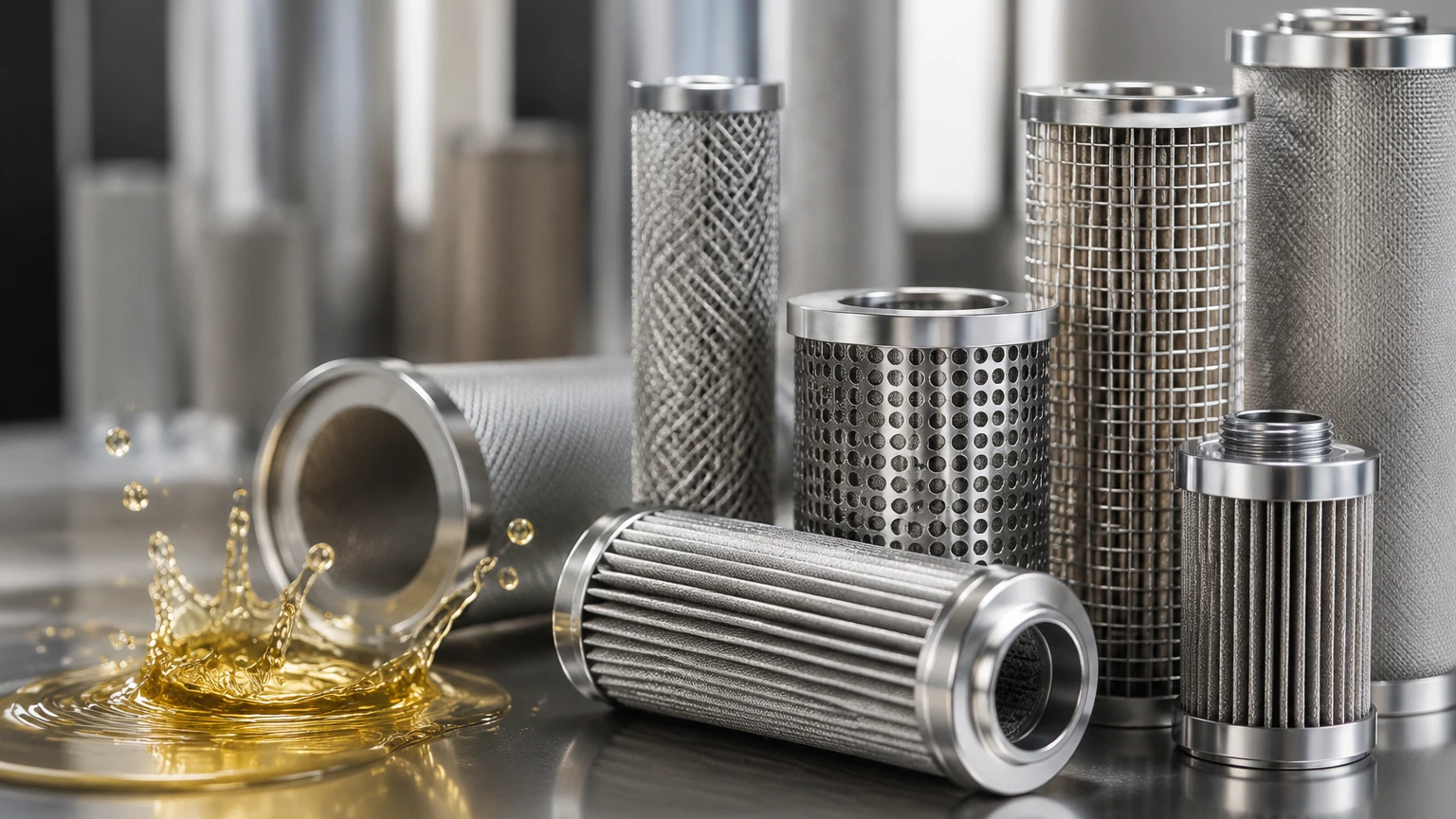
While disposable cellulose or synthetic fiber filters are common, many industrial applications require the robustness of stainless steel. Stainless steel wire mesh and sintered metal cartridges offer distinct advantages for lubricating oil filtration in challenging environments.
Temperature and Chemical Resistance
Stainless steel (typically 304 or 316L) can withstand extreme temperatures that would melt or degrade polymer-based filters. This is particularly important in heavy industrial gearboxes or chemical processing plants where oil temperatures can exceed 100°C. Furthermore, stainless steel is chemically inert to most lubricating additives and synthetic oils, ensuring no leaching or degradation occurs.
Cleanability and Reusability
One of the most significant advantages of stainless steel filters is that they are often cleanable. Through ultrasonic cleaning, backwashing, or chemical solvent baths, the accumulated contaminants can be removed, restoring the filter to its original pressure drop. This reduces the total cost of ownership and minimizes the environmental impact associated with disposing of oil-soaked cartridges.
Precision Pore Geometry
Stainless steel wire mesh filters provide highly controlled pore sizes. Unlike fibrous media, where the gaps between fibers can shift under pressure, a woven wire mesh maintains a fixed aperture. This ensures consistent filtration performance throughout the life of the component.
Maintenance Strategies and Monitoring Performance
A lubricating oil filtration system is only as effective as its maintenance regime. Relying solely on fixed time intervals for filter replacement often leads to either premature disposal or, conversely, running a clogged filter in bypass mode.
Differential Pressure Monitoring
The most reliable way to monitor filter health is through differential pressure gauges or sensors. As the filter captures contaminants, the resistance to flow increases, raising the ΔP. Most industrial systems are equipped with an alarm or indicator that triggers when the ΔP reaches a critical threshold, signaling that the filter requires cleaning or replacement.
Oil Analysis
Regular oil analysis is a proactive maintenance tool. By analyzing the particle count (ISO 4406) and the presence of specific wear metals in the oil, engineers can determine if the filtration system is performing as expected. If particle counts remain high despite frequent filter changes, it may indicate that the filter's micron rating is too coarse for the application or that there is an internal leak in the filter housing.
Proper Installation and Sealing
Even the highest-quality filter will fail if bypass occurs due to poor sealing. Ensuring that O-rings and gaskets are compatible with the lubricant and correctly seated during installation is vital. For custom applications, working with a manufacturer that provides precision-engineered end caps and sealing surfaces is essential for maintaining system integrity.
Customizing Filtration Solutions for Demanding Applications
Standard off-the-shelf filters often fail to meet the specific needs of specialized industrial equipment. Customization allows engineers to optimize the balance between filtration efficiency, flow rate, and physical footprint.
Custom lubricating oil filtration solutions may involve:
* Tailored Micron Ratings: Designing mesh weaves to target specific contaminant profiles identified through oil analysis.
* High-Pressure Housings: Engineering reinforced filter elements capable of withstanding the high-pressure spikes found in hydraulic circuits.
* Specialized Materials: Utilizing exotic alloys or specific grades of stainless steel for highly corrosive environments.
* OEM Integration: Developing proprietary filter shapes and attachment mechanisms for unique machinery designs.
Manufacturers like Kaifil specialize in these customized stainless steel solutions, providing the technical expertise required to develop components that meet exact operational parameters. By focusing on the specific demands of the chemical, pharmaceutical, and food industries, these solutions ensure that filtration is a strength, rather than a weak point, in the production chain.
Conclusion
Lubricating oil filtration is a foundational requirement for the longevity and efficiency of industrial machinery. By understanding the nature of contaminants and the engineering principles behind filter selection, organizations can significantly reduce downtime and repair costs. While many options exist, stainless steel filtration components offer the durability, precision, and long-term value required for the most demanding B2B applications.
When evaluating filtration needs, it is important to partner with a manufacturer that understands the intersection of material science and fluid dynamics. For detailed technical specifications and to explore a wide range of custom stainless steel filter options, engineers and purchasing teams should consult the resources available at the Main Page. Investing in high-quality filtration today is the most effective way to protect the mechanical investments of tomorrow.
