


Mash Filters
In the landscape of industrial liquid-solid separation, mash filters represent a critical technology for sectors requiring high-efficiency extraction and filtration, most notably in the brewing, food processing, and chemical industries. Unlike traditional gravity-based separation methods, mash filters utilize mechanical pressure and precision-engineered filtration media to achieve superior extract yields and dryer filter cakes. For engineers and procurement specialists, selecting the right filtration components—specifically the stainless steel wire mesh and support structures—is paramount to ensuring operational longevity and process consistency.
At Kaifil, the focus is on providing high-performance stainless steel filtration solutions that withstand the rigorous thermal and chemical demands of industrial mashing processes. Understanding the technical nuances of mash filters, from material science to hydraulic performance, is essential for optimizing production lines and reducing the total cost of ownership.
Engineering Principles of Mash Filtration
The fundamental objective of a mash filter is to separate the liquid phase (often referred to as wort in brewing or extract in chemical processing) from the solid phase (spent grains or precipitates). This process is governed by the principles of pressure filtration, where a slurry is pumped into a series of chambers lined with filtration media.
The Filtration Cycle
A typical mash filter operation involves several distinct phases, each placing specific mechanical stresses on the filter mesh:
1. Filling and Filtration: The mash is pumped into the filter chambers. As the liquid passes through the stainless steel mesh, solids begin to form a "pre-coat" or filter cake, which then acts as the primary filtration medium.
2. Squeezing (Membrane Inflation): In many modern designs, flexible membranes are inflated to mechanically compress the filter cake. This step requires the underlying stainless steel support mesh to handle significant compressive forces without deformation.
3. Cake Washing: Solvent or water is passed through the compressed cake to recover any remaining extract. The uniformity of the mesh weave is critical here to prevent "channeling," where the liquid takes the path of least resistance, leaving extract behind.
4. Air Blow/Drying: Compressed air is used to further reduce the moisture content of the cake before discharge.
Darcy’s Law and Mesh Selection
Engineers must consider Darcy’s Law when specifying components for mash filters. The flow rate is directly proportional to the pressure drop and the permeability of the filter cake and mesh. By selecting a wire mesh with an optimized open area and precise aperture size, manufacturers can maintain high flow rates even as the cake thickness increases. This precision is a hallmark of the solutions found on the Main Page of technical filtration providers like Kaifil.
Material Selection: The Necessity of Stainless Steel
The environment within a mash filter is often hostile. High temperatures (often exceeding 80°C), varying pH levels (from acidic mashes to alkaline cleaning cycles), and abrasive solids necessitate the use of high-grade stainless steel.
Grade 304 vs. 316L
While Grade 304 stainless steel is suitable for many general-purpose applications, Grade 316L is frequently the standard for mash filters due to the addition of molybdenum. This element provides enhanced resistance to pitting and crevice corrosion, particularly in the presence of chlorides or organic acids found in food and chemical processing. For pharmaceutical-grade mash filtration, 316L is often mandatory to meet stringent regulatory requirements regarding material stability and leaching.
Surface Integrity and Hygiene
In food and beverage applications, the surface finish of the mash filters' internal components is as important as the alloy itself. Smooth, precision-woven wire mesh prevents the adhesion of organic matter, which can lead to microbial growth. Kaifil utilizes advanced manufacturing techniques to ensure that mesh components are free from burrs and irregularities, facilitating effective Cleaning-in-Place (CIP) procedures.
Technical Specifications of Mash Filter Media
When evaluating mash filters, the specification of the wire mesh is the most critical factor in determining filtration accuracy and throughput. Several weave types are commonly employed depending on the specific solids loading and particle size distribution of the mash.
Plain Weave and Twilled Weave
Plain weave mesh offers a simple over-under pattern, providing high flow rates and easy cleaning. However, for finer filtration requirements, twilled weaves allow for thicker wires and a higher mesh count, increasing the mechanical strength of the filter element. This is particularly useful in high-pressure mash filters where the mesh must support a heavy cake without sagging.
Dutch Weave for Precision
Dutch weave patterns (Plain Dutch and Twill Dutch) are often used when high mechanical strength and precise micron ratings are required. These weaves feature a higher density of wires in one direction, creating a tortuous path for particles. This results in excellent surface filtration characteristics and high resistance to pressure differentials, making them ideal for the squeezing phase of the filtration cycle.
Micron Rating and Particle Retention
Selecting the correct micron rating for mash filters involves a trade-off between clarity and flow rate. In brewing, for example, a mesh that is too fine may lead to rapid blinding (clogging), while a mesh that is too coarse will result in high turbidity in the wort. Engineering teams must analyze the particle size distribution of their specific mash to determine the optimal balance.
Customization and OEM Integration
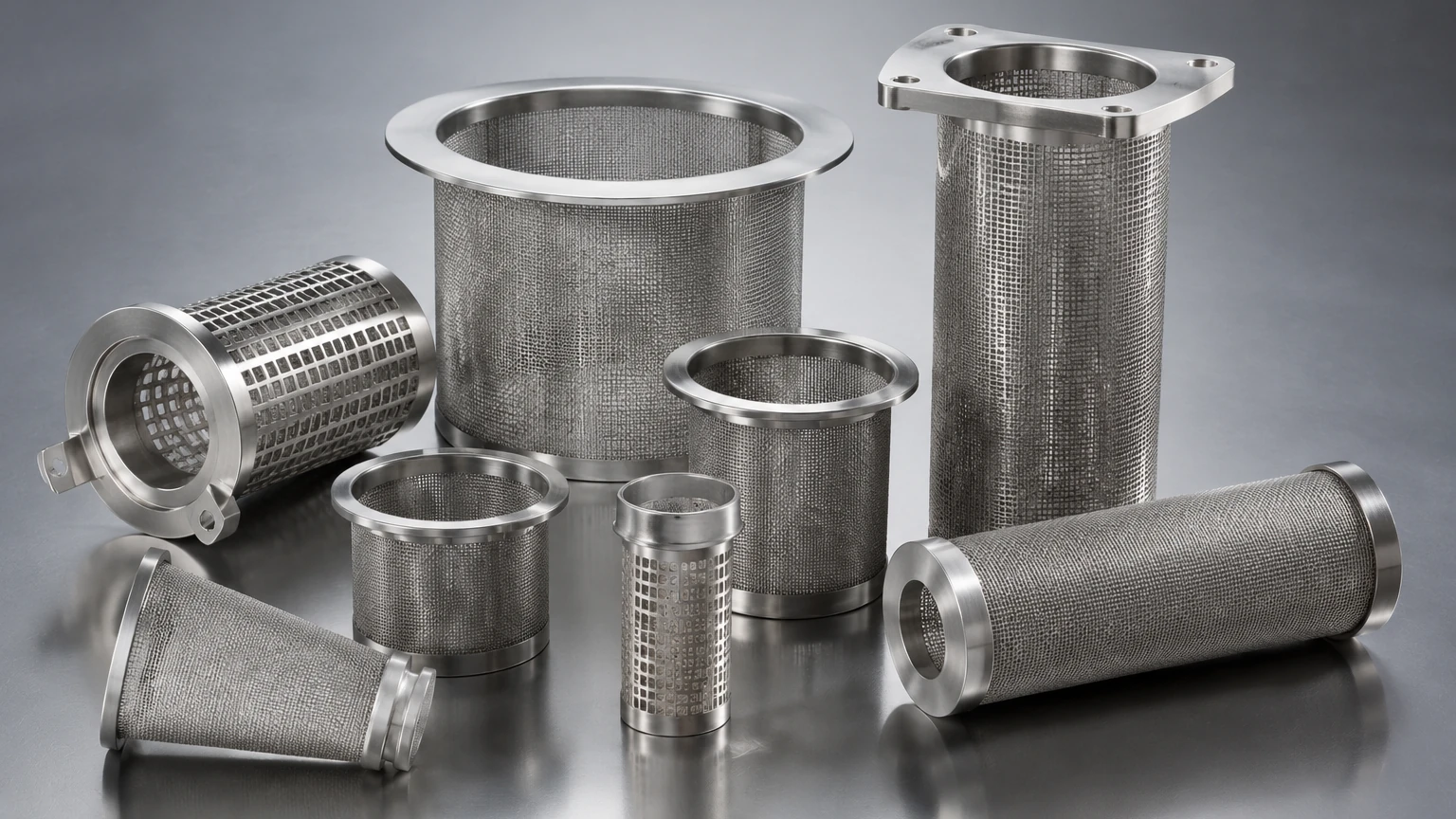
Industrial filtration is rarely a one-size-fits-all endeavor. Mash filters are often integrated into complex, proprietary machinery where standard off-the-shelf components may not suffice. Kaifil specializes in custom stainless steel filtration solutions, working closely with equipment manufacturers (OEMs) to develop bespoke filter cartridges and mesh panels.
Engineering Considerations for Custom Designs
When designing custom components for mash filters, several factors must be confirmed:
* Mechanical Interface: How the mesh is secured to the filter plate (e.g., welding, mechanical fastening, or heat sealing).
* Support Structures: The use of perforated metal or coarser mesh layers to provide structural backing for fine filtration layers.
* Edge Treatments: Specialized borders to prevent fraying and ensure a leak-proof seal within the filter press frame.
By focusing on these technical details, Kaifil ensures that custom filtration components integrate seamlessly into existing systems, maintaining the integrity of the original equipment design.
Operational Challenges: Blinding and Maintenance
The most common operational issue with mash filters is "blinding," where particles become lodged within the mesh openings or a sticky layer forms on the surface, drastically reducing permeability.
Strategies to Combat Blinding
1. Optimized Backwashing: Utilizing high-pressure liquid or gas to dislodge particles from the reverse side of the mesh.
2. Chemical Cleaning: Using caustic or acidic solutions to dissolve organic or mineral scale. The chemical compatibility of the stainless steel mesh is vital here to prevent corrosion during these cycles.
3. Ultrasonic Cleaning: For removable filter elements, ultrasonic baths can remove sub-micron particles that standard CIP cannot reach.
Replacement Cycles
While stainless steel mash filters are highly durable, they are not infinite-life components. Mechanical fatigue from repeated pressure cycles and the abrasive nature of some mashes will eventually necessitate replacement. Engineers should monitor pressure drop trends (delta-P) across the filter; a consistent increase in the baseline pressure drop after cleaning cycles is a primary indicator that the filtration media is reaching the end of its functional life.
Economic Evaluation and Total Cost of Ownership
When procuring mash filters or replacement components, the initial purchase price is only one component of the economic equation. A comprehensive Total Cost of Ownership (TCO) analysis should include:
* Yield Efficiency: How much more extract can be recovered compared to traditional methods? Mash filters often achieve yields exceeding 98%.
* Consumable Costs: The lifespan of the stainless steel mesh versus lower-quality alternatives.
* Energy Consumption: High-permeability mesh reduces the pumping energy required to maintain flow rates.
* Labor and Downtime: Ease of cleaning and the frequency of manual intervention.
Investing in high-quality stainless steel components from a specialized manufacturer like Kaifil often results in lower TCO due to extended service intervals and improved process consistency. For more detailed technical specifications and to Review product options and application support, visiting the company's resource center is recommended.
Conclusion: Selecting the Right Partner
The selection of mash filters is a technical decision that impacts the core efficiency of industrial production. By focusing on material science, precision weaving, and custom engineering, manufacturers can ensure their filtration processes are both robust and cost-effective. Whether you are designing a new system or optimizing an existing one, understanding the interaction between the mash characteristics and the filtration media is the key to success.
Kaifil remains committed to advancing industrial filtration through rigorous quality standards and engineering expertise, providing the reliable components necessary for today’s demanding industrial environments.
