


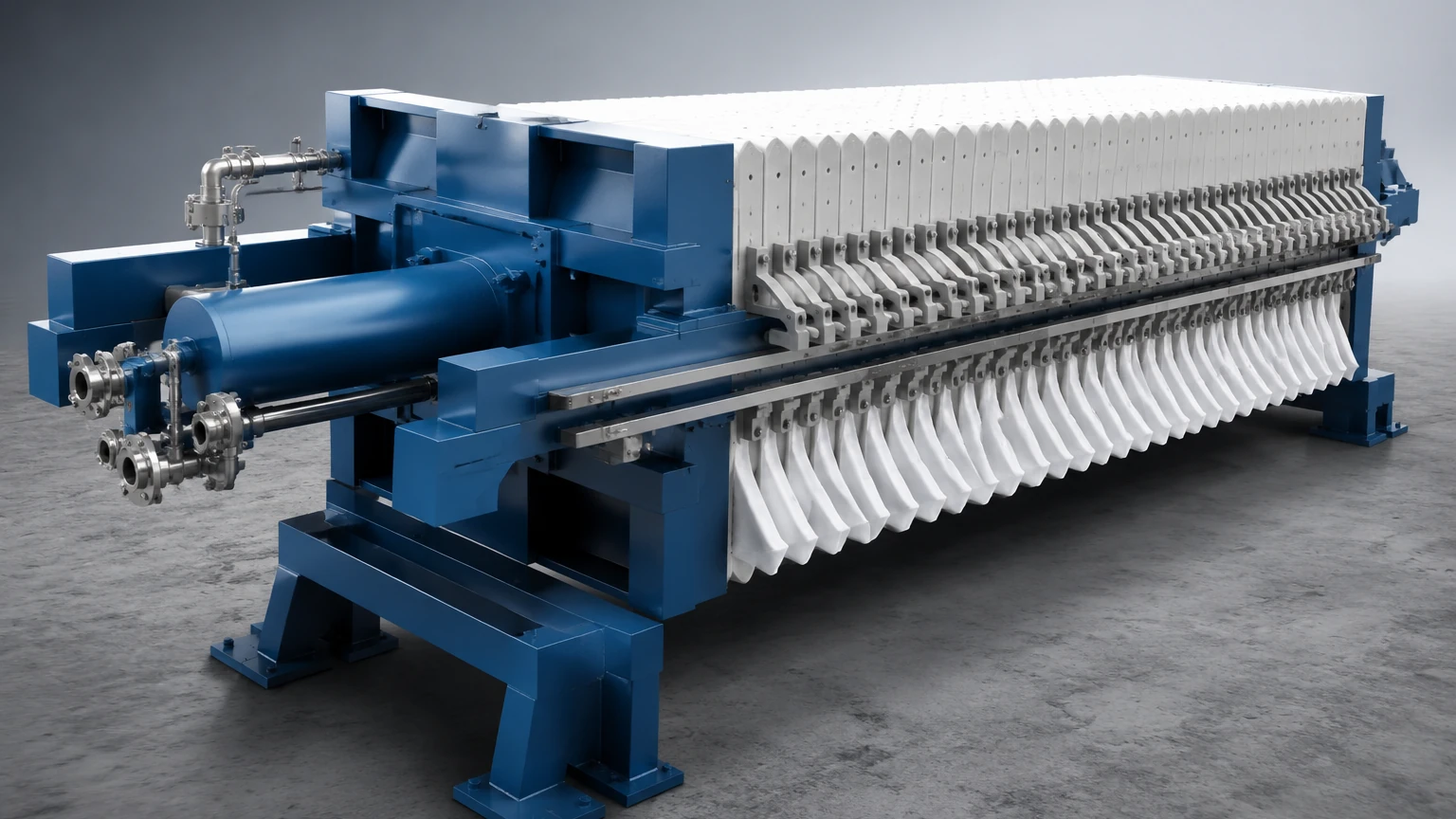
Membrane Plate Filter Press
In industrial liquid-solid separation, the membrane plate filter press represents a significant technological advancement over traditional recessed chamber filter presses. While standard filtration systems rely solely on the feed pump's pressure to form a filter cake, membrane technology introduces a secondary mechanical squeeze. This process significantly reduces moisture content in the final cake, shortens cycle times, and improves the efficiency of cake washing. For engineers and procurement teams in the chemical processing, pharmaceutical, and wastewater treatment sectors, understanding the technical nuances of membrane plate systems is essential for optimizing plant throughput and reducing total operational costs.
At the core of this technology is the membrane plate, which consists of a support body and a flexible membrane surface. Unlike fixed-volume chambers, these plates can expand when inflated with air or water, physically compressing the solids trapped within the filter chamber. This capability addresses one of the primary limitations of conventional filtration: the diminishing returns of hydraulic feed pressure. By applying a uniform mechanical force across the entire surface of the cake, the membrane plate filter press achieves a level of dewatering that is often unattainable through pumping alone.
The Mechanics of Membrane Squeeze Technology
The operation of a membrane plate filter press follows a specific sequence that distinguishes it from other filtration methods. The process begins with the "Fill and Filtration" stage, where slurry is pumped into the chambers formed between the plates. As the liquid (filtrate) passes through the filter cloth, solids begin to accumulate on the surface. In a standard press, this stage continues until the chambers are full and the flow rate drops significantly.
In a membrane system, however, the "Squeeze Phase" follows the initial filtration. Once the chambers are filled, a secondary medium—typically compressed air or high-pressure water—is introduced into the hollow interior of the membrane plates. The flexible faces of the plates expand outward, exerting mechanical pressure on the filter cake. This compression forces out interstitial liquid that remained trapped between the solid particles after the initial pumping phase.
This secondary squeeze is particularly effective for compressible solids or fine-particle slurries that tend to retain moisture. By adjusting the squeeze pressure, operators can precisely control the final moisture content of the cake. Following the squeeze, many systems also incorporate an "Air Blow" phase, where compressed air is passed through the cake to further remove moisture and clear the internal channels before the plates are opened for cake discharge.
Key Performance Advantages in Industrial Applications
The decision to implement a membrane plate filter press is usually driven by specific performance requirements that go beyond simple separation. The primary advantages include:
1. Reduced Cake Moisture
The most direct benefit is the production of a drier filter cake. In many industries, the filter cake is a waste product that must be transported and disposed of; reducing moisture content significantly lowers these costs. In cases where the cake is the final product, such as in mineral processing or pigment manufacturing, a drier cake reduces the energy required for subsequent thermal drying stages.
2. Shortened Filtration Cycles
In a traditional chamber press, the final stages of filtration are slow as the cake thickness increases and resistance rises. A membrane press allows the operator to stop the feed pump earlier—when the chamber is about 80% full—and use the membrane squeeze to complete the dewatering. This can reduce total cycle times by 30% to 50%, effectively increasing the daily capacity of the equipment without increasing its footprint.
3. Enhanced Cake Washing Efficiency
For applications requiring high purity, such as pharmaceutical intermediates or specialty chemicals, the filter cake must be washed to remove impurities. Membrane plates allow for "Squeeze-Wash-Squeeze" protocols. By squeezing the cake before washing, the wash liquid is forced to flow more uniformly through the solids rather than finding paths of least resistance (channeling). A second squeeze after washing ensures that the maximum amount of wash liquid is recovered.
Engineering and Material Selection
Selecting the right materials for membrane plates is critical for ensuring long-term reliability and chemical compatibility. The support body of the plate is typically manufactured from reinforced polypropylene (PP), which offers excellent chemical resistance and mechanical strength. However, the membrane itself must be flexible and durable enough to withstand thousands of expansion and contraction cycles.
Common membrane materials include:
* Polypropylene (PP): Often used for the entire plate in a "one-piece" design. These are cost-effective and chemically robust but may have limits on the maximum squeeze pressure.
* EPDM (Ethylene Propylene Diene Monomer): A synthetic rubber that provides excellent flexibility and resistance to heat and many chemicals. EPDM membranes are often replaceable, allowing the support body to be reused.
* NBR (Nitrile Butadiene Rubber): Preferred for applications involving oils or hydrocarbons where EPDM might swell or degrade.
* Thermoplastic Elastomers (TPE): These offer a balance between the chemical resistance of PP and the flexibility of rubber.
Engineers must also consider the "Squeeze Medium." Using compressed air is common due to ease of installation, but high-pressure water is often preferred for higher squeeze pressures (above 10-12 bar) because water is incompressible, providing a safer and more consistent force during the expansion phase.
Integration with Precision Filtration Components
While the membrane plate filter press is the primary dewatering unit, its performance is heavily dependent on the quality of the surrounding filtration infrastructure. The longevity of membrane plates is often threatened by the presence of oversized particles or abrasive contaminants in the feed slurry, which can cause premature wear or puncturing of the flexible membrane surface.
This is where high-performance stainless steel filtration components become essential. Utilizing precision-engineered wire mesh filters or stainless steel filter cartridges in the pre-filtration stage ensures that the slurry entering the press is consistent and free of debris that could damage the membranes. Furthermore, the filtrate produced by the press often requires polishing to meet strict environmental or process standards. In these instances, stainless steel filtration solutions provide the durability and accuracy needed to handle the high flow rates and chemical demands of industrial discharge. For engineers seeking to optimize the entire filtration circuit, it is useful to Review product options and application support to ensure that every component, from the primary press to the final polishing stage, is matched to the specific demands of the application.
Selection Criteria and Common Risks
When specifying a membrane plate filter press, several technical factors must be confirmed to avoid operational failures. One common risk is "uneven cake thickness." If the chambers are not filled properly before the squeeze phase begins, the membrane can expand into empty space, leading to over-stretching and eventual rupture. Automated control systems with pressure sensors are often required to ensure the squeeze only occurs when the chamber is sufficiently pressurized.
Engineers should evaluate the following before purchase:
* Slurry Characteristics: Abrasiveness, particle size distribution, and chemical pH will dictate the membrane material and the type of filter cloth required.
* Throughput Requirements: Determine the total volume of solids to be processed per day to calculate the necessary chamber volume and the number of plates.
* Automation Level: Membrane presses often require more sophisticated automation than chamber presses to manage the squeeze and air-blow sequences safely.
* Total Cost of Ownership (TCO): While the initial capital expenditure for a membrane press is higher than a chamber press, the savings in disposal costs, energy, and increased throughput often result in a lower TCO over the life of the equipment.
Maintenance and Operational Longevity
Maintenance of a membrane plate filter press focuses heavily on the integrity of the membranes and the cleanliness of the filter cloths. Over time, filter cloths can become "blinded" with fine particles, which increases resistance and reduces the efficiency of the squeeze. Regular cloth washing—often integrated into the press as an automated high-pressure spray bar system—is necessary to maintain performance.
Membranes themselves are wear parts. Their lifespan is affected by the squeeze pressure, the temperature of the process fluid, and the frequency of cycles. Replaceable membrane designs are often preferred in high-duty applications because they allow for faster maintenance without the need to replace the entire plate assembly. It is also vital to monitor the hydraulic system that keeps the plate stack closed; the closing force must always exceed the combined force of the feed pressure and the membrane squeeze pressure to prevent leaking or "spraying" between the plates.
In summary, the membrane plate filter press is a sophisticated tool for modern industrial dewatering. By combining hydraulic pressure with mechanical compression, it provides a level of efficiency and cake dryness that standard systems cannot match. When integrated with high-quality stainless steel filtration components and supported by rigorous engineering selection, these systems offer a reliable solution for the most demanding separation challenges in the global industrial market.
