


Microscreen Drum Filter
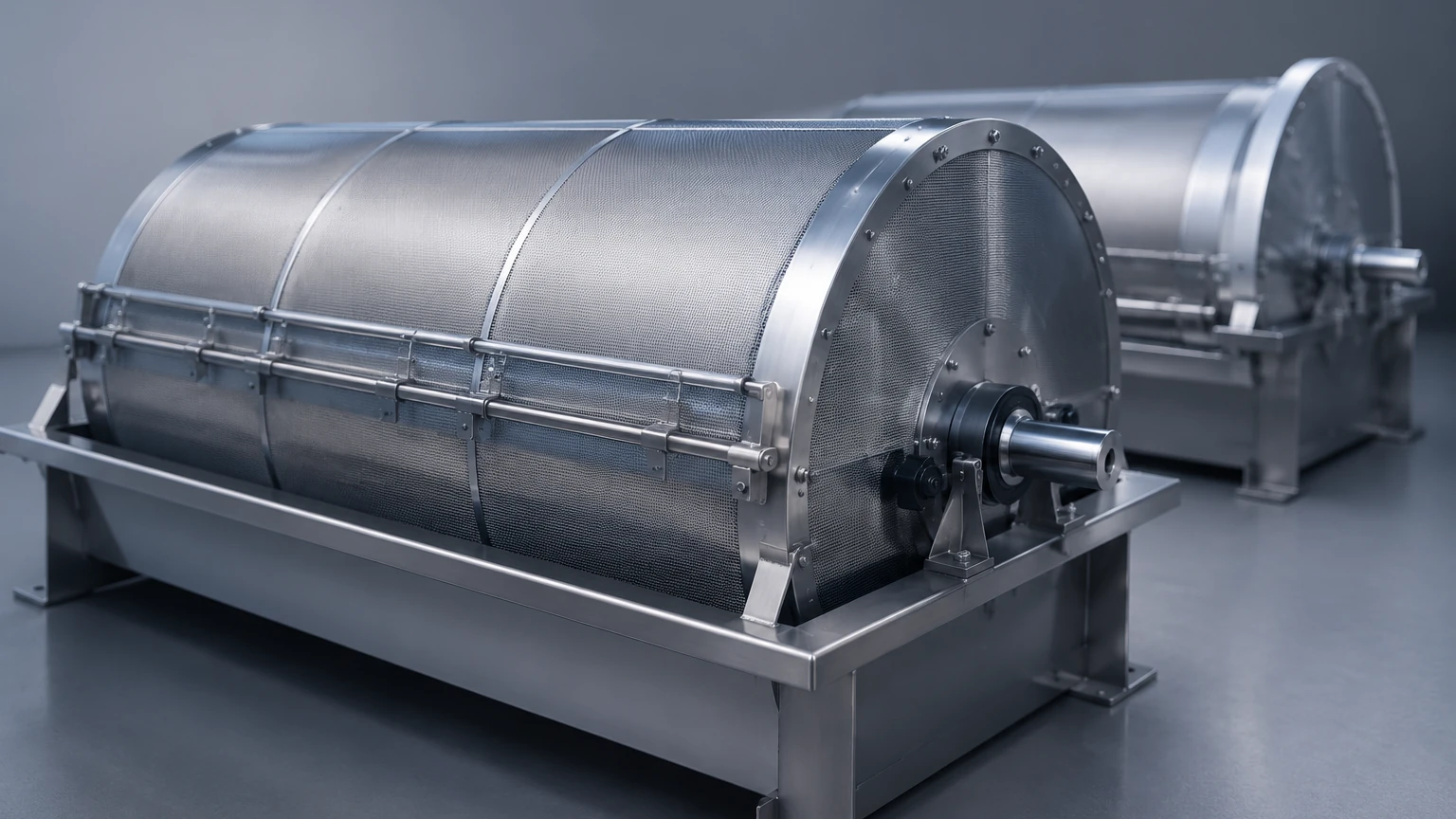
In industrial liquid-solid separation, the microscreen drum filter serves as a critical component for continuous, low-energy filtration of large volumes of water or process fluids. This mechanical filtration technology relies on a rotating drum equipped with precision-engineered filter media—typically stainless steel wire mesh—to remove suspended solids from a liquid stream. For engineers and technical procurement teams, understanding the mechanical nuances, material specifications, and operational variables of these systems is essential for optimizing process efficiency and ensuring the longevity of downstream equipment.
As a specialized manufacturer of stainless steel filtration solutions, Kaifil provides the high-precision components required for these systems. Whether for municipal wastewater treatment, industrial cooling water, or aquaculture, the performance of a microscreen drum filter is fundamentally tied to the quality and configuration of its filtration surface. You can explore our extensive range of technical resources and component specifications on our Main Page.
Principles of Operation in Drum Filtration
The fundamental operation of a microscreen drum filter is based on the principle of surface filtration. The system consists of a horizontal drum partially submerged in a tank or channel. As the influent (the liquid containing solids) enters the interior of the drum, it passes through the filter media covering the drum's circumference. The liquid permeates the mesh, while solids larger than the mesh aperture are retained on the inner surface.
As the solids accumulate, they form a "filter cake," which actually increases the filtration efficiency by trapping smaller particles. However, this accumulation also increases the hydraulic resistance, leading to a rise in the water level inside the drum. Once a predetermined head loss or water level differential is reached, the drum begins to rotate, and a backwash system is activated. High-pressure spray nozzles located outside the drum blast the retained solids into a collection trough for removal. This continuous cycle allows the system to handle fluctuating solids loads without interrupting the flow.
Engineering Considerations for Filter Media
The choice of filter media is the most significant factor in determining the performance of a microscreen drum filter. While synthetic materials like polyester are sometimes used in low-demand environments, industrial applications typically require the durability and precision of stainless steel wire mesh.
Wire Mesh Weave Types
In the context of microscreening, the weave type affects both the filtration rating and the mechanical strength of the drum surface.
* Plain Weave: This is the most common weave, where each warp wire crosses over and under each shute wire. It provides a consistent aperture size and is easy to clean during the backwash cycle.
* Twilled Weave: In this configuration, each shute wire passes over and under two warp wires. This allows for the use of heavier wires for a given mesh count, providing greater mechanical strength for high-pressure or high-load applications.
* Dutch Weave: For applications requiring extremely fine filtration (below 20 microns), Dutch weaves offer a dense, multi-layered structure. While highly efficient, they require more intensive backwashing to prevent blinding.
Micron Rating and Open Area
Engineers must balance the required filtration accuracy (micron rating) with the necessary flow rate. A smaller micron rating removes finer particles but reduces the "open area" percentage of the mesh. A lower open area increases the velocity of the fluid through the pores, which can lead to particle shearing or increased head loss. In industrial design, the goal is to maximize the open area while maintaining the structural integrity of the mesh under the pressure of the backwash system.
Material Selection: SS304 vs. SS316L
In industrial filtration, material compatibility is non-negotiable. The environment in which the microscreen drum filter operates dictates the grade of stainless steel required for the mesh and the supporting drum structure.
1. Stainless Steel 304: This is the standard grade for general industrial use. It offers excellent strength and good corrosion resistance in freshwater applications and many organic chemicals. It is a cost-effective choice for food and beverage processing where high-salinity or high-acidity conditions are not present.
2. Stainless Steel 316L: For more demanding environments, such as chemical processing, pharmaceutical manufacturing, or brackish water treatment, SS316L is preferred. The addition of molybdenum provides superior resistance to pitting and crevice corrosion, particularly in chloride-rich environments. The "L" denotes low carbon content, which improves weldability and prevents sensitization during the manufacturing of the drum components.
Kaifil's manufacturing capabilities allow for the customization of these materials to meet specific chemical compatibility profiles, ensuring that the filter media does not degrade or contaminate the process fluid.
Operational Parameters and Efficiency
When evaluating a microscreen drum filter for a specific application, several hydraulic and mechanical parameters must be confirmed to ensure the system meets performance expectations.
Flow Rate and Solids Loading
The capacity of a drum filter is defined by the volume of liquid it can process per unit of time (e.g., m³/h). This is influenced by the drum's surface area, the mesh's open area, and the concentration of suspended solids. High solids loading (high TSS) requires a larger drum surface or a more frequent backwash cycle to prevent the system from becoming overwhelmed.
Hydraulic Head Loss
Head loss is the difference in water level between the inside and outside of the drum. It is the driving force that pushes the liquid through the mesh. Engineers must calculate the maximum allowable head loss to prevent structural damage to the mesh and to ensure that the influent pump or gravity feed system can maintain the necessary flow.
Backwash Efficiency
The backwash system's effectiveness determines the filter's long-term stability. If the spray nozzles do not adequately clear the mesh, "blinding" occurs, where particles become permanently lodged in the pores. This leads to a permanent increase in head loss and a decrease in throughput. Factors such as nozzle pressure, spray angle, and water quality used for backwashing are critical design considerations.
Industrial Applications and Compatibility
The versatility of the microscreen drum filter makes it suitable for a wide range of industrial sectors, provided the components are engineered for the specific stresses of each environment.
* Food and Beverage: Used for primary screening of process water and the recovery of valuable solids. In this sector, the use of food-grade stainless steel and sanitary design principles is paramount to prevent bacterial growth.
* Chemical Processing: In chemical plants, these filters often handle aggressive solvents or corrosive byproducts. The choice of SS316L or specialized alloys is necessary to withstand these conditions.
* Pharmaceuticals: Precision filtration is required to ensure the purity of process water. The ability to provide exact micron ratings and high-quality surface finishes is essential for regulatory compliance.
* Aquaculture and Water Treatment: Large-scale fish farming relies on drum filters to remove organic waste. Here, the focus is on continuous operation and the ability to handle high flow rates with minimal maintenance.
Maintenance and Total Cost of Ownership
While the initial capital expenditure for a microscreen drum filter is a significant factor, the total cost of ownership (TCO) is largely driven by maintenance and energy consumption.
Mesh Replacement Cycles
The wire mesh is a wear part. Over time, the mechanical stress of rotation and the high-pressure impact of backwashing can lead to fatigue or physical damage. Selecting high-quality, precision-woven mesh from a reliable manufacturer like Kaifil can significantly extend the interval between replacements. Engineers should evaluate the ease of mesh replacement—some designs allow for individual panels to be swapped out without dismantling the entire drum.
Cleaning and Biofouling
In many water-based applications, biofouling (the growth of algae or bacteria on the mesh) can impede flow. Regular chemical cleaning or the integration of UV sterilization systems may be necessary. The chemical resistance of the stainless steel mesh allows for the use of aggressive cleaning agents that would destroy synthetic media.
Customization and Engineering Support
No two industrial filtration requirements are identical. A microscreen drum filter must be tailored to the specific particle size distribution, fluid viscosity, and chemical environment of the application. Customization options often include:
* Custom Drum Dimensions: Adjusting the diameter and length of the drum to fit existing tanks or space constraints.
* Variable Speed Drives: Allowing the drum rotation speed to be adjusted based on real-time solids loading.
* Specialized Mesh Configurations: Combining different mesh types or adding reinforcement layers for high-pressure environments.
Kaifil works closely with global customers to develop these customized filtration components. By focusing on material selection, filtration accuracy, and durable construction, we provide the reliable OEM solutions needed for demanding industrial environments. For technical specifications and to discuss your specific application needs, please visit our Main Page.
Conclusion
The microscreen drum filter is a robust and efficient solution for large-scale industrial filtration, provided it is engineered with the correct materials and operational parameters. By focusing on the technical details of the wire mesh, the structural integrity of the drum, and the specific requirements of the application, engineers can ensure high-performance filtration with a manageable total cost of ownership. As industrial processes become more complex and environmental regulations more stringent, the role of precision-engineered filtration components will only continue to grow.
