


Oil Filter Elements
In industrial environments, the longevity and efficiency of machinery are directly linked to the cleanliness of the fluids circulating through them. Oil filter elements serve as the critical line of defense against particulate contamination, which is responsible for the vast majority of mechanical wear and system failures in hydraulic and lubrication circuits. Whether in chemical processing, power generation, or heavy manufacturing, selecting the appropriate filtration component requires a deep understanding of fluid dynamics, material science, and the specific demands of the operating environment.
Industrial oil filter elements are engineered to remove contaminants such as metal shavings, silica, soot, and oxidation products from hydraulic oils, lubricating oils, and fuels. By maintaining fluid purity, these components prevent abrasive wear on high-precision parts like valves, pumps, and bearings, thereby reducing downtime and extending the service life of the entire system.
Engineering Fundamentals of Oil Filter Elements
The performance of an oil filter element is defined by its ability to capture particles of a specific size while maintaining an acceptable pressure drop across the media. Engineers must evaluate several technical parameters when selecting a filter to ensure it meets the system's cleanliness requirements without impeding flow.
Filtration Ratings: Absolute vs. Nominal
Understanding the difference between nominal and absolute ratings is essential for technical procurement. A nominal rating refers to a filter's ability to retain a major weight percentage of particles of a certain size (often 50% to 95%), but it does not guarantee the exclusion of all larger particles. In contrast, an absolute rating indicates that 99.9% or more of particles at a specific micron size are captured. For critical applications, such as high-pressure hydraulic systems with sensitive servo-valves, absolute-rated elements are typically required to prevent catastrophic failure.
The Beta Ratio (β)
The industry standard for measuring filter efficiency is the Beta Ratio, determined through the ISO 16889 multi-pass test. The ratio is calculated by dividing the number of particles of a specific size upstream of the filter by the number of particles of the same size downstream. For example, a Beta Ratio of 1000 (βx = 1000) means that for every 1000 particles entering the filter, only one passes through. This provides a much more accurate representation of performance than simple percentage ratings.
Media Selection and Material Considerations
The choice of filter media is perhaps the most significant factor in determining the suitability of oil filter elements for a given application. While disposable cellulose or synthetic glass fiber media are common, many industrial applications require the durability and chemical resistance of metallic media.
Stainless Steel Wire Mesh
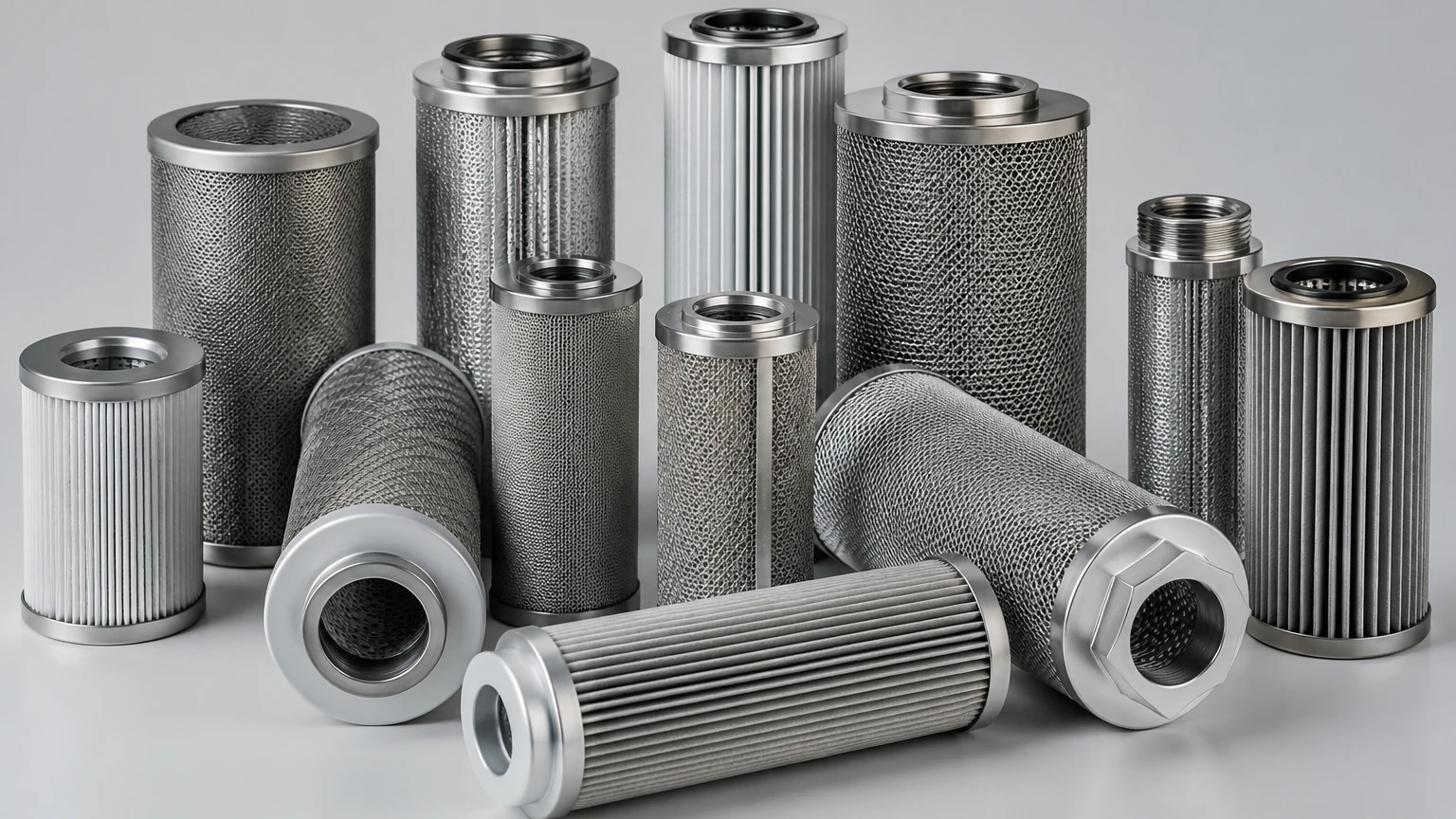
Stainless steel wire mesh is a preferred choice for high-temperature and chemically aggressive environments. These elements provide surface filtration, where particles are trapped on the outer layer of the mesh. The primary advantages of stainless steel mesh include:
* Cleanability: Unlike depth media, wire mesh elements can often be cleaned and reused, providing a lower long-term cost in specific applications.
* Structural Integrity: Stainless steel can withstand high differential pressures without collapsing or shedding media fibers into the fluid stream.
* Chemical Compatibility: Grades such as 304 and 316L offer excellent resistance to corrosion from additives in synthetic oils or harsh process chemicals.
Depth vs. Surface Filtration
Depth filtration media, such as fiberglass or pleated cellulose, trap contaminants within the thickness of the material. This allows for a higher dirt-holding capacity but makes the elements non-cleanable. Surface filtration, characteristic of precision wire mesh, is ideal for applications where the particle size distribution is relatively uniform and where the ability to withstand high pressure or temperature is paramount.
Structural Components and Design Integrity
An oil filter element is more than just the media; its structural components must be designed to survive the mechanical stresses of industrial operation. A failure in the housing or the internal support can lead to "media migration" or a complete bypass of the filtration stage.
Center Tubes and Support Shrouds
The internal center tube provides the necessary collapse strength to resist the differential pressure that builds up as the filter becomes loaded with contaminants. In high-viscosity applications or cold-start conditions, the pressure spike can be significant. High-quality industrial elements utilize perforated stainless steel or heavy-duty plated steel tubes to ensure structural stability.
End Caps and Sealing Mechanisms
End caps secure the media and provide the interface with the filter housing. These are typically manufactured from stainless steel, aluminum, or specialized polymers. The sealing method—whether using O-rings, gaskets, or metal-to-metal seals—must be compatible with the specific oil type and operating temperature. For instance, Viton (FKM) seals are often required for high-temperature synthetic lubricants, whereas Nitrile (Buna-N) may suffice for standard mineral oils.
Application-Specific Requirements
Different industrial systems place unique demands on oil filter elements. A "one-size-fits-all" approach often leads to premature failure or inadequate protection.
Hydraulic Systems
Hydraulic filters must handle varying flow rates and rapid pressure fluctuations. High-pressure line filters require elements with high collapse ratings, while return-line filters focus on high dirt-holding capacity to capture wear debris before the oil returns to the reservoir.
Lubrication Systems
In large-scale lubrication systems for turbines or compressors, the focus is often on removing fine particles that can cause varnish formation. These systems may use large-format pleated elements to maximize surface area and minimize the frequency of maintenance intervals.
Fuel Filtration
For industrial diesel engines or gas turbines, oil filter elements must also manage water separation. Coalescing elements are often used in conjunction with particulate filters to ensure that both solid contaminants and moisture are removed before the fuel reaches the combustion chamber.
Customization and OEM Solutions
Standard off-the-shelf filters frequently fall short in specialized industrial machinery. Custom-engineered oil filter elements allow for optimized performance tailored to specific spatial constraints and fluid characteristics. As a professional manufacturer, Kaifil specializes in developing bespoke filtration solutions that meet precise engineering specifications.
Customization options often include:
* Tailored Micron Ratings: Adjusting the weave or density of the media to target specific contaminant profiles.
* Specialized Dimensions: Designing elements to fit legacy housings or compact modern equipment where standard sizes are not applicable.
* Enhanced Material Grades: Utilizing 316L stainless steel or Hastelloy for extreme chemical resistance.
For engineers and purchasing teams looking to optimize their filtration strategy, reviewing the technical capabilities on our Main Page can provide insights into how custom manufacturing supports operational efficiency.
Maintenance and Total Cost of Ownership (TCO)
While the initial purchase price of oil filter elements is a factor, the total cost of ownership is a more critical metric for B2B decision-makers. TCO includes the cost of the element, the labor for replacement, the cost of oil disposal, and, most importantly, the cost of potential equipment downtime.
Monitoring Differential Pressure
The most effective way to manage filter maintenance is through differential pressure (ΔP) monitoring. As the filter captures contaminants, the resistance to flow increases. Most industrial housings are equipped with visual or electrical indicators that signal when the ΔP reaches a predetermined limit. Replacing elements based on actual condition rather than a fixed time interval prevents premature replacement while ensuring the system is never at risk of going into bypass mode.
Oil Analysis as a Diagnostic Tool
Regular oil analysis provides a window into the health of both the fluid and the filter. By tracking the ISO Cleanliness Code (ISO 4406), maintenance teams can verify that the oil filter elements are performing as expected. A sudden increase in particle count despite a low ΔP may indicate media rupture or a failing seal, necessitating immediate investigation.
Selecting a Reliable Filtration Partner
Choosing the right oil filter elements involves balancing technical performance with supply chain reliability. For industrial operators, a partner who understands the nuances of material selection and manufacturing precision is invaluable. High-performance stainless steel filters offer a level of durability and chemical compatibility that standard disposable filters cannot match, making them the preferred choice for demanding B2B applications.
By focusing on quality construction, precise filtration ratings, and application-specific designs, facilities can significantly reduce the risk of component wear and unexpected system failure. Whether you are replacing elements in a hydraulic press or designing a new lubrication circuit for a chemical plant, the technical integrity of the filter element is the foundation of system reliability.
