


Oil Press Filters
In industrial oil extraction and processing, the efficiency of separation directly dictates the quality, clarity, and shelf-life of the final product. Oil press filters serve as the critical barrier between raw extracted fluids and refined oil, removing suspended solids, meal fines, and organic impurities. For engineers and plant managers, selecting the correct filtration media is not merely a matter of sizing; it involves a complex evaluation of mechanical strength, chemical compatibility, and thermal stability.
Whether used in screw press expellers, hydraulic presses, or secondary refining stages, these filtration components must withstand significant pressure differentials while maintaining precise micron ratings. As a specialized manufacturer, Kaifil provides engineered stainless steel solutions designed to meet the rigorous demands of industrial oil processing. For detailed technical specifications and support, professionals can visit the Main Page to explore customized filtration options.
The Role of Filtration in Mechanical Oil Extraction
Mechanical oil extraction, particularly through screw pressing (expelling), generates a crude oil that contains a high percentage of "foots" or solid particles. These particles consist of seed husks, meal fragments, and proteins that can accelerate oxidation and spoilage if not removed immediately.
Oil press filters are integrated into the process to achieve several objectives:
1. Clarification: Removing visible particulates to produce a clear, bright oil.
2. Equipment Protection: Preventing downstream refining equipment, such as centrifuges and heat exchangers, from clogging or abrasive wear.
3. Yield Optimization: Efficiently separating oil from the solid cake to minimize oil loss in the waste stream.
4. Chemical Stability: Reducing the presence of organic solids that can catalyze the breakdown of fatty acids.
In high-volume industrial settings, the choice of filter media—ranging from simple cloth to advanced multi-layer stainless steel mesh—determines the frequency of maintenance cycles and the total throughput of the production line.
Technical Specifications of Stainless Steel Oil Press Filters
Stainless steel is the preferred material for industrial oil press filters due to its durability and resistance to the high temperatures associated with hot pressing. Engineering these filters requires a focus on several key technical parameters.
Material Selection: 304 vs. 316L
While Type 304 stainless steel is sufficient for many vegetable oil applications, Type 316L is often specified for oils with higher acidity or applications involving chemical solvents (such as hexane extraction). The addition of molybdenum in 316L provides superior resistance to pitting and corrosion, which is essential for maintaining the integrity of the filter mesh over years of service.
Weave Types and Micron Ratings
The geometry of the wire mesh determines the filtration characteristics. Common weaves include:
* Plain Weave: Suitable for coarse filtration where high flow rates are prioritized over fine particle retention.
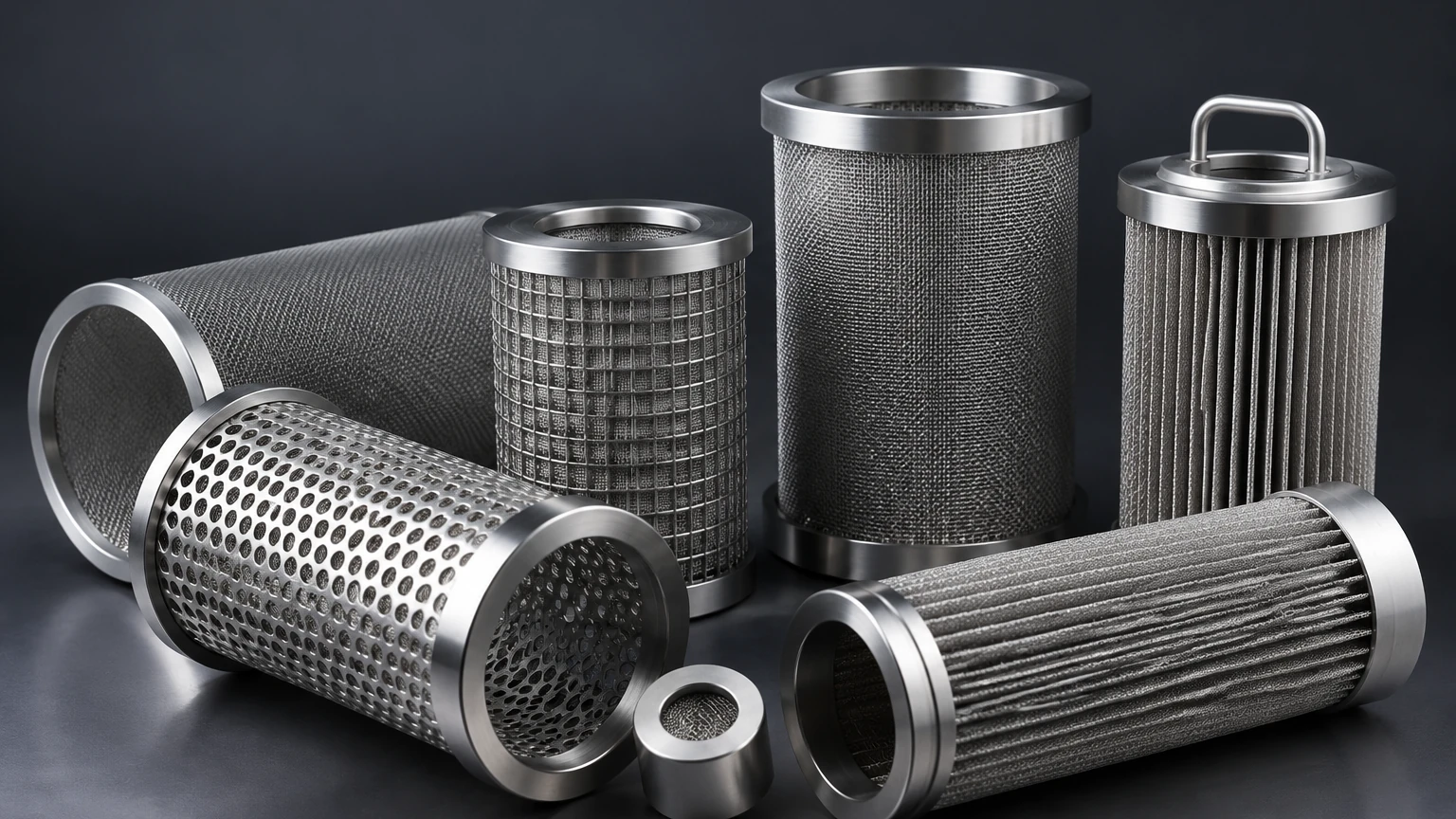
* Plain Dutch Weave: Offers a compact, firm mesh with small triangular openings. This is ideal for high-pressure oil press filters as it provides high mechanical strength and excellent retention of fine meal particles.
* Twilled Dutch Weave: Used for the finest filtration requirements (down to 5-10 microns), allowing for a high density of wires in a multi-layered structure.
Pressure Resistance and Support Structures
Oil pressing involves significant mechanical force. Filter elements must be engineered to resist deformation under high differential pressure ($ΔP$). This is typically achieved by using a multi-layer sintered structure or by reinforcing the fine filter mesh with a coarser support mesh and a perforated metal core. These layers are often bonded through vacuum sintering to ensure they act as a single, rigid component that will not delaminate under pressure surges.
Engineering Considerations for Flow and Viscosity
One of the primary challenges in oil filtration is the high viscosity of crude oils, especially at lower temperatures. The relationship between temperature, viscosity, and pressure drop is a fundamental engineering consideration when sizing oil press filters.
Temperature Effects
As the temperature of the oil increases, its viscosity decreases, allowing for higher flow rates through the filter media. However, high temperatures can also affect the structural integrity of non-metallic filters. Stainless steel filters remain stable at temperatures exceeding 300°C, making them suitable for both cold-press and hot-press operations. Engineers must calculate the required filtration area based on the maximum viscosity (lowest operating temperature) to ensure the system does not reach the bypass pressure prematurely.
Flux Rate and Surface Area
The flux rate—the volume of oil passing through a unit area of filter media per unit of time—is influenced by the available open area of the mesh. To maximize throughput without increasing the footprint of the machinery, pleated filter cartridges are often utilized. Pleating increases the effective surface area by 3 to 5 times compared to a cylindrical filter of the same dimensions, significantly extending the time between cleaning cycles.
Comparing Reusable Metal Filters vs. Disposable Media
In the B2B industrial sector, the choice between reusable stainless steel filters and disposable media (such as filter paper or cloth) involves a Total Cost of Ownership (TCO) analysis.
| Feature | Stainless Steel Mesh | Disposable Cloth/Paper |
| :— | :— | :— |
| Initial Cost | Higher | Lower |
| Durability | Years of service | Single or limited use |
| Cleaning | Ultrasonic or backwash | Replacement required |
| Waste Generation | Minimal | Significant |
| Pressure Tolerance | Very High | Low to Moderate |
| Filtration Precision | Consistent | Variable with saturation |
For continuous industrial operations, stainless steel oil press filters offer a lower TCO despite the higher initial investment. They eliminate the recurring costs of purchasing, storing, and disposing of contaminated filter media. Furthermore, metal filters provide a fixed pore size that does not stretch or widen under pressure, ensuring consistent oil quality throughout the production run.
Maintenance, Cleaning, and Service Life
To maintain optimal performance, oil press filters require a structured maintenance protocol. Over time, fine particles can become trapped within the depth of the mesh, a phenomenon known as "blinding."
Cleaning Methods
1. Backflushing: Using a reverse flow of clean oil or solvent to dislodge particles from the surface of the mesh. This can often be automated within the filtration system.
2. Ultrasonic Cleaning: For deep-seated particulates, removing the filter element and placing it in an ultrasonic bath is the most effective method. The high-frequency sound waves create cavitation bubbles that strip away contaminants without damaging the wire mesh.
3. Chemical Cleaning: Using specialized detergents or solvents to dissolve hardened organic deposits or resins that backflushing cannot remove.
Identifying Wear and Failure
Engineers should monitor the differential pressure across the filter. A rapid increase in $ΔP$ after cleaning usually indicates that the filter has reached the end of its effective service life and requires professional refurbishment or replacement. Regular inspection for mechanical damage, such as mesh tearing or weld failure, is also essential to prevent unfiltered oil from bypassing the system.
Customization and OEM Integration
Industrial oil presses vary significantly in design, from small-scale specialty oil extractors to massive industrial refineries. Standardized filter elements often fail to meet the specific spatial or flow requirements of proprietary machinery.
Customization options for oil press filters include:
* Custom End Fittings: Threaded, flanged, or bayonet-style connections to match existing piping.
* Variable Layering: Adjusting the number of sintered layers to balance filtration fineness with structural rigidity.
* Specific Dimensions: Tailoring the length and diameter to fit unique filter housings.
By working with a manufacturer that understands the nuances of metal filtration, engineering teams can optimize their systems for specific seed types—such as sunflower, rapeseed, soybean, or specialty nut oils—each of which has unique particulate characteristics and oil chemistry.
Selecting the Right Filtration Partner
Choosing a supplier for oil press filters requires an assessment of their manufacturing capabilities and engineering expertise. A reliable partner should provide more than just a component; they should offer technical guidance on material compatibility, micron selection, and flow optimization.
Kaifil specializes in the production of high-performance stainless steel filtration components, ensuring that industrial operators achieve the highest levels of purity and efficiency. With a focus on durability and precision, our solutions are tailored to the demanding environments of modern oil processing. For more information on our full range of industrial filtration products, please visit our Main Page.
Conclusion
Oil press filters are fundamental to the success of industrial oil extraction. By prioritizing high-quality stainless steel construction, precise micron ratings, and robust structural design, engineers can significantly improve oil clarity and reduce operational downtime. Understanding the technical trade-offs between different weave types, materials, and cleaning methods allows for a more informed procurement process, ultimately leading to a more efficient and profitable production line. As the industry moves toward more sustainable and continuous processing models, the role of durable, reusable metal filtration will only continue to grow in importance.
