


Pipe Sparger
In industrial process engineering, the efficient introduction of gas into a liquid medium is a fundamental requirement for numerous chemical, biological, and mechanical operations. A pipe sparger is a specialized device designed to facilitate this gas-liquid contact by dispersing gas in the form of discrete bubbles into a liquid stream or vessel. Unlike simple open-ended pipes, a precision-engineered pipe sparger utilizes porous media—often sintered stainless steel or fine wire mesh—to control bubble size, distribution, and velocity. This level of control is essential for optimizing mass transfer rates, ensuring uniform reaction conditions, and minimizing gas wastage.
For engineers and procurement professionals, selecting the correct sparging technology involves a deep understanding of fluid dynamics, material compatibility, and the specific requirements of the application. As a manufacturer specializing in custom stainless steel filtration and precision metal components, Kaifil provides the technical expertise necessary to design sparging solutions that withstand demanding industrial environments while maintaining high operational efficiency.
Fundamentals of Gas Sparging and Mass Transfer
The primary objective of using a pipe sparger is to maximize the interfacial surface area between the gas and the liquid. According to the principles of mass transfer, the rate at which a gas dissolves or reacts with a liquid is directly proportional to the total surface area of the gas bubbles.
When gas is forced through a porous pipe sparger, it is broken down into millions of micro-bubbles. Compared to a single large bubble, a multitude of small bubbles provides a significantly higher surface-area-to-volume ratio. This increased surface area accelerates the mass transfer process, whether the goal is oxygenation, carbonation, or chemical stripping. Furthermore, smaller bubbles have a lower rise velocity, which increases the "residence time"—the duration the gas remains in contact with the liquid before reaching the surface. This combination of high surface area and extended residence time ensures that the gas is utilized as efficiently as possible, reducing the volume of gas required for the process.
Types of Pipe Spargers and Design Configurations
Pipe spargers are not one-size-fits-all components; their design must be tailored to the geometry of the vessel and the flow characteristics of the liquid. Common configurations include:
Static Pipe Spargers
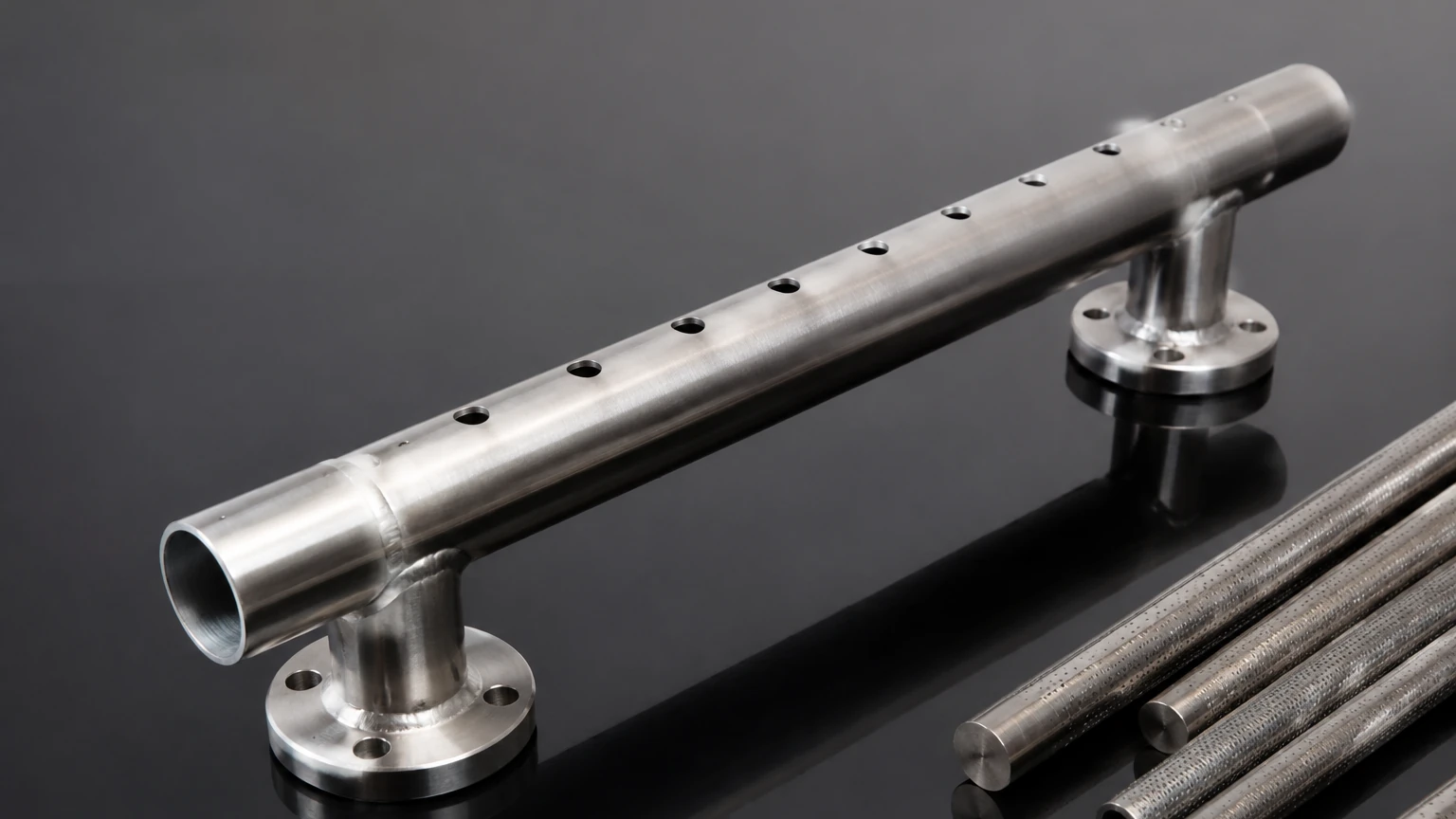
These consist of a single linear pipe, often capped at one end, with a porous section or a series of precision-drilled orifices. They are typically inserted into a pipeline or a tank. In pipeline applications, the sparger is often positioned concentrically to ensure even distribution across the flow profile.
Ring and Hub Spargers
For large-scale mixing tanks or fermentation vessels, a ring sparger provides more uniform coverage. By forming the porous media into a circular or "spider" hub configuration, gas can be introduced across the entire cross-section of the tank, preventing "dead zones" where gas-liquid contact might be insufficient.
Sintered Metal vs. Perforated Pipe
While traditional pipe spargers used simple drilled holes, modern high-efficiency systems utilize sintered metal media. Sintered stainless steel spargers offer a controlled pore size distribution, allowing for the creation of bubbles as small as 0.5 to 10 microns. Perforated pipes, by contrast, generally produce much larger bubbles and are prone to uneven distribution if the pressure drop across the orifices is not carefully managed.
Engineering Considerations for Material Selection
Material integrity is paramount in industrial sparging, as these components are often submerged in corrosive chemicals or subjected to high-temperature sterilization cycles. Stainless steel, particularly Grade 316L, is the industry standard due to its excellent corrosion resistance and mechanical strength.
When selecting materials for a pipe sparger, engineers must consider the following:
* Chemical Compatibility: The sparger must resist degradation from both the liquid medium and the gas being introduced (e.g., ozone, chlorine, or acidic vapors). For highly aggressive environments, alloys like Hastelloy or Monel may be required.
* Temperature Resistance: In applications like steam injection or high-temperature chemical synthesis, the material must maintain its structural integrity and pore geometry without warping or oxidizing.
* Structural Rigidity: Pipe spargers are often subjected to significant fluid forces, especially in agitated tanks. The design must include sufficient wall thickness and robust mounting connections (such as reinforced flanges or NPT threads) to prevent mechanical failure due to vibration or hydraulic shock.
Kaifil’s experience in manufacturing stainless steel filter cartridges and precision metal components ensures that every pipe sparger is built to withstand these rigorous conditions. For more detailed technical specifications, you can visit our Main Page to review product options and application support.
Performance Evaluation: Pore Size and Bubble Dynamics
The performance of a pipe sparger is largely defined by its pore size and the resulting bubble dynamics. The "bubble point"—the pressure at which gas first begins to pass through the largest pore of the submerged medium—is a critical metric for system design.
1. Pore Size Selection: A smaller pore size creates smaller bubbles, which is ideal for maximizing mass transfer. However, smaller pores also result in a higher pressure drop across the sparger. Engineers must balance the desire for efficiency with the available gas supply pressure.
2. Gas Exit Velocity: If the gas velocity through the pores is too high, bubbles may coalesce (merge) immediately upon exit, forming larger bubbles and defeating the purpose of the porous media. This phenomenon, known as "jetting," can be avoided by sizing the sparger surface area appropriately for the required gas flow rate.
3. Uniformity of Distribution: In a long pipe sparger, there is a risk that gas will preferentially exit near the inlet where the pressure is highest. Precision manufacturing ensures a uniform pressure drop across the entire length of the porous element, resulting in a consistent bubble curtain.
Industrial Applications and Process Integration
Pipe spargers are utilized across a broad spectrum of industries, each with unique performance requirements:
* Chemical Processing: Used for gas-liquid reactions such as hydrogenation, oxidation, and chlorination. Precision sparging ensures that expensive catalyst materials are used effectively by providing a consistent supply of reactant gas.
* Food and Beverage: Common applications include the carbonation of beverages, nitrogen stripping to remove dissolved oxygen (which prevents oxidation and extends shelf life), and the aeration of wort in brewing.
* Pharmaceutical and Biotech: In bioreactors, pipe spargers provide the oxygen necessary for cell growth. These applications require high-purity materials and designs that can be easily cleaned and sterilized (CIP/SIP).
* Water Treatment: Used for ozone injection to disinfect water or for aeration in wastewater treatment plants to support aerobic bacterial digestion.
Maintenance, Cleaning, and Replacement Cycles
Because pipe spargers operate as porous filters in reverse, they are susceptible to fouling. Particulates in the liquid can lodge in the pores, or mineral scales can build up on the surface, leading to an increased pressure drop and reduced gas flow.
To maintain performance, a regular maintenance schedule is necessary. Sintered stainless steel spargers are highly durable and can often be cleaned using:
* Ultrasonic Cleaning: Effectively removes fine particulates from deep within the porous structure.
* Chemical Circulation: Using acids or bases to dissolve mineral scale or organic deposits.
* Backflushing: Reversing the flow of gas or liquid to dislodge surface contaminants.
Engineers should monitor the differential pressure across the sparger. A significant increase in the pressure required to maintain a constant gas flow rate usually indicates that the sparger is fouled and requires cleaning or replacement. Because Kaifil focuses on high-quality manufacturing, our components are designed for longevity and repeated cleaning cycles, reducing the total cost of ownership.
Customization and Procurement Checklist
When ordering a pipe sparger for a specific industrial application, providing detailed specifications is essential for ensuring the component performs as expected. Purchasing teams and engineers should confirm the following data points before finalizing a design:
* Gas Type and Flow Rate: Specify the gas (e.g., O2, N2, CO2) and the required standard cubic feet per minute (SCFM) or liters per minute (LPM).
* Liquid Properties: Note the viscosity, temperature, and chemical composition of the liquid.
* Vessel Geometry: Provide the dimensions of the tank or pipe where the sparger will be installed to ensure proper fit and coverage.
* Connection Type: Specify flange ratings (ANSI/ASME), thread types (NPT/BSP), or sanitary tri-clamp fittings.
* Filtration/Pore Grade: Determine the required bubble size or pore micron rating based on mass transfer targets.
By addressing these factors, facilities can ensure they receive a customized filtration and sparging solution that integrates seamlessly into their existing infrastructure. Kaifil’s commitment to quality and precise filtration performance makes us a reliable partner for developing these high-performance components.
For technical assistance or to explore our full range of industrial filtration solutions, including wire mesh filters and custom cartridges, please visit our Main Page.
