


Plate and Frame Filter Press
The plate and frame filter press remains one of the most reliable and widely utilized technologies for solid-liquid separation in industrial processing. Characterized by its batch-operation nature and high-pressure capabilities, this equipment is essential for industries requiring high solids recovery and clear filtrate. For engineers and procurement teams, understanding the technical nuances of the plate and frame filter press—ranging from material selection to filtration efficiency—is critical for optimizing plant performance and ensuring long-term operational reliability.
At its core, the plate and frame filter press operates on the principle of pressure-driven filtration. By utilizing a series of plates and frames arranged in a sequence, the system creates chambers where solids are trapped while the liquid phase (filtrate) passes through a filter medium. As a manufacturer specializing in custom stainless steel filtration solutions, Kaifil provides the precision components and technical expertise necessary to enhance the performance of these systems, particularly in demanding environments such as chemical processing and pharmaceutical manufacturing.
Engineering Principles of Plate and Frame Filtration
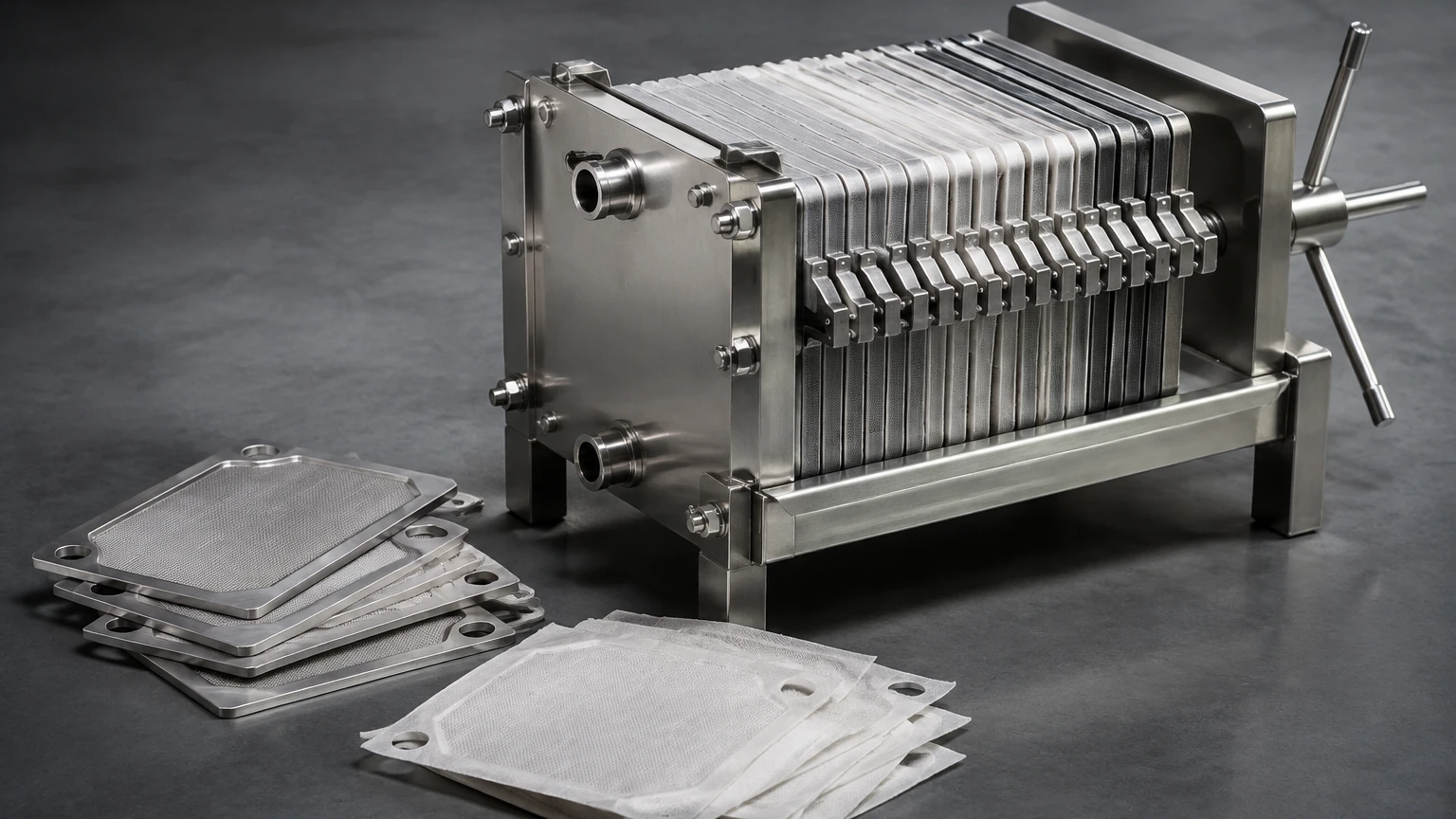
The fundamental design of a plate and frame filter press consists of a set of alternating solid plates and hollow frames. These components are supported by a heavy-duty metal structure and compressed together by a hydraulic or mechanical closing mechanism to form a series of watertight chambers.
The Filtration Cycle
The operation of a plate and frame filter press follows a structured cycle:
1. Closing: The hydraulic ram pushes the plates and frames together, creating a sealed internal environment capable of withstanding high injection pressures.
2. Filling: The slurry is pumped into the hollow frames. As the chambers fill, the pressure increases, forcing the liquid through the filter medium (such as wire mesh or filter cloth) draped over the plates.
3. Cake Formation: Solids accumulate on the surface of the filter medium, forming a "filter cake." This cake itself eventually acts as an additional filtration layer, often improving the clarity of the filtrate.
4. Washing (Optional): In applications where the solids must be purified or valuable liquid recovered from the cake, a wash liquid is pumped through the chambers.
5. Cake Discharge: Once the cycle is complete, the press is opened, and the solid cakes are removed from the frames.
From an engineering perspective, the efficiency of this cycle depends heavily on the pressure differential and the permeability of the filter medium. Utilizing high-quality stainless steel components ensures that the system can maintain structural integrity under the significant mechanical stresses generated during the compression and filling stages.
Material Selection: The Role of Stainless Steel
While many filter presses use polypropylene or other plastic materials for plates, industrial applications involving high temperatures, corrosive chemicals, or stringent hygiene requirements necessitate the use of stainless steel. Kaifil specializes in providing the precision metal filter components that support these high-performance requirements.
Advantages of Stainless Steel Components
* Corrosion Resistance: In chemical processing, slurries often contain acidic or alkaline components that would degrade standard materials. Stainless steel (typically 304 or 316L grades) provides the necessary chemical resistance to prevent premature failure.
* Thermal Stability: Many industrial filtration processes occur at elevated temperatures. Stainless steel maintains its mechanical properties and dimensional stability far better than polymers, ensuring a consistent seal and preventing leakage.
* Hygiene and Cleanability: For the food and beverage and pharmaceutical sectors, the non-porous surface of stainless steel is essential for preventing bacterial growth and facilitating thorough Cleaning-in-Place (CIP) procedures.
* Durability: Metal components offer superior resistance to abrasion from hard or sharp solid particles in the slurry, extending the replacement cycle of the internal filtration elements.
For technical teams evaluating their filtration infrastructure, reviewing product options and application support on the Kaifil Main Page can provide insights into how customized metal filtration components can be integrated into existing plate and frame systems to improve durability.
Key Evaluation Criteria for Engineers
When selecting or optimizing a plate and frame filter press, engineers must look beyond the basic dimensions of the machine. Several technical factors dictate the total efficiency of the separation process.
Filtration Accuracy and Micron Ratings
The choice of filter medium is the primary determinant of filtration accuracy. Whether using a woven wire mesh or a multi-layer sintered metal filter, the pore size must be carefully matched to the particle size distribution of the slurry. If the pore size is too large, "bleed-through" occurs, resulting in a cloudy filtrate. If it is too small, the filter may blind (clog) prematurely, leading to excessive pressure drops and shortened cycle times.
Chamber Volume and Cake Thickness
The depth of the frame determines the thickness of the filter cake. Engineers must balance the desire for high solids capacity with the need for efficient washing and discharge. A cake that is too thick may be difficult to wash thoroughly, while a cake that is too thin may not discharge cleanly from the medium.
Closing Force and Sealing Integrity
To prevent leakage between the plates, the filter press must exert a closing force that exceeds the internal pressure generated by the slurry pump. Engineers should verify the hydraulic specifications and ensure that the plate gaskets are compatible with the process fluids. Precision-machined stainless steel plates offer the flat surfaces required for a superior seal compared to molded plastic alternatives.
Common Operational Risks and Mitigation
Despite their robust design, plate and frame filter presses are subject to specific operational challenges that can impact productivity and safety.
Uneven Cake Formation
If the slurry is not distributed evenly across all chambers, some frames may overfill while others remain empty. This creates unbalanced forces within the plate stack, which can lead to plate warping or mechanical failure. Proper manifold design and consistent slurry concentration are essential for mitigating this risk.
Pressure Spikes
Rapidly increasing the pump pressure at the start of the cycle can compress the initial layer of solids too tightly against the filter medium, causing immediate blinding. A gradual ramp-up in pressure allows for the formation of a porous "pre-coat" of solids, which facilitates better flow throughout the remainder of the cycle.
Filter Medium Blinding
Over time, fine particles can become trapped within the pores of the filter mesh or cloth. In stainless steel filtration systems, this is often managed through ultrasonic cleaning or specialized chemical washes. Kaifil’s expertise in wire mesh filters ensures that the media provided are designed for optimal backwashing and longevity, reducing the total cost of ownership.
Customization and OEM Solutions in Filtration
Every industrial process has unique requirements that standard, off-the-shelf equipment may not fully address. Customization is particularly important when dealing with specialized slurries or extreme environmental conditions.
Kaifil works closely with global customers to develop tailored filtration solutions. This includes:
* Customized Micron Ratings: Engineering wire mesh with specific opening sizes to handle unique particle distributions.
* Material Upgrades: Utilizing high-nickel alloys or specialized stainless steel grades for extreme corrosion resistance.
* Structural Modifications: Designing precision metal filter components that fit into proprietary plate and frame designs for OEM manufacturers.
By focusing on the specific engineering challenges of the application—such as flow rate requirements, chemical compatibility, and mechanical stress—manufacturers can deliver components that significantly outperform generic alternatives.
Total Cost of Ownership (TCO) Considerations
For purchasing teams, the initial capital expenditure of a plate and frame filter press is only one part of the financial equation. The total cost of ownership (TCO) includes maintenance, replacement parts, energy consumption, and downtime.
1. Replacement Cycles: While stainless steel filter media have a higher upfront cost than fabric cloths, their lifespan is often significantly longer, especially in abrasive or high-temperature applications. This reduces the frequency of shutdowns for media replacement.
2. Labor Costs: The ease of cake discharge and the frequency of manual cleaning directly impact labor requirements. Systems designed with precision-engineered components often facilitate faster discharge and easier cleaning.
3. Waste Disposal: A more efficient filter press produces a drier filter cake. Since waste disposal costs are often calculated by weight, reducing the moisture content of the cake can lead to substantial annual savings.
Engineers looking to optimize these factors should consult with specialists who understand the intersection of material science and filtration mechanics. Accessing technical resources and selection advice through the Kaifil Main Page allows teams to make informed decisions that balance performance with long-term cost-effectiveness.
Conclusion
The plate and frame filter press remains a cornerstone of industrial separation technology due to its versatility and effectiveness. However, the performance of the system is only as reliable as its most critical components. By prioritizing high-quality materials like stainless steel and focusing on precision engineering, industrial facilities can achieve superior filtration accuracy, reduced maintenance costs, and enhanced durability.
Whether you are designing a new system or looking to optimize an existing filtration process, understanding the relationship between the equipment's mechanical design and the properties of the filter media is essential. As a professional manufacturer of custom stainless steel filtration solutions, Kaifil provides the technical support and high-performance components necessary to meet the most demanding industrial requirements. For more information on customized filtration components and OEM capabilities, visit the Kaifil Main Page to explore our full range of solutions.
