


Pocket Filters
In the landscape of industrial filtration, pocket filters—often referred to as bag filters—serve as a critical component for high-surface-area separation in both air and liquid processing environments. For engineers and procurement specialists managing chemical processing, pharmaceutical manufacturing, or food and beverage production, understanding the technical nuances of pocket filter construction, media selection, and operational performance is essential for optimizing system efficiency and reducing total cost of ownership.
As a specialized manufacturer of stainless steel filtration solutions, Kaifil recognizes that pocket filters often operate as part of a multi-stage filtration strategy. Whether used as secondary filters following a metal mesh pre-filter or as a primary stage in HVAC systems, their performance dictates the cleanliness of the downstream environment and the protection of sensitive equipment. This guide examines the engineering principles, selection criteria, and industrial applications of pocket filters within professional B2B contexts.
Engineering Fundamentals of Pocket Filter Design
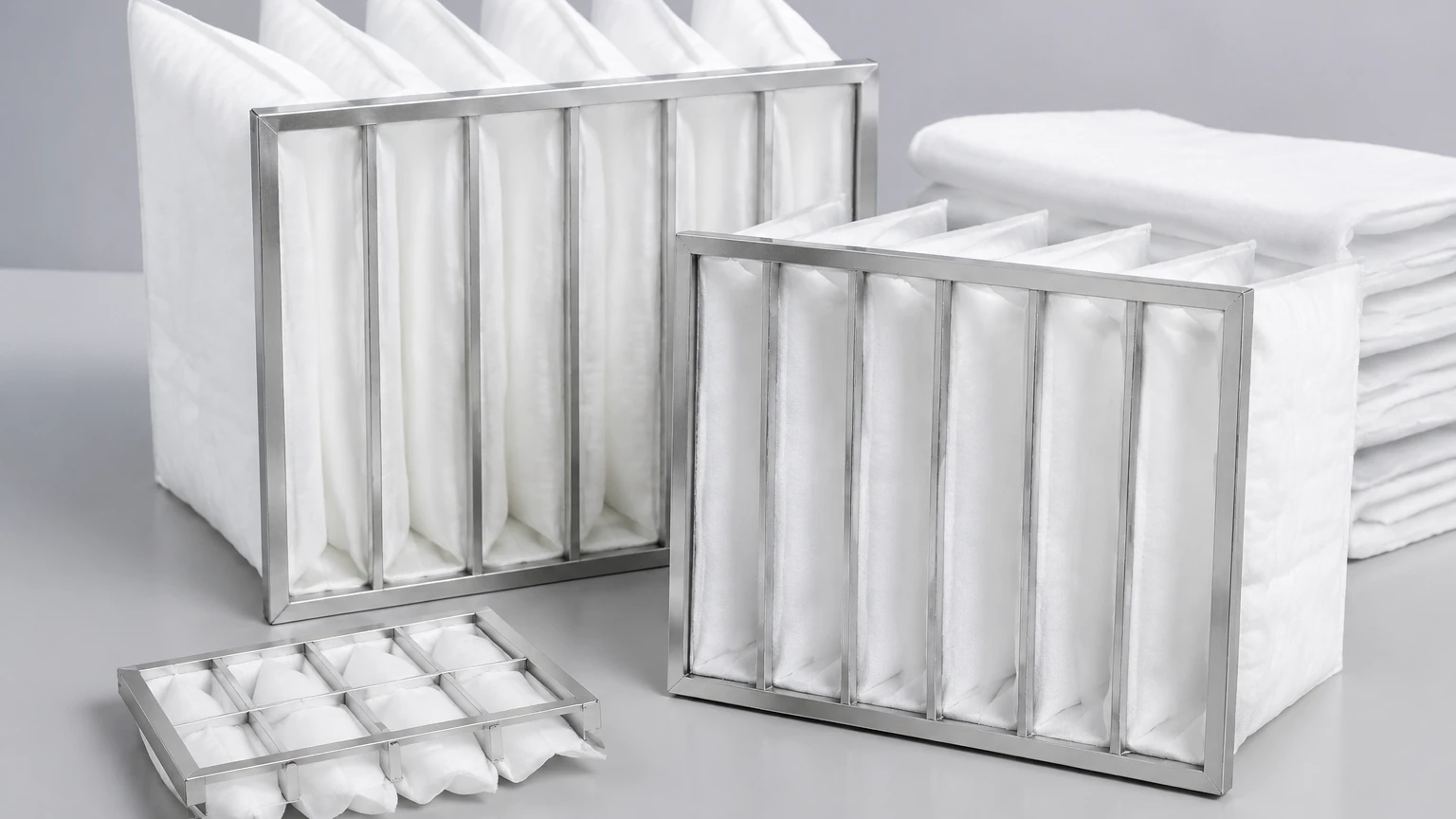
The primary advantage of a pocket filter lies in its geometry. By utilizing a series of deep, tapered pockets, these filters provide a significantly larger surface area relative to their face dimensions compared to flat-panel or pleated filters. This increased surface area is fundamental to achieving low resistance and high dust-holding capacity.
Pocket Configuration and Aerodynamics
Most industrial pocket filters consist of 3 to 12 pockets, depending on the required airflow and the dimensions of the header frame. The pockets are designed with a tapered or "V-shape" to ensure they remain inflated during operation without touching adjacent pockets. This aerodynamic stability is crucial; if pockets touch or collapse, the effective filtration area decreases, leading to a rapid increase in differential pressure and a reduction in filter life.
Header Frame Construction
The header frame provides the structural rigidity necessary to hold the pockets in place against the force of the bypass air or fluid. In standard applications, these frames are made from galvanized steel or high-impact plastic. However, in demanding industrial environments—such as those involving corrosive chemicals or high temperatures—stainless steel frames are often required. These frames must be precision-engineered to ensure a leak-proof seal within the filter housing, preventing the bypass of unfiltered contaminants.
Efficiency Standards and Performance Metrics
For technical professionals, selecting a pocket filter requires an understanding of standardized efficiency ratings. The transition from the older EN 779 standard to the ISO 16890 standard has changed how engineers evaluate filter performance, shifting the focus to the filter's ability to capture specific particulate matter (PM) sizes.
ISO 16890 and MERV Ratings
Under ISO 16890, pocket filters are categorized based on their efficiency in capturing PM1 (particles ≤ 1 μm), PM2.5 (≤ 2.5 μm), and PM10 (≤ 10 μm).
- ePM1: Used in pharmaceutical and cleanroom applications where sub-micron particle capture is critical.
- ePM2.5: Common in food processing and general industrial air intake systems.
- ePM10: Typically used as pre-filtration or in less sensitive industrial environments.
In North American markets, the MERV (Minimum Efficiency Reporting Value) scale remains prevalent. Pocket filters typically range from MERV 11 to MERV 15. Engineers must match the MERV or ISO rating to the specific sensitivity of the downstream processes to avoid over-specifying (which increases energy costs) or under-specifying (which risks product contamination).
Material Selection and Chemical Compatibility
The media used in pocket filters is selected based on the physical and chemical properties of the process stream. Since industrial environments often involve exposure to moisture, oils, or chemical vapors, the durability of the media is a primary engineering consideration.
Synthetic Melt-Blown Media
Synthetic materials, such as polypropylene or polyester, are widely used due to their moisture resistance and mechanical strength. These fibers are often produced using a melt-blown process, creating a gradient density structure where larger particles are trapped in the outer layers and finer particles are captured deeper within the media. Synthetic media is generally preferred in high-humidity environments where fiberglass might lose structural integrity.
Glass Fiber Media
Glass fiber media offers exceptional filtration efficiency and thermal stability. It is often used in applications where high-temperature resistance is required. However, glass fibers can be brittle; in systems with high vibration or frequent airflow fluctuations, synthetic alternatives may be more durable.
Sonic Welding and Seam Integrity
In high-quality pocket filters, the seams are joined using ultrasonic welding rather than stitching. Stitching creates needle holes that can allow particle bypass. Ultrasonic welding fuses the media layers together, creating a continuous, leak-proof bond that maintains the integrity of the pocket even under high pressure-drop conditions.
Operational Considerations: Pressure Drop and Service Life
From a maintenance perspective, the two most important data points for a pocket filter are the initial pressure drop and the recommended final pressure drop.
Differential Pressure (ΔP)
The initial pressure drop is the resistance the filter offers to the airflow when it is clean. A lower initial ΔP translates directly to lower energy consumption for the system's fans or pumps. As the filter loads with contaminants, the ΔP increases.
Engineers typically set a "change-out" pressure—often double the initial pressure or a specific value like 250-450 Pa for air systems—to ensure the system does not exceed its design capacity. Monitoring this via differential pressure gauges is a standard practice in industrial maintenance to prevent catastrophic filter failure or system inefficiency.
Dust-Holding Capacity (DHC)
DHC refers to the total weight of a specific synthetic dust that a filter can hold before reaching its final pressure drop. Pocket filters are prized for their high DHC, which allows for longer intervals between replacements. In heavy industrial sectors, such as metalworking or cement production, high DHC is essential to minimize downtime.
Integrating Pocket Filters with Stainless Steel Filtration Solutions
While pocket filters provide excellent fine-particle capture, they are often susceptible to damage or premature clogging if exposed to large, heavy, or abrasive particulates. This is where the integration of stainless steel filtration components becomes vital.
In many industrial configurations, a stainless steel wire mesh filter acts as the primary stage. These metal filters, which Kaifil specializes in, are designed to capture large debris and can be cleaned and reused indefinitely. By removing the bulk of the particulate load, the metal pre-filter protects the pocket filter, allowing it to focus on fine-particle separation and significantly extending its service life.
Furthermore, in applications involving high-pressure liquids or steam, the structural components that house or support pocket filters must be constructed from high-grade materials like 304 or 316L stainless steel. These materials provide the corrosion resistance and mechanical strength necessary to withstand the rigors of chemical cleaning (CIP) and high-temperature sterilization (SIP) common in the pharmaceutical and food industries. To explore how custom metal components can enhance your filtration system, you can visit our Main Page for detailed technical specifications.
Customization and OEM Requirements for Industrial Filtration
Off-the-shelf pocket filters often fail to meet the specific spatial or performance constraints of specialized industrial machinery. For OEM (Original Equipment Manufacturer) applications, customization is often necessary.
Custom Dimensions and Pocket Counts
Engineers may require non-standard header sizes to fit legacy equipment or unique pocket lengths to accommodate shallow filter housings. Adjusting the pocket count allows for a balance between airflow velocity and filtration surface area, ensuring the filter operates within the laminar flow regime necessary for high-efficiency capture.
Specialized Coatings and Treatments
In some chemical processing environments, pocket filter media may be treated with oleophobic (oil-repelling) or hydrophobic (water-repelling) coatings. These treatments prevent the media from "blinding" when exposed to oily mists or heavy moisture, ensuring that the pressure drop remains stable throughout the filter's life.
Quality Assurance and Compliance
For the pharmaceutical and food sectors, pocket filters must often comply with specific regulatory standards, such as FDA-approved materials for food contact or ISO 14644 for cleanroom air quality. When sourcing filters, purchasing teams must confirm that the manufacturer provides the necessary documentation and batch testing to ensure compliance with these stringent industrial requirements.
Conclusion: Selecting the Right Filtration Partner
Selecting the appropriate pocket filter is a technical decision that impacts energy efficiency, product quality, and equipment longevity. Engineers must weigh the benefits of different media types, efficiency ratings, and structural designs against the specific demands of their industrial environment.
By understanding the relationship between pre-filtration—such as the stainless steel solutions provided by Kaifil—and secondary pocket filters, organizations can design more robust and cost-effective filtration systems. When evaluating your next filtration project, ensure you confirm compatibility with your chemical environment, establish clear performance benchmarks for pressure drop, and consider the long-term benefits of customized OEM components. For more information on how precision metal filtration supports industrial processes, review the product options and application support available on our Main Page.
