


Press Filter
In industrial solid-liquid separation, the press filter remains one of the most reliable and efficient methods for dewatering slurry and recovering solids. Whether utilized in chemical processing, wastewater treatment, or pharmaceutical manufacturing, the effectiveness of a press filter is fundamentally dependent on the quality and specification of the filter media used within its chambers. As industrial requirements become increasingly stringent regarding temperature resistance, chemical compatibility, and filtration precision, engineering teams are shifting away from traditional textile media toward advanced stainless steel filtration solutions.
At Kaifil, we specialize in the engineering and manufacturing of high-performance stainless steel filter components designed to withstand the rigorous mechanical stresses of industrial filtration. Understanding the technical nuances of press filter operation and media selection is essential for optimizing throughput and ensuring long-term operational stability.
The Mechanics of Press Filter Operation
A press filter operates on the principle of pressure-driven separation. The equipment typically consists of a series of filter plates arranged in a frame, which are pressed together to form internal chambers. Slurry is pumped into these chambers under high pressure. The liquid (filtrate) passes through the filter medium and exits through drainage ports, while the solids are retained on the surface of the medium, forming a "filter cake."
The cycle of a press filter generally involves four distinct stages:
1. Closing: The hydraulic system compresses the plates to create a leak-proof seal.
2. Filling and Filtration: Slurry is injected into the chambers. As the cake builds up, it becomes its own filter medium, often increasing the filtration efficiency but also increasing the pressure drop.
3. Cake Washing (Optional): Solvent or water is passed through the cake to remove impurities or recover valuable solutes.
4. Cake Discharge: The plates are separated, and the solid cake is removed mechanically or manually.
For engineers, the choice of filter media is the most critical variable in this process. While polymer cloths are common, they often fail in environments involving high temperatures, abrasive solids, or aggressive solvents. This is where stainless steel wire mesh and sintered metal components provide a distinct technical advantage.
Engineering Advantages of Stainless Steel Media in Press Filters
When integrating stainless steel components into a press filter system, several performance metrics are significantly improved. Kaifil’s focus on precision metal filtration allows for the development of media that addresses the specific limitations of traditional materials.
Thermal and Chemical Stability
Industrial processes in the chemical and petrochemical sectors often operate at temperatures exceeding the limits of polypropylene or polyester cloths. Stainless steel (typically Grade 304 or 316L) maintains its structural integrity at temperatures up to 800°F (427°C) and higher, depending on the alloy. Furthermore, the corrosion resistance of 316L stainless steel ensures that the press filter can handle acidic or alkaline slurries without degradation of the mesh structure.
Mechanical Strength and Pressure Resistance
Press filters rely on high differential pressures to drive the liquid through the cake and medium. Synthetic fabrics can stretch or tear under these conditions, leading to "bypass," where solids contaminate the filtrate. Stainless steel wire mesh is dimensionally stable. When used as a support or a primary filter layer, it resists deformation, ensuring consistent micron ratings even under fluctuating pressure cycles.
Enhanced Cake Release
The surface characteristics of the filter medium dictate how easily the cake can be discharged. Stainless steel mesh can be manufactured with specific surface finishes and weave patterns—such as Dutch weave or twill weave—that minimize particle entrapment. This reduces the time required for cleaning and prevents "blinding," a condition where particles become permanently lodged in the media pores.
Selecting the Right Media for Your Press Filter
Selecting the appropriate filtration component requires a deep dive into the rheology of the slurry and the desired clarity of the filtrate. Engineers should evaluate the following criteria when sourcing components from our Main Page:
Micron Rating and Pore Geometry
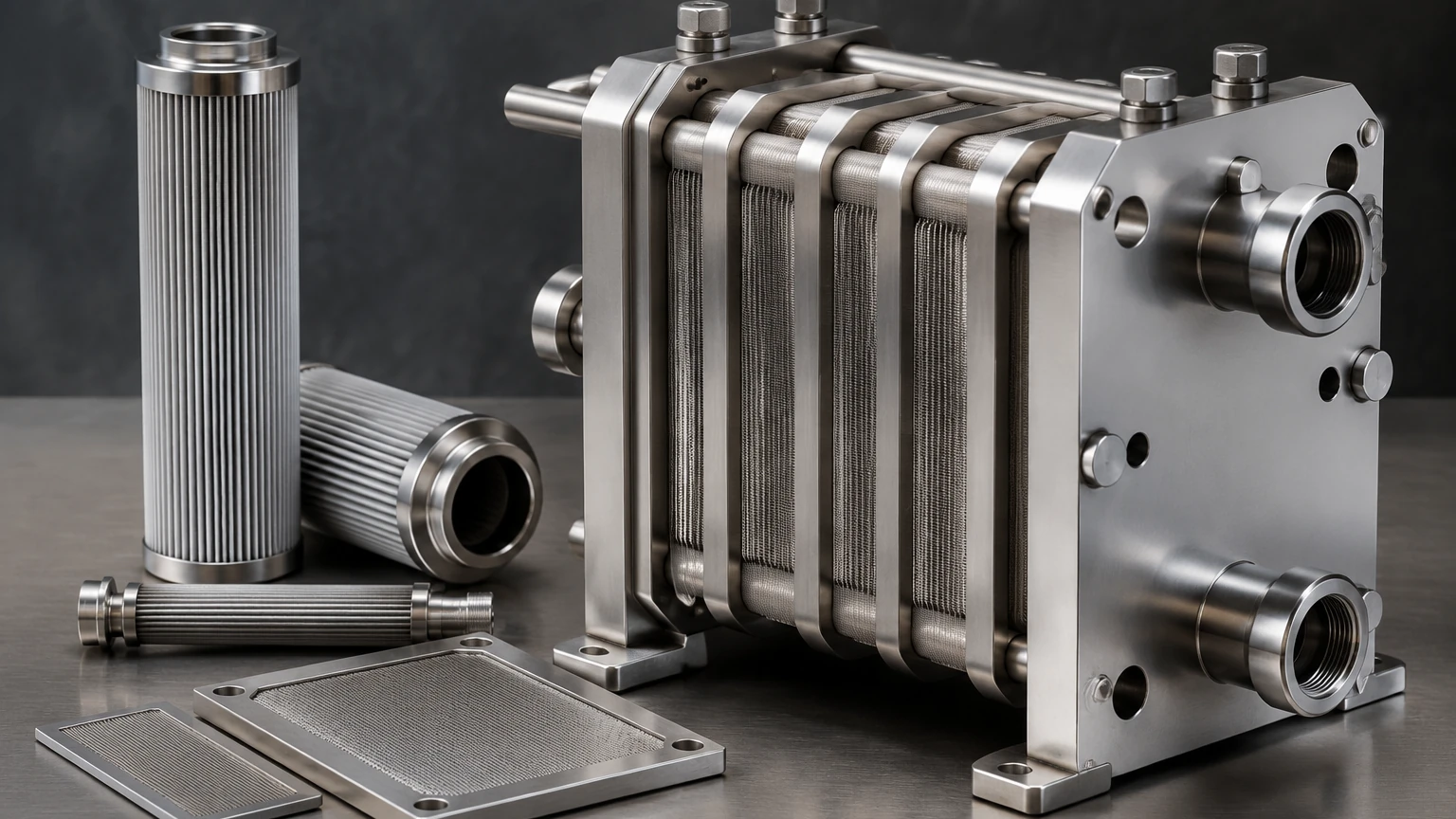
The micron rating defines the size of particles the press filter will retain. However, pore geometry is equally important. Plain weave mesh offers high flow rates but lower mechanical strength, whereas sintered multi-layer mesh provides exceptional strength and precise filtration. For fine chemical applications, a sintered mesh plate can combine a fine filtration layer with several coarser support layers, providing a rigid, high-performance medium that fits directly into the press frame.
Flow Rate and Open Area
There is always a trade-off between filtration fineness and flow rate. A press filter with a very fine mesh may achieve high clarity but result in long cycle times. Calculating the required open area is essential to ensure that the pump's flow rate matches the media’s permeability. Our engineering team at Kaifil assists clients in balancing these factors to maximize the number of cycles per shift.
Compatibility with Cleaning Protocols
In many B2B industrial environments, Clean-in-Place (CIP) systems are used to maintain hygiene and efficiency. Stainless steel components are compatible with high-pressure steam sterilization and aggressive chemical cleaning agents that would destroy synthetic filters. This makes them ideal for the food and beverage and pharmaceutical industries, where batch-to-batch purity is non-negotiable.
Customization and OEM Solutions for Press Filters
No two industrial applications are identical. The dimensions of the filter plates, the nature of the slurry, and the existing hardware of the press filter all necessitate a customized approach. Kaifil provides comprehensive OEM services to manufacture filter components that integrate seamlessly into existing press systems.
Customization options include:
* Material Grades: Beyond 304 and 316L, we can utilize specialized alloys for extreme environments.
* Edge Reinforcement: To ensure a perfect seal within the press filter frame, stainless steel mesh can be fitted with reinforced borders or custom gaskets.
* Multi-Layer Sintering: We can laminate multiple layers of wire mesh together to create a "filter plate" that is virtually indestructible under normal operating pressures.
* Precision Cutting: Using advanced laser or waterjet cutting, we ensure that the filter media matches the exact dimensions and bolt-hole patterns of your press plates.
By working directly with a manufacturer, purchasing teams can reduce the total cost of ownership. While the initial investment in stainless steel media is higher than cloth, the extended service life—often lasting years rather than weeks—results in significant long-term savings and reduced downtime.
Addressing Common Engineering Challenges
Managing Filter Blinding
One of the most frequent issues with a press filter is media blinding. This occurs when fine particles penetrate the surface of the medium and become trapped within the structure. To combat this, we recommend selecting a mesh weave that promotes surface filtration rather than depth filtration. Sintered metal mesh is particularly effective here, as its rigid structure allows for back-pulsing or ultrasonic cleaning to dislodge trapped debris.
Ensuring Seal Integrity
Leaking between plates is a common failure point in press filter operations. If the filter medium is too thick or uneven, the hydraulic ram cannot create a uniform seal. Kaifil’s precision manufacturing ensures that each metal filter component has a uniform thickness, allowing for consistent compression across the entire plate stack.
Optimizing Cake Dryness
In many applications, the goal of the press filter is to achieve maximum cake dryness to reduce disposal costs. The drainage capacity of the filter medium plays a role here. A medium that allows for efficient air blowing or membrane squeezing will result in a drier end product. Our technical team can advise on the mesh structures that best facilitate these secondary dewatering steps.
Conclusion: Why Choose Kaifil for Press Filter Components?
As a professional manufacturer of custom stainless steel filtration solutions, Kaifil understands that the press filter is a workhorse of industrial production. Our commitment to quality and engineering precision ensures that every component we produce—from wire mesh filters to complex sintered cartridges—meets the demanding standards of our global clientele.
When you choose to source your filtration components through our Main Page, you are gaining a partner with extensive experience in chemical processing, hydraulic systems, and water treatment. We don't just provide parts; we provide engineered solutions that improve the reliability and efficiency of your filtration processes.
For engineers and purchasing managers looking to upgrade their current press filter systems or develop new OEM equipment, the transition to stainless steel media offers a clear path to better performance. Contact Kaifil today to discuss your specific application requirements, material preferences, and filtration goals. Our team is ready to provide the technical support and high-quality manufacturing necessary to optimize your industrial filtration outcomes.
