


Pressure Leaf Filter
In the landscape of industrial liquid-solid separation, the pressure leaf filter stands as a cornerstone technology for high-efficiency batch processing. Designed to handle large volumes of liquid with varying solids content, these systems are prized for their closed-loop operation, minimal floor space requirements, and the ability to produce high-clarity filtrates. For engineers and procurement specialists, understanding the nuances of pressure leaf filter design—specifically the construction of the internal filter leaves—is essential for optimizing process efficiency and ensuring long-term equipment reliability.
As a specialized manufacturer of stainless steel filtration components, Kaifil provides the precision-engineered elements that define the performance of these systems. This guide explores the technical specifications, operational principles, and selection criteria necessary for integrating pressure leaf filters into demanding industrial environments.
Understanding the Pressure Leaf Filter Mechanism
A pressure leaf filter operates on the principle of pressure-driven filtration across a series of vertical or horizontal leaves housed within a pressure vessel. Unlike continuous filters, the pressure leaf filter operates in a batch cycle, which typically consists of four distinct phases: pre-coating, filtration, cake drying, and cake discharge.
The Pre-coating Phase
To achieve high clarity and prevent the fine stainless steel mesh from blinding, a pre-coat layer is often applied. This involves circulating a slurry of filter aid—such as diatomaceous earth (DE) or perlite—through the filter. The filter aid builds a permeable layer on the surface of the filter leaves, which then acts as the primary filtration medium.
The Filtration Phase
Once the pre-coat is established, the process liquid is pumped into the vessel. Under pressure, the liquid passes through the filter aid and the stainless steel mesh, while solids are retained on the surface, forming a "filter cake." The clarified liquid (filtrate) exits through the internal drainage manifold of each leaf.
Cake Drying and Discharge
After the filtration cycle is complete, the remaining liquid is displaced using compressed air or inert gas to dry the cake. Depending on the design, the cake is then discharged either as a dry solid via a vibration mechanism or as a wet slurry using a high-pressure sluicing system. This versatility makes the pressure leaf filter suitable for both waste recovery and product harvesting.
Vertical vs. Horizontal Pressure Leaf Filters
Choosing between a vertical and horizontal configuration depends largely on the available facility footprint, the volume of slurry to be processed, and the desired state of the discharged cake.
Vertical Pressure Leaf Filters (VPLF)
Vertical filters are the standard choice for applications where floor space is at a premium. They are characterized by a vertical pressure vessel and vertically oriented leaves. These units are highly efficient for small to medium-sized batches and are most commonly used for dry cake discharge. The cake is dislodged from the leaves using a pneumatic vibrator, falling through a large bottom discharge valve.
Horizontal Pressure Leaf Filters (HPLF)
Horizontal filters are designed for high-capacity applications. The vessel is oriented horizontally, and the leaf bundle can often be retracted on a rail system for easy maintenance and inspection. HPLFs are preferred when dealing with very large filtration areas or when the process requires frequent cleaning and leaf replacement. They are equally capable of handling dry or wet cake discharge, often utilizing a sluicing header for rapid cleaning.
Critical Engineering Components: The Filter Leaf
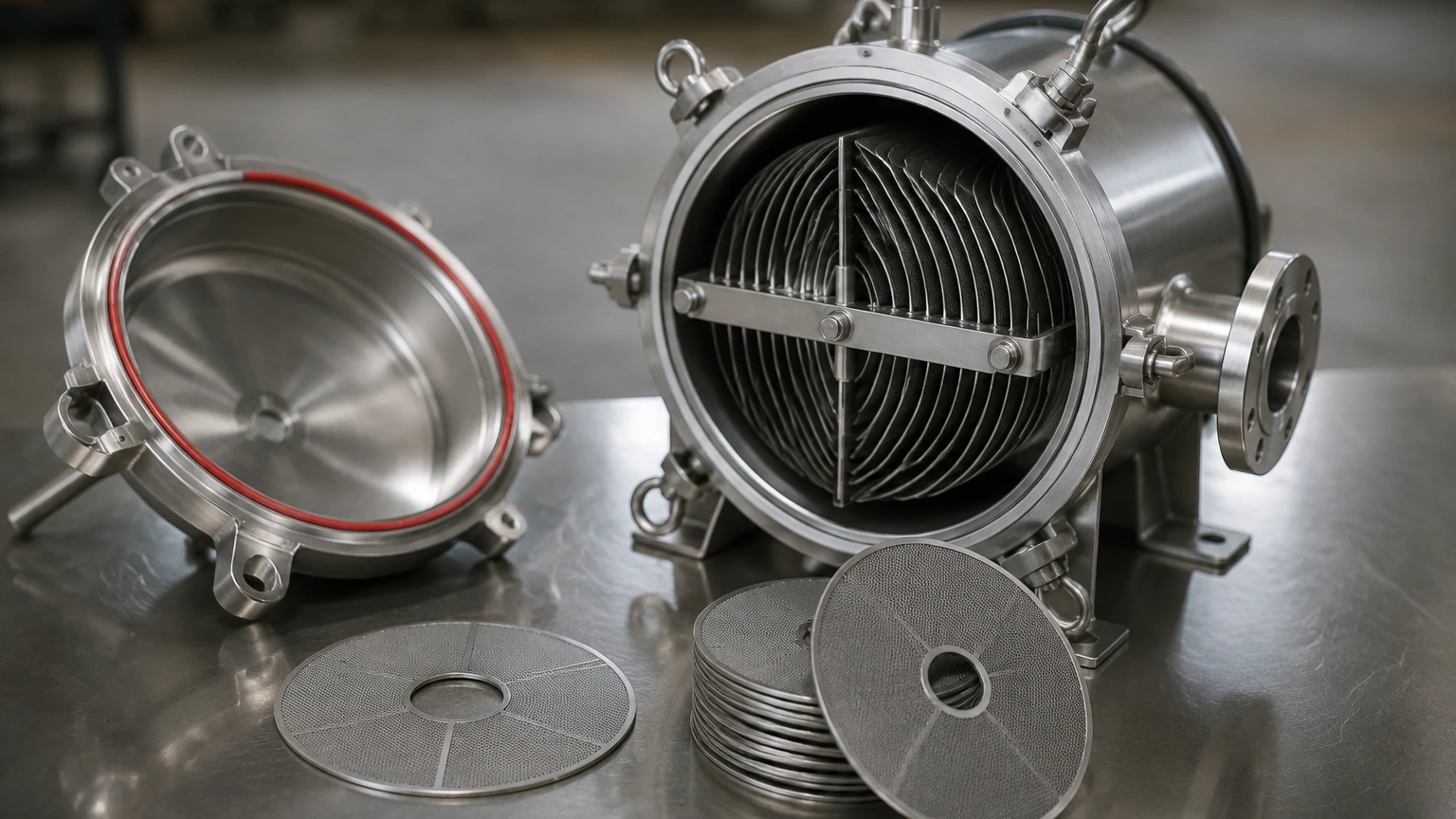
The performance of any pressure leaf filter is fundamentally limited by the quality and design of its filter leaves. As the primary interface between the slurry and the filtrate, the leaf must withstand significant pressure differentials while maintaining structural integrity.
At Kaifil, we focus on the precision manufacturing of these components, typically employing a multi-layer stainless steel wire mesh construction. A standard high-performance filter leaf consists of five to seven layers:
1. Outer Filtration Mesh: This is the fine mesh layer (often a Dutch weave or Twilled Dutch weave) that determines the filtration rating. It must be woven with high precision to ensure uniform pore distribution.
2. Support Mesh: Positioned immediately behind the filtration mesh, this layer provides the necessary support to prevent the fine mesh from deforming under pressure.
3. Internal Drainage Member: The core of the leaf is a heavy-duty, coarse mesh or a perforated plate that allows the filtrate to flow freely toward the discharge nozzle.
These layers are secured within a rigid stainless steel frame. Engineers must choose between riveted or bolted frames based on the need for onsite mesh replacement. A well-constructed leaf ensures a low pressure drop and prevents "channeling," where liquid bypasses the filter media, compromising filtrate quality.
Material Selection and Chemical Compatibility
Industrial filtration often involves aggressive chemicals, high temperatures, or strict sanitary requirements. Therefore, material selection is a primary engineering consideration. Stainless steel is the industry standard due to its mechanical strength and corrosion resistance.
* Grade 304/304L: Suitable for general-purpose applications, including many food and beverage processes where corrosion risk is moderate.
* Grade 316/316L: The preferred choice for chemical processing and pharmaceutical applications. The addition of molybdenum provides enhanced resistance to chlorides and organic acids.
* Specialty Alloys (904L, Hastelloy): For highly corrosive environments, such as those involving hot brine or concentrated acids, specialty alloys are utilized to prevent premature failure of the wire mesh.
Beyond the metal itself, the choice of gaskets and O-rings (Viton, EPDM, PTFE) must be validated against the process fluid to ensure a leak-proof seal within the pressure vessel.
Performance Evaluation and Selection Criteria
When specifying a pressure leaf filter, engineers should evaluate several key performance indicators (KPIs) to ensure the system meets the process requirements. For a comprehensive overview of available filtration components and technical support, professionals can visit the Main Page to review product options and application support.
Filtration Area and Cake Volume
The filtration area (measured in square meters or square feet) determines the flow rate capacity. However, the cake volume—the space between the leaves—is equally important. If the solids concentration is high, the filter may reach its cake capacity before the pressure limit is hit, necessitating shorter cycles.
Flux Rate
The flux rate (volume of filtrate per unit area per unit time) is influenced by the viscosity of the liquid and the permeability of the filter cake. High-viscosity liquids, such as heavy resins or oils at low temperatures, require larger filtration areas to maintain throughput.
Particle Retention
While the pre-coat often handles the finest particles, the base mesh of the filter leaf must be sized correctly to support the pre-coat and provide a backup in case of pre-coat failure. Selection of the micron rating is a balance between clarity and the risk of premature blinding.
Maintenance and Optimization of Filtration Performance
To maintain the efficiency of a pressure leaf filter, a structured maintenance program is required. The most common cause of performance degradation is the gradual fouling of the stainless steel mesh.
* Cleaning Cycles: For wet discharge systems, the sluicing nozzles must be inspected regularly to ensure full coverage of the leaf surface. In dry discharge systems, the vibration frequency and duration should be optimized to ensure complete cake removal without fatiguing the leaf frames.
* Mesh Inspection: Over time, the outer filtration mesh may experience mechanical wear or localized blinding. Regular visual inspections can identify "hot spots" where the mesh is thinning or pulling away from the frame.
* Replacement Cycles: While high-quality stainless steel leaves are durable, they are considered wear parts. Maintaining a stock of replacement leaves or utilizing OEM-quality mesh kits is essential for minimizing downtime.
Customization and OEM Solutions for Industrial Filtration
Every industrial process has unique variables, from the specific gravity of the slurry to the volatility of the solvent. Standard off-the-shelf filtration components often fall short in specialized applications. This is where custom manufacturing becomes vital.
Kaifil specializes in providing tailored filtration solutions, including custom-sized filter leaves, specialized mesh weaves, and precision-engineered internal components. By working closely with engineering teams, we ensure that the filtration media is perfectly matched to the operational demands of the pressure leaf filter. Whether you are designing a new system or retrofitting an existing installation, focusing on the quality of the internal stainless steel components is the most effective way to ensure consistent performance and a lower total cost of ownership.
For technical professionals looking to optimize their liquid-solid separation processes, the pressure leaf filter remains one of the most reliable and cost-effective tools available. By prioritizing material quality, precise mesh selection, and robust leaf construction, facilities can achieve the high-clarity results required in today's competitive industrial market.
