


Pressure Vessell
In the landscape of industrial fluid processing, the pressure vessell serves as the primary containment unit for high-pressure filtration systems. Whether utilized in chemical processing, pharmaceutical manufacturing, or hydraulic systems, these components are engineered to withstand significant internal or external pressure while housing critical filtration media. For engineers and procurement specialists, understanding the technical nuances of pressure vessel design, material compatibility, and filtration integration is essential for ensuring operational safety and efficiency.
Industrial filtration often requires a robust housing that can manage the stresses of pressurized flow without compromising the integrity of the filter element or the safety of the facility. As a manufacturer specializing in custom stainless steel filtration solutions, Kaifil provides the precision components that reside within these vessels, ensuring that the interface between the pressure housing and the filter media is seamless and reliable.
Engineering Fundamentals of Industrial Pressure Vessels
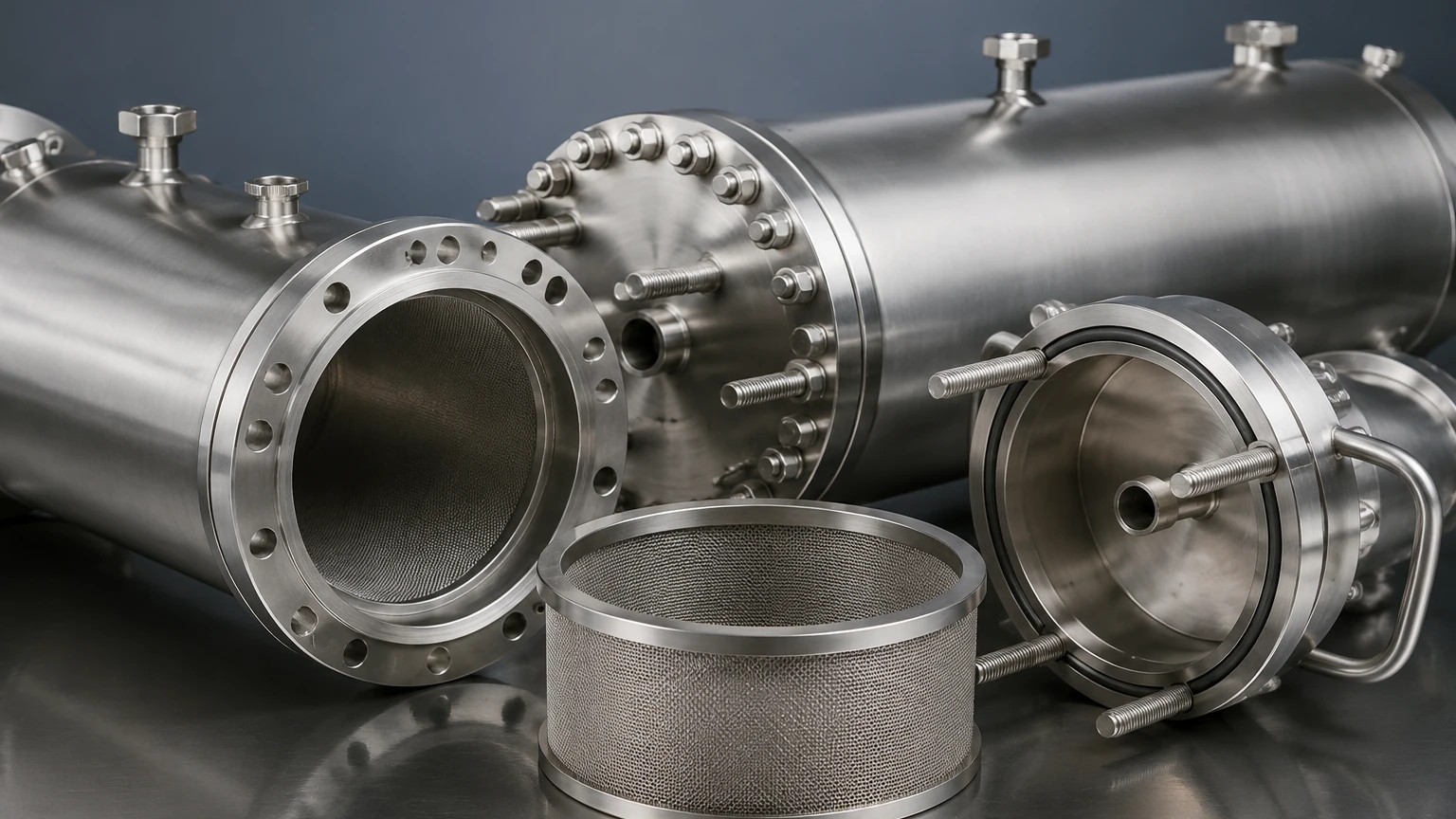
A pressure vessell is defined as a container designed to hold gases or liquids at a pressure substantially different from the ambient pressure. In the context of industrial filtration, these vessels act as the housing for wire mesh filters, sintered metal elements, or pleated cartridges. The design and construction of these vessels are governed by strict engineering standards, most notably the ASME (American Society of Mechanical Engineers) Boiler and Pressure Vessel Code (BPVC) Section VIII in North America, and the Pressure Equipment Directive (PED) in the European Union.
Design Pressure and Temperature
The primary consideration in vessel engineering is the Maximum Allowable Working Pressure (MAWP). This value is determined based on the wall thickness of the vessel, the strength of the material used, and the geometry of the heads (dished, hemispherical, or flat). For filtration applications, the vessel must not only handle the steady-state operating pressure but also the transient pressure spikes common in hydraulic systems or during the start-up of centrifugal pumps.
Temperature also plays a critical role. As temperature increases, the allowable stress of stainless steel and other alloys decreases. Therefore, a vessel rated for 300 PSI at 70°F may only be rated for 240 PSI at 400°F. Engineers must specify the full range of operating temperatures to ensure the vessel remains within safe elastic deformation limits.
Stress Distribution and Geometry
Most industrial filtration vessels are cylindrical with curved heads. This geometry is preferred because it distributes internal stress evenly across the surface. Sharp corners or flat surfaces are avoided where possible, as they act as stress concentrators that can lead to fatigue cracking over time, especially in systems subject to cyclic loading.
Material Selection for Corrosive and High-Purity Environments
The longevity of a pressure vessell is largely dictated by its material composition. In industries such as food and beverage or pharmaceutical production, stainless steel is the industry standard due to its corrosion resistance and ease of sterilization.
Stainless Steel 304 vs. 316L
* Grade 304: This is the most common stainless steel used for general industrial applications. It offers good corrosion resistance to most oxidizing acids and is highly durable. However, it is susceptible to chloride-induced pitting.
* Grade 316L: The "L" stands for low carbon, which improves weldability and reduces the risk of intergranular corrosion. The addition of molybdenum in 316L provides superior resistance to chlorides and marine environments. For chemical processing plants handling aggressive solvents or saline solutions, 316L is the preferred choice for both the vessel body and the internal filtration components.
Surface Finish and Passivation
For high-purity applications, the internal surface finish of the vessel is as important as the material itself. Electropolishing or mechanical polishing to a specific Ra (Roughness average) value ensures that there are no microscopic pits where bacteria or contaminants can accumulate. Following fabrication, passivation is performed to remove free iron from the surface and enhance the protective chromium oxide layer.
Integration of Stainless Steel Filtration Media
The effectiveness of a pressure vessell in a filtration circuit depends on the quality of the internal filter elements. Kaifil specializes in manufacturing the high-performance components that integrate into these housings. To explore the full range of custom filtration options, engineers can visit the Main Page for detailed technical specifications on wire mesh and sintered metal solutions.
Sealing Mechanisms and Bypass Prevention
A critical failure point in many filtration vessels is the seal between the filter element and the vessel housing. If fluid bypasses the filter media, the entire process is compromised. Common sealing methods include:
1. O-Ring Seals: Utilizing Viton, EPDM, or PTFE O-rings to create a compression seal at the base of the filter cartridge.
2. Knife-Edge Seals: A sharp metal edge that bites into a softer gasket material, often used in high-temperature applications where elastomers might fail.
3. Threaded Connections: Providing a mechanical lock that is ideal for high-vibration environments.
Support Structures
Inside the vessel, the filter media must be supported to prevent collapse under high differential pressure (Delta P). Perforated metal cores or outer cages are often used to provide structural rigidity to fine wire mesh or pleated elements. Engineering these supports requires a balance between structural strength and maintaining maximum open area for fluid flow.
Operational Parameters: Pressure Drop and Flow Dynamics
When selecting or designing a pressure vessell for filtration, engineers must account for the total pressure drop across the system. The total Delta P is the sum of the pressure drop caused by the vessel inlet/outlet nozzles and the pressure drop across the clean filter media.
Factors Influencing Delta P
* Fluid Viscosity: Higher viscosity fluids require larger filtration surface areas to maintain reasonable flow rates without excessive pressure build-up.
* Flow Velocity: As velocity increases, the turbulence at the vessel inlet can cause uneven loading of the filter media. Internal baffles are often used to distribute the flow evenly.
* Contaminant Loading: As the filter captures particles, the effective pore size decreases, and the pressure drop increases. The vessel must be equipped with differential pressure gauges to signal when the filter element requires cleaning or replacement.
Sizing the Vessel
Sizing is not merely about the volume of the fluid; it is about the "flux rate"—the volume of fluid passing through a unit area of filter media per unit of time. Oversizing a vessel can lead to higher capital costs but results in lower maintenance frequency and longer element life. Conversely, undersizing leads to frequent downtime and potential damage to the filter media due to high-velocity impingement.
Maintenance, Cleaning, and Replacement Cycles
To maintain the safety and performance of a pressure vessell, a rigorous maintenance schedule is required. Unlike disposable plastic housings, stainless steel vessels are designed for decades of service, provided they are cared for correctly.
Inspection Protocols
Regular inspections should focus on:
* Weld Integrity: Checking for signs of stress corrosion cracking or erosion-corrosion near the weld zones.
* Seal Surfaces: Ensuring that the seating areas for O-rings and gaskets remain free of scratches or debris.
* Closure Mechanisms: Inspecting swing bolts, clamps, or threaded covers for wear or thread galling.
Cleaning the Internals
One of the primary advantages of using stainless steel filtration elements within a pressure vessel is the ability to clean and reuse them. Methods such as ultrasonic cleaning, backwashing, or chemical CIP (Clean-in-Place) processes allow operators to restore the filter’s performance without opening the vessel, reducing the risk of process contamination.
Customization and OEM Solutions for Pressure Vessell Applications
Every industrial process has unique requirements that off-the-shelf solutions may not meet. Customization is often necessary to accommodate specific pipe sizes, space constraints, or extreme operating conditions.
Tailored Filtration Components
As a professional manufacturer, Kaifil works closely with global customers to develop bespoke filtration components that fit perfectly within existing or new pressure vessel designs. This includes:
* Custom Micron Ratings: Engineering wire mesh to capture specific particle sizes while maximizing flow.
* Specialized Alloys: Utilizing Monel, Inconel, or Hastelloy for environments where even 316L stainless steel might fail.
* Bespoke End Fittings: Designing custom adapters to ensure compatibility with legacy vessel housings.
The Role of OEM Partnerships
For manufacturers of complete pressure vessel systems, partnering with a specialized filtration component supplier like Kaifil ensures that the internal "heart" of the system is engineered to the same high standards as the outer shell. This collaborative approach allows for optimized performance, where the filter media and the vessel housing are designed as a single, cohesive unit.
Conclusion: Selecting the Right Filtration Partner
The selection of a pressure vessell and its internal filtration media is a critical decision that impacts the safety, purity, and cost-effectiveness of an industrial process. By focusing on high-quality materials like stainless steel, adhering to rigorous engineering standards, and choosing components designed for specific flow dynamics, engineers can ensure long-term reliability.
Whether you are designing a new system for chemical processing or seeking to optimize the filtration performance of an existing hydraulic circuit, understanding the relationship between the vessel and the filter element is key. For technical assistance and a comprehensive look at available filtration technologies, visit the Main Page to connect with engineering experts who can help refine your filtration strategy.
