


Rotary Disc Screen
In industrial liquid-solid separation, the rotary disc screen (RDS) represents a highly efficient, space-saving solution for continuous filtration. Designed to handle large volumes of water or process fluids with varying solids loading, these systems are integral to municipal wastewater treatment, pulp and paper processing, and food and beverage production. For engineers and procurement specialists, understanding the technical nuances of rotary disc screen construction—specifically the selection of filtration media and structural materials—is critical to ensuring long-term operational reliability and meeting stringent discharge or process requirements.
A rotary disc screen operates on the principle of gravity or low-pressure filtration through a series of parallel, rotating discs covered with precision-engineered filter media. As the fluid passes through the media, solids are retained on the surface and subsequently removed, allowing for a continuous, self-cleaning cycle that minimizes downtime. For a broader overview of custom filtration components that support these systems, technical professionals can refer to the Main Page for detailed specifications on stainless steel media.
Engineering Principles and Mechanical Design
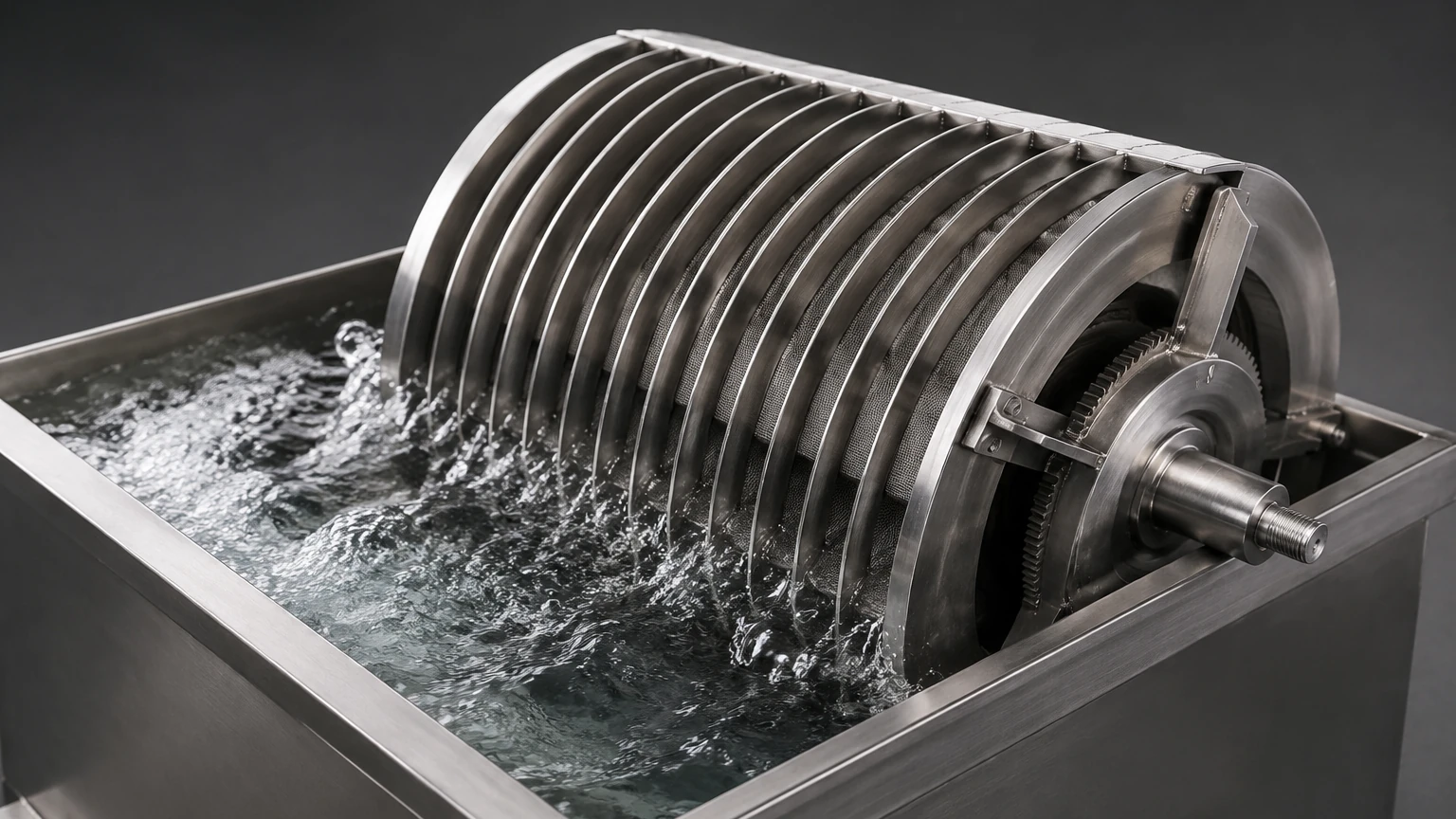
The core of a rotary disc screen is its central shaft, which supports multiple vertical discs. These discs are typically submerged to approximately 60% to 70% of their diameter in the influent. As the shaft rotates, the submerged portion of the disc filters the incoming fluid. The filtered liquid (filtrate) enters the interior of the disc and is discharged through the hollow central shaft or a dedicated outlet manifold.
Flow Dynamics and Head Loss
One of the primary engineering considerations in RDS design is the hydraulic head loss. Unlike static screens, the rotary disc screen manages head loss through variable speed drives. As solids accumulate on the mesh (forming a "filter cake"), the resistance to flow increases, raising the water level in the inlet tank. Sensors detect this level change and trigger or accelerate the rotation of the discs and the cleaning mechanism. Engineers must calculate the maximum allowable head loss to prevent upstream flooding while optimizing the filter cake thickness, which can actually improve filtration fineness by acting as a secondary filter medium.
Effective Filtration Area (EFA)
The compact footprint of the RDS is its greatest advantage. By utilizing vertical discs, the system provides a significantly larger effective filtration area compared to traditional drum screens or traveling band screens of the same width. The EFA is determined by the number of discs, their diameter, and the percentage of the disc surface that remains open for flow (the open area of the wire mesh).
Material Selection for Industrial Durability
Because rotary disc screens are frequently exposed to corrosive environments—such as saline wastewater, acidic chemical process streams, or chlorinated wash water in food plants—material selection is the most significant factor in determining the equipment's lifespan.
Stainless Steel Alloys
Kaifil specializes in the manufacture of stainless steel filtration components, which are the industry standard for RDS media.
* Grade 304/304L: Suitable for general industrial applications and municipal wastewater with low chloride content. It offers excellent formability and weldability for disc segments.
* Grade 316/316L: The preferred choice for more aggressive environments. The addition of molybdenum provides superior resistance to pitting and crevice corrosion, particularly in the presence of chlorides.
* Duplex Stainless Steels: For specialized applications involving high temperatures or extreme chemical concentrations, duplex alloys provide higher mechanical strength and even greater corrosion resistance, though they require more specialized fabrication techniques.
Wire Mesh vs. Synthetic Media
While some light-duty applications use polyester or needle-felt media, industrial-grade rotary disc screens almost exclusively utilize stainless steel wire mesh. Stainless steel mesh provides structural rigidity, prevents "blinding" (permanent clogging) under high pressure, and can withstand the mechanical stress of high-pressure backwash sprays. The weave type—whether plain, twill, or Dutch weave—is selected based on the required micron rating and the physical characteristics of the solids being removed.
Filtration Accuracy and Performance Criteria
Selecting the correct micron rating for a rotary disc screen involves a trade-off between filtration fineness and throughput. Industrial applications typically range from 10 microns to several hundred microns.
Micron Ratings and Solids Loading
In tertiary wastewater treatment, a 10-to-20-micron mesh is common for removing residual suspended solids (TSS) and associated phosphorus. In industrial intake water screening, a coarser mesh (100–500 microns) may be sufficient to protect downstream equipment like heat exchangers or membrane systems. Engineers must confirm the particle size distribution (PSD) of the influent to ensure the selected mesh will capture the target pollutants without requiring excessive backwashing.
Backwash Efficiency
The cleaning mechanism usually consists of a spray bar with high-pressure nozzles located at the top of the disc rotation. As the discs turn, the nozzles spray clean water (often filtered effluent) from the outside in, or vice versa, to dislodge the filter cake into a collection trough. The efficiency of this process depends on nozzle pressure (typically 5–8 bar), nozzle angle, and the smoothness of the wire mesh surface. A precision-manufactured stainless steel mesh from Kaifil ensures that the surface is free of burrs or irregularities that could trap fibers and impede cleaning.
Customization and OEM Integration
No two industrial filtration requirements are identical. Customization is often required to integrate a rotary disc screen into an existing plant layout or to handle specific waste streams.
Disc Segment Design
Large rotary discs are usually constructed in segments (pie-shaped pieces) to facilitate easy replacement of the filter media without dismantling the entire shaft assembly. Custom-engineered segments allow for different mesh types to be tested or replaced as process conditions change. For OEMs, the ability to source precision-cut and pre-tensioned mesh segments is vital for maintaining the structural integrity of the disc under hydraulic load.
Sealing and Gaskets
To prevent "bypass"—where unfiltered liquid leaks around the edges of the filter media—high-quality sealing is required. EPDM, Viton, or PTFE gaskets are selected based on chemical compatibility. The interface between the rotating shaft and the stationary tank also requires robust mechanical seals to prevent leakage and maintain hydraulic head.
Operational Considerations and Total Cost of Ownership (TCO)
When evaluating a rotary disc screen, engineers must look beyond the initial capital expenditure (CAPEX) and consider the long-term operational expenditure (OPEX).
1. Energy Consumption: The power required to rotate the shaft is relatively low (often 1.5–5.5 kW), but the energy used by the backwash pumps can be significant if the screen is constantly cleaning. Optimizing the control logic to trigger cleaning only when necessary reduces energy costs.
2. Water Consumption: Using filtered effluent for backwashing is a common way to reduce fresh water consumption. However, the volume of backwash water produced (which must be re-treated) must be factored into the plant’s total hydraulic balance.
3. Media Replacement Cycles: Stainless steel mesh is highly durable, but it is not immortal. Factors such as abrasive grit, chemical scaling, or mechanical fatigue from frequent backwashing will eventually necessitate media replacement. Choosing high-quality, precision-woven mesh extends these cycles significantly.
4. Maintenance Accessibility: An RDS design that allows for the inspection and replacement of individual spray nozzles and disc segments from a service platform reduces labor costs and minimizes downtime.
Technical Confirmation for Purchasing Teams
Before finalizing a specification for a rotary disc screen or its replacement components, purchasing teams and engineers should confirm the following data points with their manufacturer:
* Influent Characteristics: Peak flow rate, average TSS, particle size distribution, and chemical composition (pH, chlorides, oils).
* Required Effluent Quality: Target TSS or specific micron cut-off.
* Material Compatibility: Verification that the stainless steel grade and gasket materials are suited for the process fluid.
* Structural Support: Ensure the disc frames can handle the maximum differential pressure expected during a power failure or surge event.
By focusing on these technical parameters, industrial operators can ensure that their rotary disc screen provides consistent, high-performance filtration with minimal intervention. For organizations seeking specialized stainless steel filter cartridges or custom wire mesh components to optimize their filtration systems, visiting the Main Page provides access to technical expertise and manufacturing capabilities designed for demanding industrial environments.
