


Rotary Filter Drum
In the landscape of industrial solid-liquid separation, the rotary filter drum stands as a cornerstone technology for continuous, high-volume processing. Engineered to handle slurries with varying solids concentrations, these systems are essential in sectors ranging from chemical processing and wastewater treatment to food production and pharmaceuticals. For engineers and procurement specialists, understanding the technical nuances of drum construction, material selection, and filtration mechanics is vital for optimizing system uptime and filtration efficiency.
As a specialized manufacturer of stainless steel filtration solutions, Kaifil provides the precision components required to maintain these complex systems. Detailed technical specifications and custom engineering options are available on our Main Page, where professionals can evaluate high-performance filter media tailored for rotary applications.
The Engineering Principles of Rotary Drum Filtration
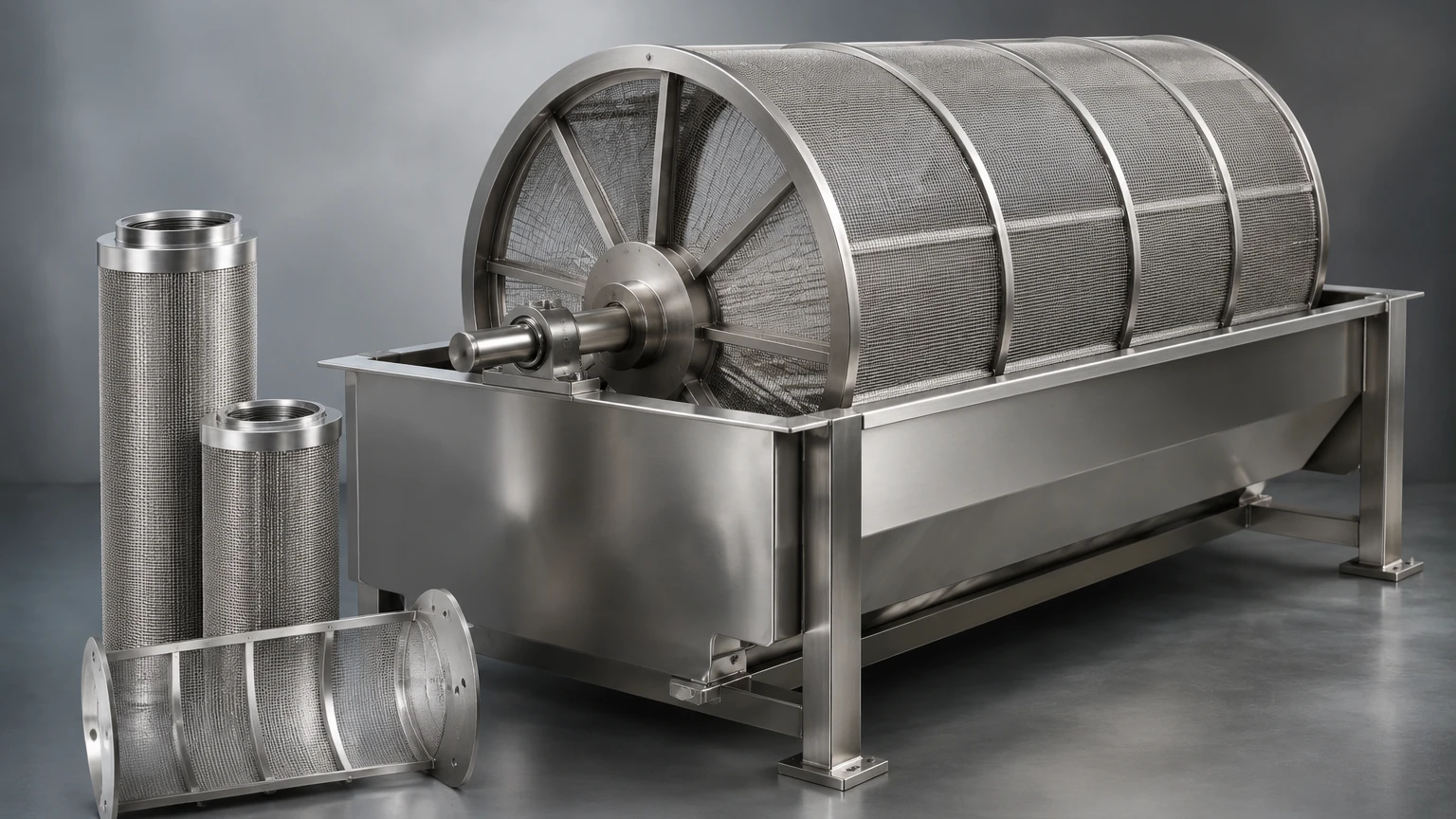
A rotary filter drum operates on the principle of pressure differential—either vacuum or positive pressure—to drive liquid through a filter medium while retaining solids on the surface. The drum rotates through a trough containing the slurry. As the drum submerged portion passes through the liquid, the internal pressure differential causes the filtrate to pass through the mesh, leaving a layer of solids, known as the "filter cake," on the exterior.
The Filtration Cycle
The operation of a rotary filter drum is typically divided into several functional zones:
1. Cake Formation Zone: The portion of the drum submerged in the slurry trough where the initial layer of solids is deposited.
2. Cake Washing and Drying Zone: As the drum rotates out of the trough, the cake may be washed with solvent or water to remove impurities. Continued vacuum or air pressure then draws moisture out of the cake.
3. Discharge Zone: The dried cake is removed from the drum surface using a discharge mechanism, such as a doctor blade, roller, or string discharge.
4. Cloth Cleaning Zone: Before the drum section re-enters the slurry, the filter medium is often cleaned via backwashing or high-pressure sprays to prevent blinding.
Material Selection and Structural Integrity
The choice of materials for a rotary filter drum is perhaps the most critical factor in determining its service life and performance in demanding industrial environments. Because these drums are often exposed to corrosive chemicals, abrasive particles, and fluctuating temperatures, stainless steel is the industry standard for high-performance applications.
Stainless Steel Grades
* Grade 304: Suitable for general industrial applications where moderate corrosion resistance is required. It is commonly used in food and beverage processing where hygiene is paramount but chemical aggression is low.
* Grade 316/316L: The preferred choice for chemical processing and pharmaceutical applications. The addition of molybdenum provides superior resistance to chlorides and organic acids. The "L" (low carbon) variant is essential for components requiring extensive welding to prevent intergranular corrosion.
* Duplex Steels: For extreme environments involving high saline concentrations or highly acidic slurries, duplex stainless steels offer enhanced yield strength and resistance to stress corrosion cracking.
The Role of Precision Wire Mesh
The filter medium attached to the drum's exterior is the primary functional component. Kaifil specializes in manufacturing the stainless steel wire mesh and sintered metal components that serve as this interface. The mesh must balance three competing requirements: filtration accuracy (micron rating), mechanical durability (to withstand the discharge blade), and permeability (to maintain high flow rates).
Key Evaluation Criteria for Engineers
When specifying or replacing a rotary filter drum or its associated filter media, engineers must look beyond the initial purchase price and focus on total cost of ownership (TCO) and operational reliability.
1. Filtration Accuracy and Micron Rating
The target particle size for retention dictates the weave pattern and wire diameter of the mesh. In a rotary filter drum, the "nominal" rating refers to the percentage of particles retained, while the "absolute" rating defines the size of the largest particle that can pass through. For fine chemical processes, multi-layered sintered mesh may be required to provide the necessary support and precision.
2. Hydraulic Capacity and Flow Rate
The throughput of a rotary drum is a function of the surface area, the rotation speed, and the permeability of the filter cake and medium. Engineers must calculate the flux (volume per unit area per unit time) to ensure the drum can handle the peak loads of the production line without causing upstream bottlenecks.
3. Mechanical Strength and Tensioning
The filter mesh on a rotary filter drum is subject to constant mechanical stress. During the discharge phase, a doctor blade or scraper may physically contact the mesh. Therefore, the mesh must be high-tensile and properly tensioned to prevent sagging, which leads to uneven cake formation and premature wear. Sintered wire mesh is often utilized here because the wires are fused at their contact points, preventing pore migration and increasing structural rigidity.
Common Risks and Mitigation Strategies
Operating a rotary filter drum involves several technical risks that can lead to system failure or product contamination if not properly managed.
Media Blinding
Blinding occurs when fine particles become lodged within the pores of the filter mesh, or when biological growth (in water treatment) creates a film that blocks flow. This results in a rapid increase in differential pressure and a drop in throughput. To mitigate this, engineers should specify mesh with high open-area ratios and implement robust backwashing systems. In some cases, specialized surface treatments or coatings can reduce the adhesion of the filter cake.
Mechanical Abrasion
In mining or heavy industrial applications, the slurry may contain highly abrasive minerals. This can erode both the filter media and the drum structure itself. Utilizing hardened stainless steel alloys and thicker wire diameters in the mesh construction can significantly extend the replacement cycle.
Chemical Incompatibility
Even stainless steel can fail if the wrong grade is chosen for a specific chemical environment. For instance, using 304 stainless steel in a high-chloride environment will lead to pitting corrosion. Engineers must perform a thorough chemical compatibility check, considering not only the primary slurry but also the cleaning agents used during the maintenance cycle.
Customization and OEM Solutions
Every industrial process has unique requirements, meaning that off-the-shelf filtration components rarely provide the optimal balance of performance and longevity. Customization is often necessary for the internal drainage pipes, the drum grid support, and the specific weave of the wire mesh.
Kaifil works closely with OEM partners and end-users to develop custom stainless steel filter cartridges and drum components. By adjusting parameters such as wire diameter, mesh count, and reinforcement layers, we ensure that the filtration media is perfectly matched to the specific rheology of the slurry. For more information on our engineering capabilities, please visit our Main Page.
Maintenance and Replacement Cycles
A proactive maintenance strategy is essential for the longevity of a rotary filter drum. Because these machines operate continuously, any unplanned downtime can result in significant production losses.
Inspection Checklist
* Mesh Integrity: Regularly check for tears, thinning, or localized corrosion, especially near the seams and discharge points.
* Seal Performance: Ensure that the vacuum seals and trunnion bearings are lubricated and functioning to prevent pressure loss.
* Discharge Alignment: The doctor blade or scraper must be perfectly aligned with the drum surface. If it is too tight, it will damage the mesh; if it is too loose, the cake will not be removed effectively.
* Cleaning Efficiency: Monitor the effectiveness of the spray nozzles. Clogged nozzles lead to localized blinding and uneven drum loading.
Replacement Considerations
When the filter medium reaches the end of its functional life, the choice of replacement mesh is an opportunity to improve process efficiency. If the previous mesh suffered from frequent blinding, moving to a different weave pattern (such as plain Dutch weave vs. twilled Dutch weave) may provide better release characteristics and higher flow rates.
Conclusion
The rotary filter drum remains a vital asset in modern industrial processing due to its ability to provide continuous, automated solid-liquid separation. However, the efficiency of the entire system is heavily dependent on the quality and suitability of the filtration media and the structural components of the drum.
By focusing on material science, mechanical precision, and application-specific customization, engineers can ensure their filtration systems deliver consistent performance and a lower total cost of ownership. For technical support, material data sheets, and custom manufacturing of stainless steel filtration components, professionals are encouraged to explore the resources available on the Kaifil Main Page. Understanding the intersection of fluid dynamics and material durability is the key to mastering rotary drum filtration in any industrial context.
