


Self-cleaning Filter for Liquids
In modern industrial processing, the efficiency of liquid filtration systems directly impacts production uptime, product quality, and operational costs. Traditional filtration methods often rely on manual cleaning or the frequent replacement of disposable cartridges, both of which introduce significant downtime and labor costs. A self-cleaning filter for liquids offers an automated alternative designed to maintain continuous flow and consistent filtration performance without the need for manual intervention.
For engineers and technical procurement teams, selecting the right automated filtration system requires a deep understanding of mechanical cleaning mechanisms, material compatibility, and the specific rheological properties of the fluid being processed. This guide examines the technical foundations of self-cleaning filtration technology, focusing on the engineering considerations essential for industrial integration.
Understanding the Mechanics of Automated Filtration
A self-cleaning filter for liquids operates on the principle of removing accumulated solids from the filter medium while the system remains online. Unlike duplex filters that require a flow diversion to a standby housing, self-cleaning systems use internal mechanisms to clear the "filter cake" or debris. This is typically triggered by a timer or a differential pressure (DP) sensor.
When the DP sensor detects that the pressure drop across the filter element has reached a predefined threshold—indicating that the mesh is restricted by contaminants—the cleaning cycle begins. Depending on the design, this process can take several forms, such as mechanical scraping or pressurized backwashing. Because the cleaning occurs in situ, the process flow is rarely interrupted, making these systems ideal for high-volume or critical-path applications.
Primary Cleaning Mechanisms for Liquid Systems
Choosing the appropriate cleaning mechanism is the first step in optimizing a filtration system. The nature of the contaminant (sticky, fibrous, or hard particles) determines which mechanical approach is most effective.
Mechanical Scraping Systems
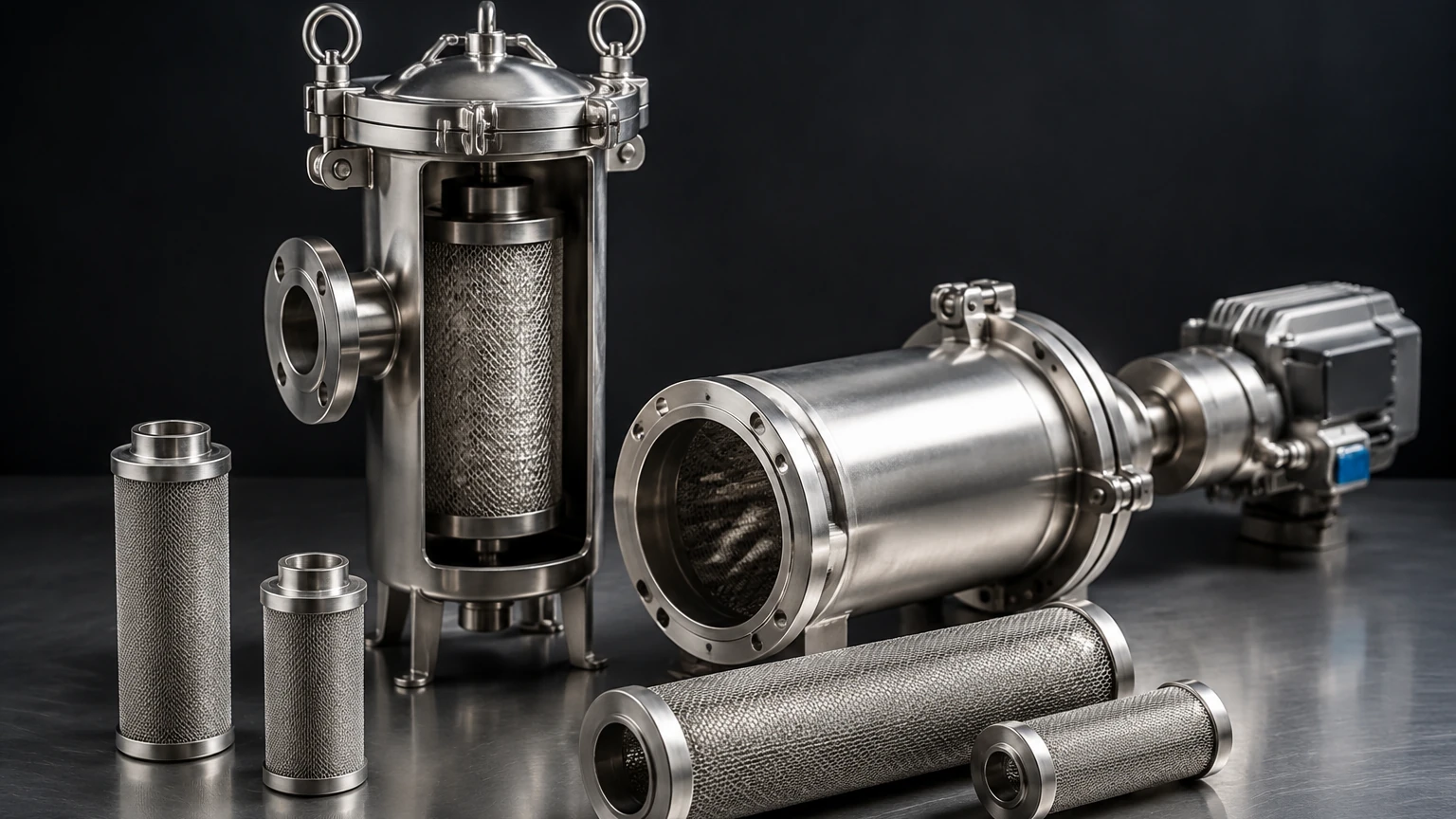
In a mechanical scraping filter, a blade or brush moves across the surface of a cylindrical filter element—often a wedge wire or perforated stainless steel screen. As the scraper moves, it physically dislodges solids from the surface, which then settle into a collection chamber at the bottom of the housing for periodic purging. This method is particularly effective for highly viscous liquids or fluids containing sticky contaminants that would be difficult to remove via backwashing alone.
Backwashing and Suction Scanning
Backwashing systems utilize a portion of the filtered fluid (or an external clean fluid source) to reverse the flow through the filter medium. This reversal flushes particles off the screen and out through a waste valve. Suction scanning is a more precise variation of this, where a small nozzle moves across the inner surface of the filter screen, creating a localized high-velocity vacuum that pulls debris away. This method is highly efficient for low-viscosity liquids like water or light oils and consumes minimal process fluid during the cleaning cycle.
Material Selection and Engineering Specifications
The durability of a self-cleaning filter for liquids depends heavily on the materials used for the filter element and the housing. In industrial environments involving corrosive chemicals or high temperatures, stainless steel is the standard choice.
Stainless Steel Filter Elements
Kaifil specializes in high-performance stainless steel filtration solutions, utilizing materials such as 304, 316, and 316L stainless steel. These materials provide the necessary mechanical strength to withstand the stresses of automated cleaning cycles.
* Wedge Wire: Known for its non-clogging characteristics, wedge wire consists of V-shaped profiles welded onto support rods. This structure creates a slot that widens inwardly, ensuring that particles slightly smaller than the slot size pass through without getting wedged.
* Sintered Wire Mesh: For finer filtration requirements, multi-layer sintered wire mesh provides high porosity and precise micron ratings while maintaining the structural integrity required for high-pressure backwashing.
Housing and Seals
The filter housing must be engineered to meet specific pressure vessel codes (such as ASME or PED). Furthermore, the choice of seals (EPDM, Viton, or PTFE) must be validated against the chemical composition and temperature of the liquid to prevent premature failure and leakage.
Critical Performance Factors for Industrial Integration
When evaluating a self-cleaning filter for liquids, engineers must look beyond the basic micron rating. Several interconnected factors influence the total efficiency of the system.
Flow Rate and Flux
The flow rate determines the size of the filter housing and the surface area of the filter element. Flux, or the flow rate per unit of filter area, is a critical metric. If the flux is too high, particles may be forced into the mesh openings, making them harder to remove during the cleaning cycle and leading to more frequent cleaning and increased wear.
Viscosity and Temperature
Liquid viscosity significantly affects the pressure drop across the filter. High-viscosity fluids require larger surface areas or wider slot openings to maintain flow. Additionally, temperature fluctuations can change the viscosity of the fluid and the thermal expansion of the internal mechanical components, which must be accounted for in the filter design.
Particle Loading and Nature
The concentration of solids in the liquid (measured in PPM or percentage by weight) determines how often the cleaning cycle will trigger. If the particle loading is exceptionally high, a self-cleaning filter may need to be paired with a primary separator to prevent the system from being overwhelmed. The shape and hardness of the particles also dictate whether a scraper or a backwash system is more appropriate; abrasive particles, for instance, may require hardened scraper blades or specialized coatings.
Application-Specific Requirements
Different industries impose unique constraints on filtration equipment. A self-cleaning filter for liquids must be tailored to meet these specific regulatory and functional needs.
* Chemical Processing: Requires extreme resistance to corrosive agents. Filters often utilize 316L stainless steel or exotic alloys to ensure long-term reliability in acidic or alkaline environments.
* Food and Beverage: Systems must adhere to sanitary standards (such as 3-A or EHEDG). This involves polished internal surfaces, the absence of dead legs where bacteria could grow, and the ability to withstand Clean-in-Place (CIP) procedures.
* Pharmaceuticals: Precision is paramount. Filtration elements must provide absolute micron ratings and be manufactured in controlled environments to prevent contamination.
* Hydraulic and Cooling Systems: These applications often deal with high-pressure environments where the filter must protect sensitive downstream components from metallic wear particles.
For more detailed information on specific product configurations and how they align with these industry standards, technical teams can refer to the Main Page for a comprehensive overview of available manufacturing capabilities.
Maintenance, Durability, and Total Cost of Ownership (TCO)
While the initial capital expenditure for an automated self-cleaning filter is higher than for a manual bag or cartridge filter, the Total Cost of Ownership (TCO) is generally lower in high-volume applications.
Reduced Consumable Costs
Self-cleaning systems eliminate the recurring cost of purchasing, storing, and disposing of filter bags or cartridges. In processes where filters would otherwise need replacement every few days, the ROI on an automated system can often be realized within the first year of operation.
Labor and Safety
Manual filter changes require operator time and often involve exposing workers to the process liquid, which may be hazardous, hot, or pressurized. Automated systems enhance site safety by containing the liquid within a closed system and reducing the need for manual handling.
Wear Parts and Service Cycles
Despite being "self-cleaning," these systems do have wear parts, such as scraper blades, seals, and bearings. Engineers should confirm the expected lifespan of these components and the ease of access for maintenance. A well-designed system allows for the replacement of wear parts without specialized tools or extensive downtime.
Technical Checklist for Procurement and Customization
Before finalizing a specification for a self-cleaning filter for liquids, the following data points should be confirmed with the manufacturer to ensure the system is fit for purpose:
1. Liquid Characteristics: What is the chemical composition, pH, viscosity, and density?
2. Contaminant Profile: What is the particle size distribution, concentration, and morphology (e.g., granular, fibrous, or gelatinous)?
3. Operating Parameters: What are the normal and maximum flow rates, operating pressures, and temperatures?
4. Filtration Goal: What is the required micron rating, and is it an absolute or nominal requirement?
5. Control Integration: Does the system need to interface with a central PLC via Modbus, Profibus, or simple analog signals for DP monitoring?
6. Space Constraints: Are there footprint or height limitations in the existing piping layout that require a custom housing orientation?
Conclusion
Integrating a self-cleaning filter for liquids into an industrial process is a strategic decision that balances upfront investment against long-term operational efficiency. By automating the removal of contaminants, facilities can achieve higher throughput, protect expensive downstream equipment, and significantly reduce the environmental impact associated with disposable filter media.
As a professional manufacturer specializing in custom stainless steel filtration, Kaifil provides the engineering expertise required to navigate these complex selection criteria. From selecting the appropriate wire mesh density to designing housings that withstand demanding chemical environments, the focus remains on delivering reliable, high-performance components. For further technical specifications and to explore customized filtration designs, visit the Kaifil Main Page to connect with our engineering team.
