


Self-cleaning Filter Technology
In modern industrial processing, the transition from batch production to continuous operation has necessitated significant advancements in filtration efficiency. Manual filtration systems, while effective for low-volume or intermittent tasks, often become bottlenecks in high-capacity environments due to the labor-intensive nature of cleaning and the inevitable downtime required for element replacement. Self-cleaning filter technology addresses these challenges by providing an automated, reliable method for removing suspended solids from liquid streams without interrupting the flow of the process.
For engineers and facility managers, understanding the mechanics, material requirements, and integration strategies of these systems is essential for optimizing plant performance. This guide explores the engineering principles behind self-cleaning systems, the role of precision stainless steel components, and the critical factors involved in selecting the right technology for demanding industrial applications.
The Mechanics of Self-cleaning Filter Technology
At its core, self-cleaning filter technology relies on a pressure differential ($ΔP$) to trigger a cleaning cycle. As contaminants accumulate on the surface of the filter element—typically a stainless steel wire mesh or wedge wire screen—the resistance to flow increases. Once the pressure drop reaches a pre-determined set point, the system initiates a cleaning mechanism to remove the debris while the main process fluid continues to pass through the housing.
There are several primary methods used to achieve this automated cleaning:
1. Backwash Systems
Backwashing involves reversing the flow of a portion of the filtered liquid (or an external clean fluid) through the filter media. In suction scanner systems, a nozzle moves across the inner surface of the filter screen, creating a localized low-pressure zone that sucks debris off the mesh and out through a flush valve. This method is highly efficient as it uses a minimal amount of process fluid for cleaning.
2. Mechanical Scraper Systems
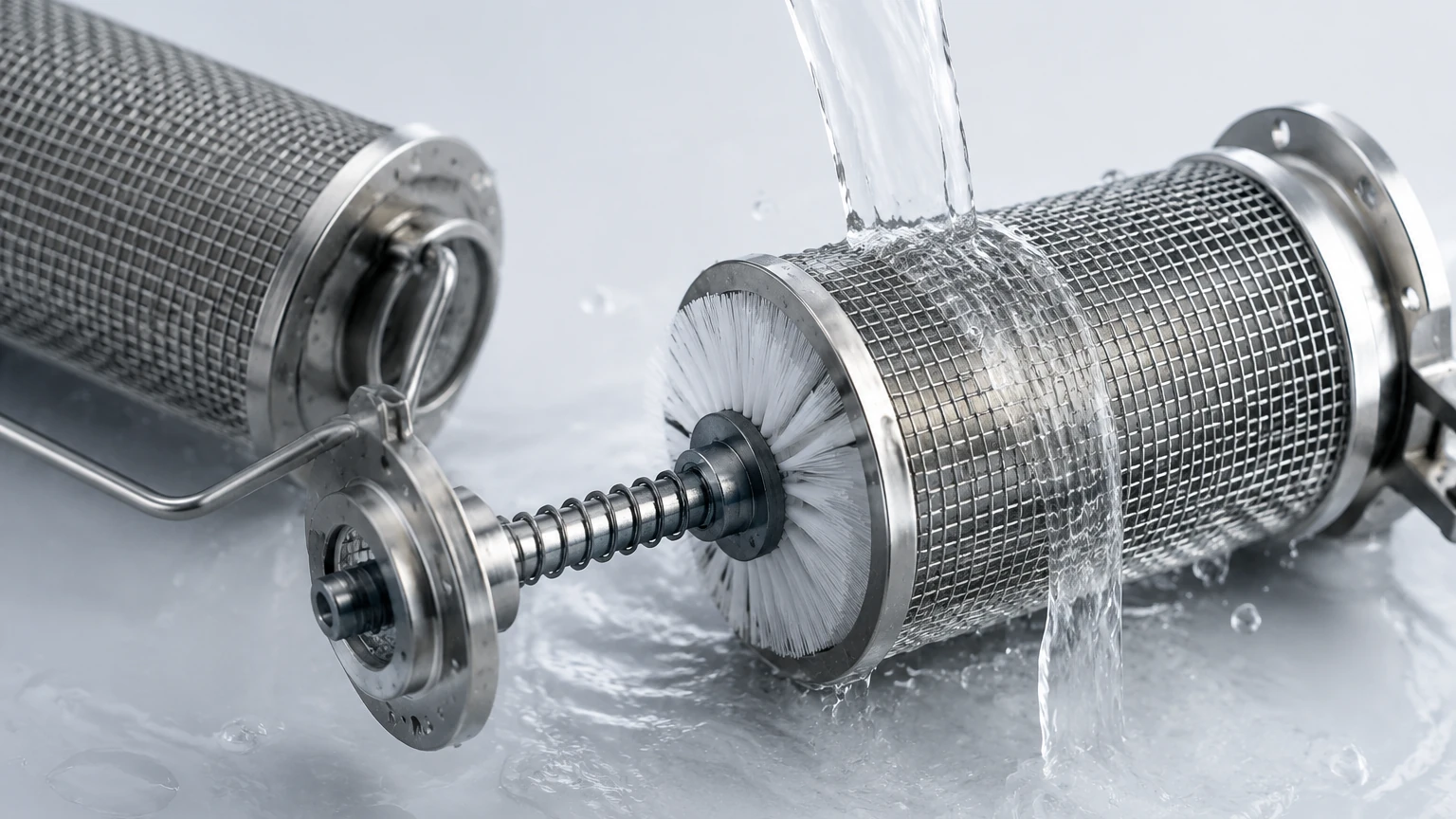
Mechanical cleaning uses a blade or brush to physically sweep the surface of the filter element. These are particularly effective for high-viscosity fluids or sticky contaminants that might not be easily dislodged by backwashing alone. The scrapers move either linearly or rotationally, pushing the collected solids toward a collection chamber at the bottom of the housing, where they are periodically purged.
3. High-Frequency Vibration
In specialized applications, high-frequency vibration is applied to the filter media to prevent the formation of a filter cake. This keeps the particles in suspension near the surface, allowing the liquid to pass through while the solids are concentrated and removed. This is often used in the processing of coatings, papers, and specialized chemicals.
Engineering Considerations for Filter Media
The heart of any self-cleaning system is the filter element. Because these components are subjected to frequent cleaning cycles and varying pressure loads, the choice of material and construction is paramount. Stainless steel is the industry standard for these applications due to its mechanical strength and resistance to corrosion.
Material Selection
Most industrial self-cleaning filters utilize Stainless Steel 304 or 316L. 316L is generally preferred in chemical processing, pharmaceutical, and food and beverage sectors due to its superior resistance to pitting and crevice corrosion, especially in the presence of chlorides. For highly aggressive environments, specialized alloys like Duplex stainless steel or Hastelloy may be required, though these are typically reserved for custom-engineered solutions.
Construction: Wire Mesh vs. Wedge Wire
Two primary types of stainless steel media are used in self-cleaning filter technology:
- Sintered Wire Mesh: Multiple layers of stainless steel wire cloth are sintered together to create a robust, porous structure. This provides high filtration accuracy (down to sub-micron levels) and excellent mechanical stability under high $ΔP$.
- Wedge Wire (V-Wire): This consists of V-shaped profiles resistance-welded to support rods. The V-shaped opening widens inward, which minimizes the risk of particles becoming wedged in the screen—a critical feature for mechanical scraper systems.
Integration into Industrial Processes
Implementing self-cleaning filter technology requires a holistic view of the fluid dynamics within a facility. Engineers must account for several variables to ensure the system operates within its design limits.
Flow Rate and Viscosity
The flow rate determines the size of the filter housing and the total surface area of the mesh required. Viscosity plays a significant role in determining the initial pressure drop; higher viscosity fluids require larger surface areas or coarser filtration ratings to maintain a manageable $ΔP$. If the viscosity changes significantly with temperature, the system must be designed to handle the "worst-case" cold-start scenario.
Contaminant Loading
The concentration and type of solids (fibrous, granular, or deformable) dictate the frequency of the cleaning cycles. If the contaminant load is too high, the filter may enter a continuous cleaning loop, which increases wear on moving parts and leads to excessive fluid loss during backwashing. In such cases, a primary coarse strainer may be installed upstream to protect the self-cleaning unit.
Micron Rating and Efficiency
Selecting the correct micron rating is a balance between product purity and operational longevity. While a finer mesh provides higher purity, it also fouls faster. Engineers often use particle size distribution (PSD) analysis of the process fluid to select a mesh size that captures the target contaminants without unnecessary over-filtration.
Operational Benefits and Total Cost of Ownership
While the initial capital expenditure for self-cleaning filter technology is higher than that of manual bag or cartridge housings, the Total Cost of Ownership (TCO) is often lower over the life of the equipment.
1. Reduced Labor Costs: Automated systems eliminate the need for operators to manually open housings, clean baskets, or replace spent cartridges. This is particularly valuable in hazardous environments where exposure to the process fluid must be minimized.
2. Increased Uptime: Because the cleaning occurs during operation, there is no need to shut down the line or divert flow to a standby filter. This ensures a consistent supply of filtered fluid to downstream equipment, such as spray nozzles, heat exchangers, or filling lines.
3. Waste Minimization: Traditional cartridge filters generate a significant amount of solid waste. Self-cleaning systems produce a concentrated sludge or purge stream, which is often easier to treat or dispose of, reducing the environmental footprint of the facility.
4. Protection of Downstream Assets: By providing consistent filtration, these systems prevent the fouling of sensitive equipment, extending the service life of pumps, seals, and instrumentation.
Maintenance and Reliability
Despite their automated nature, self-cleaning filters are not "set and forget" systems. Reliable performance depends on a proactive maintenance schedule focused on the moving parts and the integrity of the filter media.
- Seal and Gasket Inspection: The dynamic seals in scraper systems and the valves in backwash systems are subject to wear. Regular inspection prevents bypass and external leaks.
- Mesh Integrity: Over time, high-velocity backwashing or mechanical scraping can cause fatigue in the wire mesh. Periodic internal inspections are recommended to check for signs of abrasion or deformation.
- Control System Calibration: The differential pressure sensors must be calibrated regularly to ensure the cleaning cycle triggers at the correct threshold. A malfunctioning sensor can lead to either excessive cleaning or a completely blinded filter.
Selecting a Manufacturing Partner
When sourcing components for self-cleaning systems, it is vital to work with a manufacturer that understands the nuances of stainless steel fabrication and filtration physics. Customization is often required to meet specific footprint constraints, flange configurations, or pressure ratings.
Engineers should confirm the manufacturer’s capabilities in:
- Precision Welding: Ensuring the structural integrity of the filter element under backwash pressures.
- Material Traceability: Providing documentation for stainless steel grades, especially for regulated industries like pharmaceuticals or food production.
- Custom Engineering: The ability to adjust mesh patterns or housing designs to suit unique fluid characteristics.
As a professional manufacturer of custom stainless steel filtration solutions, Kaifil provides the technical expertise required to develop high-performance components for demanding industrial environments. From material selection to filtration accuracy, our engineering team supports global customers in achieving efficient and durable filtration performance. For more information on our full range of products and custom capabilities, visit our Main Page.
Conclusion
Self-cleaning filter technology represents a critical component in the drive toward industrial automation and process optimization. By reducing downtime, minimizing manual intervention, and providing consistent filtration quality, these systems offer a robust solution for managing solids in liquid streams. Success in implementation, however, depends on a rigorous engineering approach to media selection, housing design, and an understanding of the specific demands of the application environment. When properly specified and maintained, self-cleaning filters provide a reliable, cost-effective foundation for modern industrial fluid processing.
