


Self Cleaning Suction Filter
In industrial fluid handling, the suction side of a pump is perhaps the most critical point for filtration. Debris, particulates, and contaminants present in the source liquid can cause catastrophic failure in downstream equipment, particularly high-pressure pumps and sensitive instrumentation. Traditionally, suction strainers required manual cleaning, necessitating system downtime and labor-intensive maintenance. The advent of the self cleaning suction filter has transformed this landscape, providing a mechanism that ensures continuous flow while protecting the system from ingress.
For engineers and procurement teams, selecting the right filtration solution involves more than just matching a pipe size. It requires a deep understanding of fluid dynamics, material compatibility, and the mechanical reliability of the cleaning mechanism itself. This guide explores the technical nuances of self-cleaning suction technology and how it integrates into modern industrial processes.
Understanding the Role of Self Cleaning Suction Filters in Industrial Systems
A self cleaning suction filter is designed to be installed on the intake side of a pump. Its primary function is to remove solids from the process fluid before they reach the pump impeller or internal valves. Unlike standard filters that eventually clog and restrict flow—leading to pump cavitation and potential motor burnout—a self-cleaning model utilizes an automated process to clear the filter element while the system remains operational.
In many B2B applications, such as chemical processing or large-scale water treatment, the cost of a single hour of downtime can exceed the initial investment of the filtration system. By automating the removal of accumulated solids, these filters maintain a consistent pressure drop across the mesh, ensuring the pump operates within its designed performance curve. This is particularly vital in applications where the source fluid has a high or variable solids load, such as raw river water or recycled process fluids.
Technical Working Principles: From Manual to Automatic Backwashing
The core of a self cleaning suction filter is its ability to sense when the filter element is becoming restricted. Most systems utilize a differential pressure ($ΔP$) sensor. When the accumulated debris on the filter screen causes the pressure drop to reach a pre-set threshold, the cleaning cycle is triggered.
The Cleaning Cycle
There are several methods used to achieve "self-cleaning," but the most common in industrial suction applications are:
1. Backwashing/Back-flushing: A portion of the filtered fluid is reversed through the filter element, dislodging the cake of solids and flushing it out through a dedicated waste valve.
2. Mechanical Scrapers: A blade or brush physically moves across the surface of the filter element (usually a wedge wire or perforated screen) to push solids toward a collection chamber.
3. Suction Scanners: Internal nozzles move in a spiral or linear path across the screen, creating a localized high-velocity vacuum effect that pulls debris off the mesh and into a waste line.
What makes these systems efficient is that the cleaning cycle often takes place without stopping the main flow. This "online" cleaning capability is a prerequisite for continuous manufacturing environments. For more technical details on the various filter cartridges used in these systems, engineers can visit the Main Page of the manufacturer's site to compare mesh types and flow capacities.
Material Selection and Durability: The Case for Stainless Steel
In the context of industrial filtration, material selection is not just about corrosion resistance; it is about structural integrity under pressure. Kaifil specializes in manufacturing these components using high-grade stainless steel, which offers several engineering advantages over plastic or lower-grade alloys.
Stainless Steel 304 vs. 316L
For most general-purpose industrial applications, Grade 304 stainless steel provides sufficient resistance to oxidation and mechanical wear. However, in environments involving chlorides, acids, or pharmaceutical-grade requirements, 316L is the standard. The "L" denotes low carbon content, which is essential for components that require extensive welding, as it prevents sensitized zones that could lead to intergranular corrosion.
Wire Mesh vs. Wedge Wire
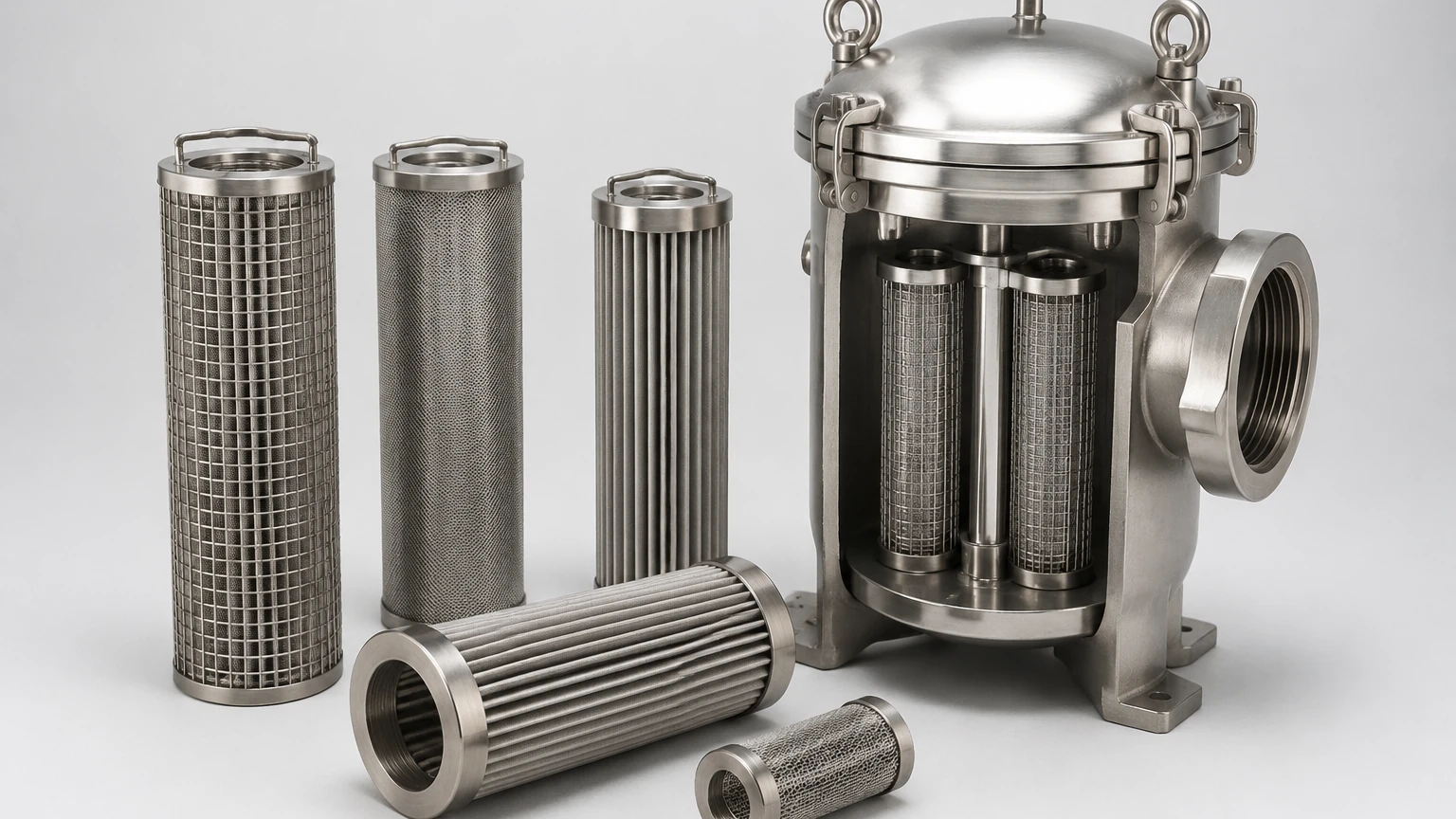
The choice of the filter media itself is critical. Woven wire mesh, often used in multi-layer sintered configurations, provides precise filtration ratings down to the micron level. Wedge wire, on the other hand, is exceptionally robust and easier to clean mechanically due to its V-shaped profile, which minimizes the risk of particles becoming "wedged" in the openings. A self cleaning suction filter must balance the need for fine filtration with the mechanical strength required to withstand the forces of the cleaning mechanism.
Critical Performance Metrics for Engineering Selection
When specifying a self cleaning suction filter, engineers must evaluate several key performance indicators (KPIs) to ensure the unit will perform reliably in the field.
Flow Rate and Pressure Drop
The filter must be sized to handle the maximum flow rate of the pump with a minimal initial pressure drop. A common mistake is sizing the filter based on the pipe diameter rather than the actual fluid velocity and solids concentration. If the initial $ΔP$ is too high, the cleaning cycle will trigger too frequently, leading to excessive waste of the process fluid and premature wear on the moving parts.
Micron Rating and Filtration Efficiency
Defining the "nominal" vs. "absolute" micron rating is essential. In suction applications, the goal is often to protect the pump from particles larger than the internal clearances of the equipment. If the filtration is too fine, the filter will clog rapidly; if it is too coarse, the pump will suffer abrasive wear. Engineers should consult with manufacturers like Kaifil to determine the optimal balance based on the specific particle size distribution (PSD) of the fluid.
Net Positive Suction Head (NPSH)
In suction-side applications, the pressure drop across the filter directly impacts the Net Positive Suction Head Available (NPSHA). If the filter causes the NPSHA to drop below the pump's required NPSH (NPSHR), cavitation will occur. Self-cleaning filters are advantageous here because they keep the $ΔP$ within a narrow, predictable range, preventing the sudden drops in suction pressure that occur with manual filters as they fill with debris.
Evaluating Total Cost of Ownership (TCO) and ROI
While the initial capital expenditure (CAPEX) for a self cleaning suction filter is higher than that of a simple Y-strainer or basket filter, the Total Cost of Ownership is often significantly lower.
Labor and Maintenance Savings
Manual cleaning requires a technician to shut down the line, vent the housing, remove the element, clean it, and reassemble the unit. In a 24/7 operation, these labor costs accumulate quickly. Furthermore, every time a filter housing is opened, there is a risk of seal failure, contamination of the environment, and safety hazards for the operator.
Reduced Waste and Improved Yield
Automated systems can be tuned to minimize the amount of fluid lost during the backwash cycle. By using sensors to trigger cleaning only when necessary, the system optimizes fluid usage. Additionally, the consistent filtration quality leads to fewer downstream issues, such as clogged spray nozzles or fouled heat exchangers, which improves overall process yield.
Customization and Integration with Existing Infrastructure
No two industrial sites are identical, and off-the-shelf filtration solutions often require compromises in piping layout or performance. This is where OEM and customization capabilities become vital. A professional manufacturer can adapt the housing orientation, flange types (ANSI, DIN, JIS), and the automation logic to fit the specific needs of the facility.
Control Systems and Industry 4.0
Modern self-cleaning filters are often equipped with PLC-based controllers that can communicate with a central SCADA system. This allows for remote monitoring of filtration performance, predictive maintenance alerts, and data logging of cleaning frequencies. For engineers, this data is invaluable for identifying shifts in the process—such as a sudden increase in solids that might indicate a failure in an upstream process.
Common Risks and Mitigation Strategies
Despite their advantages, self-cleaning filters are not "set and forget" devices. Engineers should be aware of potential risks:
* Sticky or Fibrous Contaminants: Some materials, like certain polymers or long fibers, can be difficult to remove via standard backwashing. In these cases, specialized mechanical scrapers or modified mesh designs are required.
* Mechanical Wear: Because these filters have moving parts (valves, motors, scanners), they require periodic inspection of seals and bearings. Choosing a manufacturer that uses high-quality stainless steel internal components reduces the frequency of these repairs.
* Undersizing for Peak Loads: If a system is designed for average solids loading but encounters a "slug" of heavy debris, the cleaning mechanism may be overwhelmed. Always specify the filter based on the worst-case scenario for solids concentration.
Conclusion: Choosing the Right Partner for Filtration
The implementation of a self cleaning suction filter is a strategic decision that impacts the reliability and efficiency of an entire industrial system. By moving away from manual maintenance, facilities can achieve higher uptime, better pump protection, and a safer working environment.
When evaluating potential solutions, it is crucial to work with a manufacturer that understands the engineering challenges of stainless steel fabrication and industrial fluid dynamics. Kaifil provides the technical expertise and customized manufacturing capabilities required to develop filtration components that meet the rigorous demands of the chemical, food and beverage, and pharmaceutical industries.
For those looking to optimize their filtration processes or seeking custom OEM solutions, reviewing the available configurations and technical specifications is the first step toward a more efficient system. To explore the full range of custom stainless steel filtration solutions, please visit the Main Page for comprehensive product information and application support.
