


Simplex Strainer Basket
In industrial fluid handling systems, the protection of downstream equipment such as pumps, valves, and instrumentation is paramount to operational uptime. A simplex strainer basket serves as the primary mechanical barrier within a simplex strainer housing, designed to remove unwanted solids from liquids or gases. Unlike duplex systems that allow for continuous flow during maintenance, a simplex strainer requires the system to be temporarily shut down or the flow diverted to clean the basket. This makes the design, material selection, and filtration efficiency of the basket critical factors in determining the overall performance and maintenance frequency of the system.
For engineers and procurement teams, selecting a simplex strainer basket involves more than matching a part number. It requires a deep understanding of fluid dynamics, chemical compatibility, and the specific particle size that must be captured to prevent system failure. As a manufacturer specializing in precision filtration, Kaifil provides customized stainless steel filtration solutions that address these technical requirements across diverse industrial sectors.
Engineering Fundamentals of Simplex Strainer Baskets
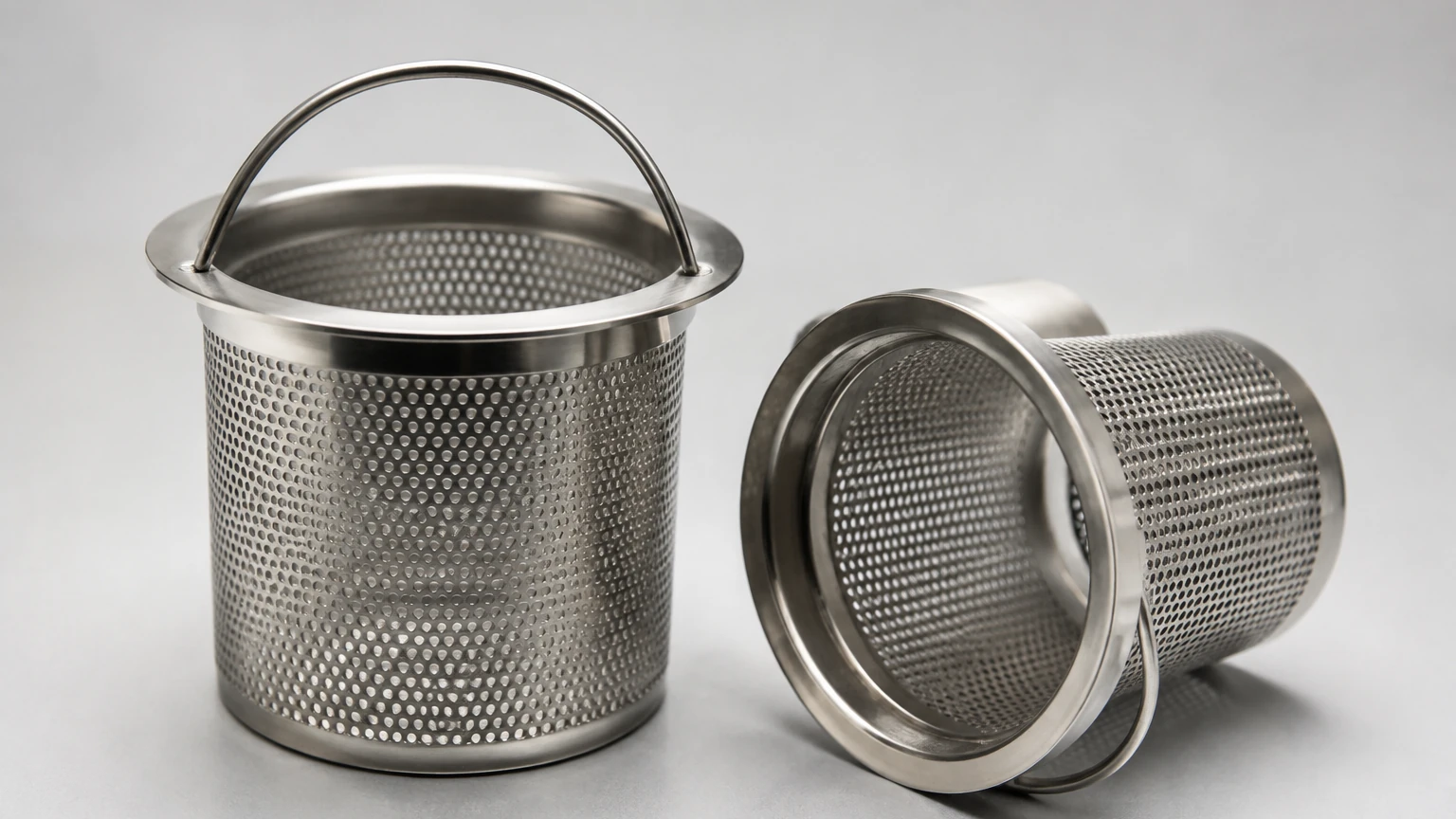
The fundamental purpose of a simplex strainer basket is to provide a high-capacity collection area for debris while maintaining a low pressure drop. The basket is typically a cylindrical or tapered component that fits into the strainer body. Fluid enters the basket, passes through the filtration media, and exits through the outlet, leaving the contaminants trapped inside the basket for manual removal.
Filtration Media: Perforated vs. Mesh
Most industrial baskets utilize a two-stage construction. The outer structure is usually made of perforated metal, which provides the necessary mechanical strength to withstand the differential pressure across the filter. For finer filtration, a wire mesh liner is sintered or welded to the interior or exterior of the perforated metal.
* Perforated Metal: Used for coarse filtration, typically removing particles larger than 1/32 of an inch. Common hole patterns include staggered or straight-line configurations.
* Wire Mesh: Used for precision filtration, ranging from 20 mesh down to 400 mesh (approximately 37 microns). The choice of mesh weave—such as plain weave or twilled Dutch weave—affects both the flow rate and the particle retention capability.
The Importance of Open Area Ratio
The "Open Area Ratio" (OAR) is a critical engineering metric. It is the ratio of the total open area of the basket's holes to the cross-sectional area of the inlet pipe. A high OAR (typically 6:1 or higher) ensures that the strainer can collect a significant amount of debris before the pressure drop becomes excessive, thereby extending the time between cleaning cycles.
Material Selection for Demanding Environments
Industrial filtration often occurs in aggressive environments involving corrosive chemicals, high temperatures, or strict sanitary requirements. The material of the simplex strainer basket must be carefully selected to ensure longevity and prevent contamination of the process fluid.
Stainless Steel Grades
Stainless steel is the industry standard due to its durability and resistance to oxidation.
* Grade 304: Suitable for general-purpose applications, including water treatment and mild chemical processing. It offers good corrosion resistance at a cost-effective price point.
* Grade 316/316L: Contains molybdenum, which provides superior resistance to chlorides and pitting. This is the preferred choice for marine environments, pharmaceutical manufacturing, and the food and beverage industry.
* Specialty Alloys: For highly corrosive or high-temperature applications, baskets can be fabricated from Monel, Hastelloy, or Titanium to ensure structural integrity where standard stainless steel would fail.
Structural Integrity and Reinforcement
In high-pressure systems, the basket is subjected to significant mechanical stress, especially as it becomes loaded with debris. To prevent the basket from collapsing or "bursting," engineers often specify reinforced bottoms, heavy-duty side seams, and support ribs. The welding method—typically TIG or resistance welding—must ensure that there are no bypass paths for contaminants.
Selection Criteria for Industrial Applications
When specifying a simplex strainer basket for a new installation or as a replacement part, several variables must be confirmed to ensure compatibility and performance. Engineers should evaluate the following parameters:
1. Fluid Viscosity: Highly viscous fluids require larger mesh openings or increased surface area to prevent excessive pressure drop.
2. Specific Gravity: The density of the fluid affects the velocity and the force exerted on the basket walls.
3. Maximum Allowable Pressure Drop ($ΔP$): This is the difference in pressure between the inlet and outlet of the strainer. A clean basket should ideally have a $ΔP$ of less than 2 PSI. If the pressure drop exceeds 10-15 PSI, the basket is at risk of structural deformation.
4. Particle Loading: If the process fluid contains a high concentration of solids, a high-capacity "heavy-duty" basket with a deeper profile may be required to reduce the frequency of manual cleanouts.
Customization and OEM Capabilities
Standard off-the-shelf baskets often fail to meet the specific needs of specialized industrial equipment. Customization allows for the optimization of the filtration process based on unique spatial constraints or performance targets. At Kaifil, we specialize in the design and manufacture of custom stainless steel filter components, ensuring that every simplex strainer basket meets the exact tolerances required by the application.
Design Variations
* Slanted or Flat Bottoms: Depending on the housing design, the bottom of the basket may be flat or slanted to facilitate easier removal and cleaning.
* Handle Configurations: Baskets can be equipped with various handle types, including bail handles, lifting lugs, or even threaded connections for mechanical extraction in deep housings.
* Gasket and Seal Integration: To prevent fluid bypass, the top flange of the basket can be fitted with O-rings or flat gaskets made of Viton, EPDM, or PTFE, depending on chemical compatibility.
For more information on customized filtration components and engineering support, visit our Main Page.
Maintenance and Total Cost of Ownership
While the initial purchase price of a simplex strainer basket is an important factor, the total cost of ownership (TCO) is largely determined by the basket’s durability and ease of maintenance. A poorly designed basket that requires frequent replacement or allows bypass can lead to catastrophic damage to downstream pumps, resulting in expensive repairs and lost production time.
Cleaning Protocols
To maintain efficiency, baskets must be cleaned regularly. The cleaning process typically involves:
1. Isolating the strainer and relieving internal pressure.
2. Removing the housing cover and extracting the basket.
3. Using a soft brush or high-pressure water/air (depending on the mesh fineness) to remove debris.
4. Inspecting the mesh for signs of wear, such as fraying, holes, or separation from the perforated support.
When to Replace the Basket
Engineers should monitor the differential pressure across the strainer. If the pressure drop remains high even after cleaning, it indicates that the mesh is blinded (permanently clogged) or that the basket has undergone mechanical deformation. In such cases, immediate replacement is necessary to prevent a total system blockage or bypass of contaminants.
Industry-Specific Applications
The versatility of the simplex strainer basket makes it a staple in numerous sectors:
* Chemical Processing: Protecting flow meters and spray nozzles from particulate matter in corrosive chemical lines.
* Food and Beverage: Removing pulp, seeds, or scale from process water and ingredients while adhering to FDA-compliant sanitary standards.
* Hydraulic Systems: Filtering oil to prevent wear on precision hydraulic cylinders and valves.
* Water Treatment: Acting as a pre-filter for membrane systems or removing sand and grit from cooling water loops.
Conclusion
A simplex strainer basket is a critical component in the reliability of industrial fluid systems. By focusing on technical specifications such as material grade, mesh size, and open area ratio, engineers can ensure that their filtration systems operate at peak efficiency. Whether you are replacing an existing component or designing a new filtration system, choosing a manufacturer with deep technical expertise in stainless steel fabrication is essential for achieving long-term performance.
Kaifil remains committed to providing high-quality, customized filtration solutions that meet the rigorous demands of global industrial applications. From material selection to final production, our engineering-centric approach ensures that every component provides the durability and precision required for your specific process. To explore our full range of filtration capabilities, please visit the Main Page.
