


Sintered Filter Tube
In industrial filtration, the ability to maintain structural integrity under extreme pressure and temperature is a critical requirement for process efficiency. The sintered filter tube represents one of the most robust solutions for these demanding environments. Unlike traditional fabric or polymer-based filters, a sintered filter tube is constructed through a thermal bonding process that fuses metal particles or wire mesh layers without the use of binders or adhesives. This results in a rigid, porous component capable of providing precise filtration in applications ranging from chemical processing to high-temperature steam filtration.
For engineers and procurement teams, selecting the right filtration media involves balancing filtration accuracy, mechanical strength, and chemical compatibility. As a specialized manufacturer, Kaifil provides a range of custom stainless steel filtration solutions designed to meet these specific technical challenges. To explore the full scope of available configurations, professionals can visit the Kaifil Main Page for detailed specifications and application support.
The Engineering Behind Sintering Technology
The performance of a sintered filter tube is derived from the sintering process itself. Sintering is a metallurgical process where metal powder or multi-layer wire mesh is placed in a high-temperature vacuum furnace. The temperature is raised to just below the melting point of the metal, causing the contact points of the particles or wires to bond through solid-state diffusion.
This process creates a stable pore structure that is resistant to migration. In many traditional filters, the pores can shift or enlarge under high differential pressure, leading to "media migration" where the filter material itself or captured contaminants pass into the filtrate. A sintered filter tube eliminates this risk because the pore geometry is permanently fixed within the metal matrix. This rigidity allows the filter to withstand significant backpressure during cleaning cycles without losing its filtration rating.
Types of Sintered Filter Tubes: Powder vs. Mesh
When specifying a sintered filter tube, engineers must choose between two primary types of media: sintered metal powder and sintered wire mesh. Each offers distinct advantages depending on the application requirements.
Sintered Metal Powder Tubes
These are manufactured by compressing stainless steel powder into a cylindrical mold before sintering. The resulting tube has a high porosity (typically between 30% and 50%) and provides a tortuous path for the fluid. This depth-filtration characteristic makes powder-sintered tubes excellent for removing fine particulates and achieving very low micron ratings, often down to 0.5 microns. They are frequently used in gas filtration, catalyst recovery, and sparging applications.
Sintered Wire Mesh Tubes
These tubes are constructed from multiple layers of stainless steel wire mesh that are sintered together to form a single, integrated structure. The layers often include a fine filtration layer protected by coarser drainage and support layers. Sintered mesh tubes offer higher permeability and are easier to clean than powder tubes. They are the preferred choice for liquid filtration where high flow rates and frequent backwashing are required, such as in hydraulic systems and food processing.
Material Selection and Chemical Compatibility
The longevity of a sintered filter tube depends heavily on the material's resistance to the operating environment. While stainless steel is the standard, different grades offer varying levels of protection against corrosion and oxidation.
1. 316L Stainless Steel: This is the most common material for sintered filters due to its excellent corrosion resistance, particularly in acidic and chloride-rich environments. The "L" denotes low carbon content, which minimizes carbide precipitation during welding, ensuring the structural integrity of the filter ends.
2. 304 Stainless Steel: Suitable for less aggressive environments, 304 provides a cost-effective solution for water treatment and general industrial air filtration.
3. Specialty Alloys: For extreme conditions involving high concentrations of sulfuric acid or high-temperature oxidation, materials such as Hastelloy, Monel, or Inconel can be utilized in the sintering process. These alloys extend the service life of the filter in chemical reactors and aerospace applications.
Performance Evaluation Criteria
When evaluating a sintered filter tube for a specific project, several technical parameters must be confirmed to ensure the component meets the system's operational demands.
Filtration Accuracy (Micron Rating)
It is vital to distinguish between nominal and absolute micron ratings. A sintered filter tube typically offers an absolute rating, meaning it will stop 99.9% of particles at the specified size. Engineers should verify the particle size distribution of the contaminant to select a pore size that prevents premature blinding while maintaining the required filtrate purity.
Permeability and Pressure Drop
Permeability refers to how easily a fluid can pass through the filter media. A higher permeability results in a lower initial pressure drop (ΔP). In energy-intensive processes, minimizing the pressure drop is essential for reducing pump or compressor load. The thickness of the sintered wall and the porosity percentage are the primary factors influencing these hydraulic characteristics.
Mechanical Strength
Sintered tubes are often subjected to high differential pressures, especially as the filter cake builds up. The structural design must account for the maximum expected pressure at the end of the filtration cycle. For high-pressure applications, internal or external support cores (perforated tubes) may be integrated into the sintered filter tube assembly to prevent collapsing or bursting.
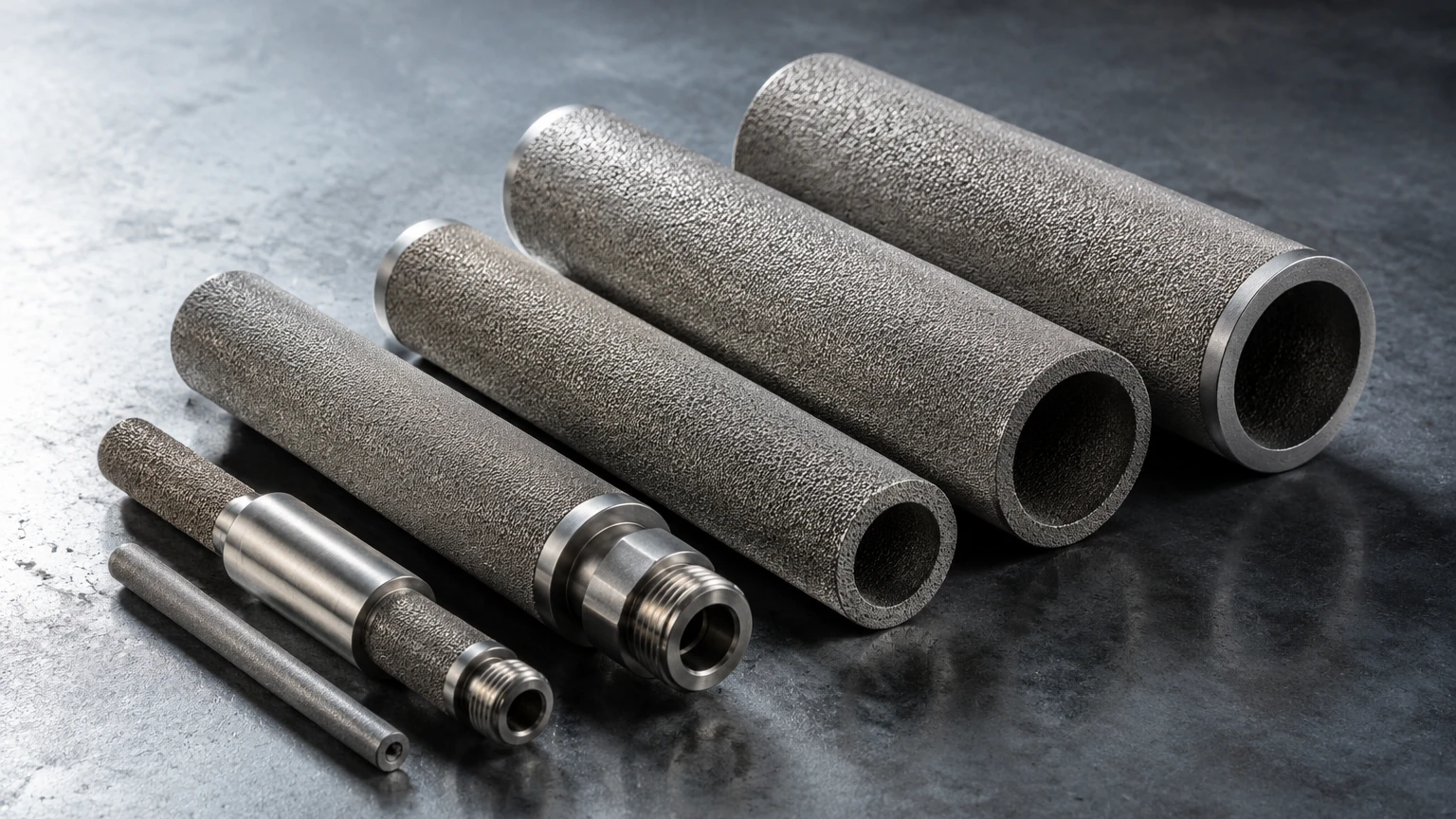
Customization and Design Considerations
Standard off-the-shelf filters rarely meet the precise needs of complex industrial systems. Customization is a core aspect of the manufacturing process at Kaifil. When ordering a sintered filter tube, several design elements can be tailored:
* Dimensions: Length and diameter can be adjusted to fit existing filter housings. Sintered tubes can be produced in lengths ranging from a few centimeters to over a meter, with diameters scaled to the required flow volume.
* End Fittings: To ensure a leak-proof seal, various end-cap configurations are available. Common options include Double Open End (DOE), threaded connections (NPT or BSP), flange mounts, and specialized O-ring seals (such as 222 or 226 configurations).
* Multi-Layer Construction: For wire mesh tubes, the number of layers can be customized. A 5-layer sintered mesh is a common standard, providing a balance of filtration, protection, and support, but 3-layer or 7-layer designs are used for specific flow or strength requirements.
Maintenance and Cleaning Procedures
One of the primary economic advantages of a sintered filter tube is that it is a permanent component. Unlike disposable cartridges, sintered metal filters can be cleaned and reused multiple times, significantly reducing the total cost of ownership and waste.
Backwashing and Backpulsing
In liquid and gas systems, reversing the flow (backwashing or backpulsing) can dislodge the filter cake from the surface of the tube. Because the sintered media is rigid, it can handle the high-pressure surges required for effective cleaning without deforming.
Ultrasonic Cleaning
For deep-seated particulates that backwashing cannot remove, ultrasonic cleaning is highly effective. The filter tube is submerged in a cleaning solvent, and high-frequency sound waves create cavitation bubbles that scrub the internal pore structures.
Chemical Cleaning
In applications involving organic fouling or specific chemical scales, the sintered filter tube can be soaked in caustic or acidic solutions. The inherent chemical resistance of 316L stainless steel allows for aggressive cleaning protocols that would destroy polymer-based filters.
Industrial Applications of Sintered Filter Tubes
Due to their durability and precision, these filters are utilized across various sectors where process failure is not an option.
* Chemical and Petrochemical: Used for catalyst recovery, polymer filtration, and the removal of impurities from corrosive liquids. The ability to operate at temperatures exceeding 400°C (750°F) makes them indispensable in refinery operations.
* Pharmaceutical and Biotech: Sintered tubes are used for sterile air filtration and the recovery of expensive active pharmaceutical ingredients (APIs). The smooth surface finish of stainless steel facilitates easy sterilization (SIP/CIP).
* Food and Beverage: Employed in the carbonation of beverages (sparging) and the filtration of steam used for equipment sterilization. Compliance with food-grade standards is a baseline requirement for these components.
* Hydraulic and Lubrication Systems: Protecting sensitive valves and pumps from wear particles in high-pressure hydraulic circuits.
Conclusion: Selecting the Right Filtration Partner
Specifying a sintered filter tube requires a deep understanding of the fluid dynamics and chemical interactions within a process. Engineers must confirm the operating temperature, maximum differential pressure, fluid viscosity, and the nature of the contaminants before finalizing a design.
Kaifil specializes in translating these technical requirements into high-performance filtration hardware. By focusing on precision manufacturing and material integrity, Kaifil ensures that each sintered filter tube provides reliable service in the most demanding industrial environments. For technical consultations or to review available filtration grades, visiting the Kaifil Main Page provides access to the engineering resources necessary for informed decision-making.
