


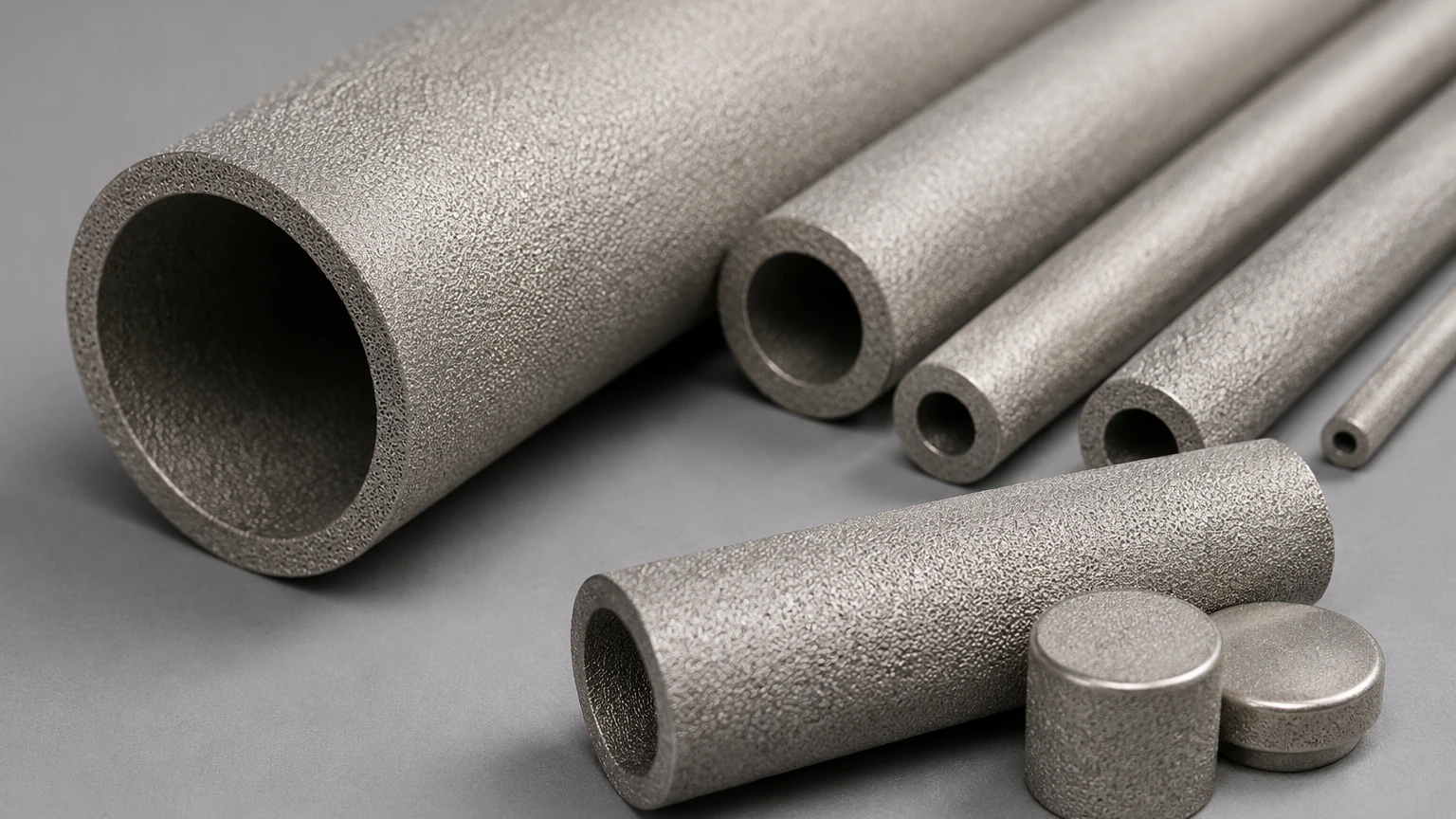
Sintered Metal Tube
In the landscape of industrial filtration, the sintered metal tube stands as a critical component for applications requiring high mechanical strength, thermal stability, and precise filtration accuracy. Unlike traditional fabric or polymer-based filters, these components are engineered through advanced powder metallurgy, resulting in a robust, porous structure capable of withstanding extreme operational environments. For engineers and procurement specialists, understanding the technical nuances of sintered metal tubes—from manufacturing processes to maintenance protocols—is essential for optimizing system performance and reducing the total cost of ownership.
The Science of Sintering: Manufacturing Porous Metal Structures
The production of a sintered metal tube begins with the careful selection of metal powders. These powders are typically spherical or irregular in shape, and their particle size distribution directly determines the final porosity and filtration rating of the tube. The manufacturing process generally involves two primary stages: compaction and sintering.
During the compaction phase, metal powder is shaped into a tubular form using methods such as cold isostatic pressing (CIP) or gravity molding. In CIP, the powder is placed in a flexible mold and subjected to high hydraulic pressure from all directions, ensuring a uniform density throughout the green body. This uniformity is vital for achieving consistent permeability across the entire surface of the filter.
Following compaction, the "green" tube undergoes a sintering process in a high-temperature furnace with a controlled atmosphere (often vacuum or hydrogen-reducing). The temperature is raised to just below the melting point of the metal. At this stage, atomic diffusion occurs at the contact points between particles, creating metallurgical bonds or "necks." This process fuses the particles into a rigid, interconnected matrix without melting the entire structure, thereby preserving the intricate network of pores. The result is a self-supporting sintered metal tube that possesses the structural integrity of solid metal while maintaining high permeability.
Material Selection and Chemical Compatibility
Selecting the appropriate alloy is the most significant factor in ensuring the longevity of a sintered metal tube within a specific process fluid. The choice of material impacts corrosion resistance, temperature limits, and mechanical durability.
1. 316L Stainless Steel: This is the industry standard for most filtration applications. The "L" denotes low carbon content, which minimizes carbide precipitation during welding and sintering, enhancing corrosion resistance. It is highly effective in mildly acidic or alkaline environments and can operate in temperatures up to 450°C (842°F) in oxidizing atmospheres.
2. 304 Stainless Steel: Often used for less demanding applications where cost-efficiency is a priority. While it offers good mechanical properties, it lacks the molybdenum found in 316L, making it more susceptible to pitting and crevice corrosion in chloride-rich environments.
3. Hastelloy and Inconel: For extreme chemical processing involving highly corrosive acids or high-temperature oxidation (up to 900°C), nickel-based alloys like Hastelloy C-276 or Inconel 600 are preferred. These materials are essential in petrochemical and specialty chemical sectors where standard stainless steels would fail prematurely.
4. Titanium: Sintered titanium tubes are utilized for their exceptional strength-to-weight ratio and superior resistance to seawater, wet chlorine, and nitric acid. They are also biocompatible, making them suitable for pharmaceutical and medical applications.
Engineers must verify the chemical composition of the process fluid, including trace contaminants, to prevent localized corrosion or leaching that could compromise the filtration system.
Key Performance Indicators: Micron Rating and Permeability
The performance of a sintered metal tube is defined by its ability to remove specific particle sizes while allowing fluid to pass with minimal resistance. Two metrics are paramount: filtration rating and permeability.
Filtration Rating: Absolute vs. Nominal
In industrial specifications, it is crucial to distinguish between nominal and absolute micron ratings. A nominal rating refers to the ability of the filter to retain a certain percentage (usually 60-90%) of particles of a specific size. In contrast, an absolute rating indicates that 99.9% or more of particles above the specified micron size will be captured. Sintered metal tubes are often preferred for their high absolute filtration accuracy, which is verified through Bubble Point testing (per ISO 4003) to ensure no pores exceed the specified limit.
Permeability and Pressure Drop
Permeability is a measure of the fluid flow capacity of the porous media. According to Darcy’s Law, the flow rate is directly proportional to the pressure drop across the filter. A well-engineered sintered metal tube balances high porosity (for low pressure drop) with sufficient thickness and density (for mechanical strength). If the pore structure is too tortuous, the "clean pressure drop" will be high, reducing the operational window before the filter reaches its terminal pressure drop and requires cleaning.
Mechanical Strength and Thermal Stability
One of the primary advantages of the sintered metal tube is its mechanical robustness. Unlike pleated paper or polymer membranes, sintered metal does not require an internal support core in most standard applications. It can withstand high differential pressures—often exceeding 50 bar (725 psi) depending on the wall thickness and diameter.
Thermal stability is another hallmark of these components. Industrial processes often involve rapid temperature fluctuations, known as thermal shock. The metallurgical bonds formed during sintering allow the tube to expand and contract without cracking or losing its pore structure. This makes them ideal for steam filtration, hot gas cleaning, and high-temperature catalyst recovery. Furthermore, the rigid structure prevents "media migration," a common failure in fiber-based filters where the filter material itself sheds particles into the downstream filtrate.
Applications in Demanding Industrial Environments
Sintered metal tubes are versatile components used across a wide spectrum of industries. Their ability to be customized in terms of length, diameter, and micron rating allows them to solve complex filtration challenges.
* Chemical and Petrochemical: Used for the filtration of aggressive solvents, polymers, and catalyst recovery. In catalyst recovery, the tubes capture expensive precious metal catalysts from slurry streams, allowing them to be backwashed and reused.
* Food and Beverage: Employed in the carbonation of beverages and the filtration of culinary steam. The smooth surface and high-quality stainless steel construction meet stringent hygienic standards.
* Pharmaceutical: Ideal for gas sparging and the filtration of active pharmaceutical ingredients (APIs). The ability to sterilize the tubes using SIP (Steam-In-Place) or autoclave methods is a significant benefit.
* Gas-Liquid Sparging: Sintered tubes are used as spargers to introduce gases into liquids in the form of thousands of tiny, uniform bubbles. This maximizes the surface area for mass transfer, which is critical in fermentation, aeration, and carbonation processes.
* Hydraulic Systems: Protecting sensitive valves and pumps from particulate contamination in high-pressure hydraulic circuits.
Cleaning Protocols and Maintenance Strategies
To maximize the service life of a sintered metal tube, a proactive maintenance strategy is required. Because these filters are depth-loading to an extent, particles can become trapped within the pore matrix. However, the rigid metal structure allows for aggressive cleaning methods that would destroy other filter types.
Physical Cleaning Methods
* Backwashing/Backpulsing: This is the most common in-situ cleaning method. By reversing the flow of fluid or gas at a higher pressure, trapped particles are dislodged from the upstream surface of the tube. This is highly effective for surface-loading contaminants.
* Ultrasonic Cleaning: For deep-seated particulates, removing the tube and placing it in an ultrasonic bath is highly effective. High-frequency sound waves create cavitation bubbles that implode, creating localized energy that pulls contaminants out of the pores.
Chemical Cleaning Methods
* Solvent/Acid Cleaning: Depending on the contaminant, the tube can be soaked in caustic solutions, nitric acid, or specialized detergents to dissolve organic or inorganic deposits. It is vital to ensure that the cleaning agent is compatible with the filter material (e.g., avoiding high concentrations of hydrochloric acid on 316L).
* Burn-off/Calcination: For organic polymers or carbonaceous deposits, the tubes can be heated in a controlled furnace to oxidize and remove the contaminants, restoring the original permeability.
Procurement Considerations: Customization and Specification
When sourcing a sintered metal tube, engineers must provide detailed specifications to ensure the component meets the application requirements. Off-the-shelf solutions may not always account for specific flow dynamics or installation constraints.
Key details to confirm before procurement include:
* Dimensions: Inner diameter (ID), outer diameter (OD), and total length. Tolerances should be specified, especially if the tube must fit into a precision-machined housing.
* End Fittings: Common options include Double Open End (DOE), NPT/BSP threaded connections, or specialized flange mounts. Proper welding of these fittings is essential to prevent bypass.
* Operating Conditions: Maximum operating temperature, normal operating pressure, and expected differential pressure at the start and end of the cycle.
* Filtration Efficiency: Required micron rating and whether the application demands an absolute or nominal rating.
By focusing on these technical parameters, purchasing teams can ensure they receive a product that provides reliable performance over a multi-year service life. For more information on custom filtration solutions and engineering support, professionals can visit the Main Page to explore the full range of manufacturing capabilities.
Conclusion
The sintered metal tube is a sophisticated engineering solution designed for the most challenging industrial filtration tasks. Its combination of high mechanical strength, chemical resistance, and the ability to be repeatedly cleaned makes it a cost-effective choice for long-term operations. By carefully selecting materials, understanding flow dynamics, and implementing rigorous cleaning protocols, industrial facilities can achieve high-purity results while minimizing downtime and waste. As industries move toward more efficient and sustainable processes, the role of durable, reusable filtration components like the sintered metal tube will only continue to grow in importance.
