


Sintered Porous Filter
In industrial filtration, the requirement for components that can withstand extreme temperatures, high pressure, and corrosive environments is constant. The sintered porous filter represents a pinnacle of engineering in this field, offering a combination of mechanical strength and precise filtration accuracy that traditional fiber or polymer-based filters cannot match. As a specialized manufacturer, Kaifil focuses on delivering these high-performance components to meet the rigorous demands of chemical processing, pharmaceuticals, and heavy industrial applications.
Understanding the technical nuances of a sintered porous filter is essential for engineers and procurement teams who must balance filtration efficiency with long-term operational costs. This guide examines the manufacturing principles, material considerations, and application-specific selection criteria for these critical components.
The Engineering Principles of Sintering
At its core, a sintered porous filter is produced through a process called sintering, which involves heating metal powders or multiple layers of wire mesh to a temperature just below their melting point. Under controlled atmospheric conditions, the contact points of the metal particles or wires fuse together through molecular diffusion. This creates a rigid, interconnected pore structure that is mechanically integrated into a single solid piece.
Unlike depth filters made from compressed fibers, a sintered filter does not rely on binders or glues. The resulting structure is physically robust and resistant to media migration—a common failure point in lesser filtration materials where fibers or particles break loose and contaminate the filtrate. This structural integrity allows the filter to maintain its pore geometry even under significant differential pressure.
There are two primary types of sintered media used in industrial applications:
1. Sintered Metal Powder: Created from spherical or irregular metal powders, resulting in a tortuous path for fluids that excels in fine particulate capture.
2. Sintered Wire Mesh: Created by laminating multiple layers of stainless steel wire mesh. This provides excellent permeability and is easier to clean through backwashing.
Material Selection and Chemical Compatibility
The performance of a sintered porous filter is heavily dependent on the alloy from which it is manufactured. Stainless steel is the industry standard due to its balance of cost, mechanical strength, and corrosion resistance. Within the Kaifil product range, several grades are commonly utilized:
* 304 Stainless Steel: Suitable for general industrial applications where basic corrosion resistance is required.
* 316L Stainless Steel: The preferred choice for the pharmaceutical and chemical industries. The "L" denotes low carbon content, which minimizes carbide precipitation during welding, ensuring the filter remains corrosion-resistant at the joints.
* Nickel-Based Alloys (Inconel, Monel, Hastelloy): For environments involving extreme temperatures (up to 900°C) or highly aggressive chemical agents like hydrofluoric acid or high-concentration chlorides.
When selecting materials, engineers must consider the pH level of the fluid, the presence of oxidizing agents, and the operating temperature. A sintered porous filter made from 316L stainless steel provides a reliable solution for most steam filtration and solvent recovery processes, but specialized alloys are necessary when the chemical profile exceeds the limits of standard stainless steel.
Filtration Accuracy and Pore Dynamics
The primary function of any filter is to remove contaminants of a specific size. Sintered porous filters are characterized by their micron rating, which can be categorized as either nominal or absolute.
* Nominal Rating: Refers to the ability of the filter to retain a major percentage (usually 60% to 90%) of particles of a specific size.
* Absolute Rating: Refers to the pore size at which 99.9% of particles are retained. In critical applications, such as catalyst recovery or sterile gas filtration, absolute ratings are mandatory to ensure process integrity.
The pore structure of a sintered porous filter is "tortuous," meaning the fluid must navigate a complex path through the media. This increases the probability of particle entrapment through several mechanisms: physical sieving, inertial impaction, and diffusion. Because the pores are fixed in place by the sintering process, the filter does not suffer from "unloading," where increased pressure forces trapped particles through the media.
Design Customization and Structural Reinforcement
Industrial filtration systems rarely use "off-the-shelf" components without some level of customization. As an OEM manufacturer, Kaifil works with engineering teams to adapt the sintered porous filter to specific housing requirements. Customization options typically include:
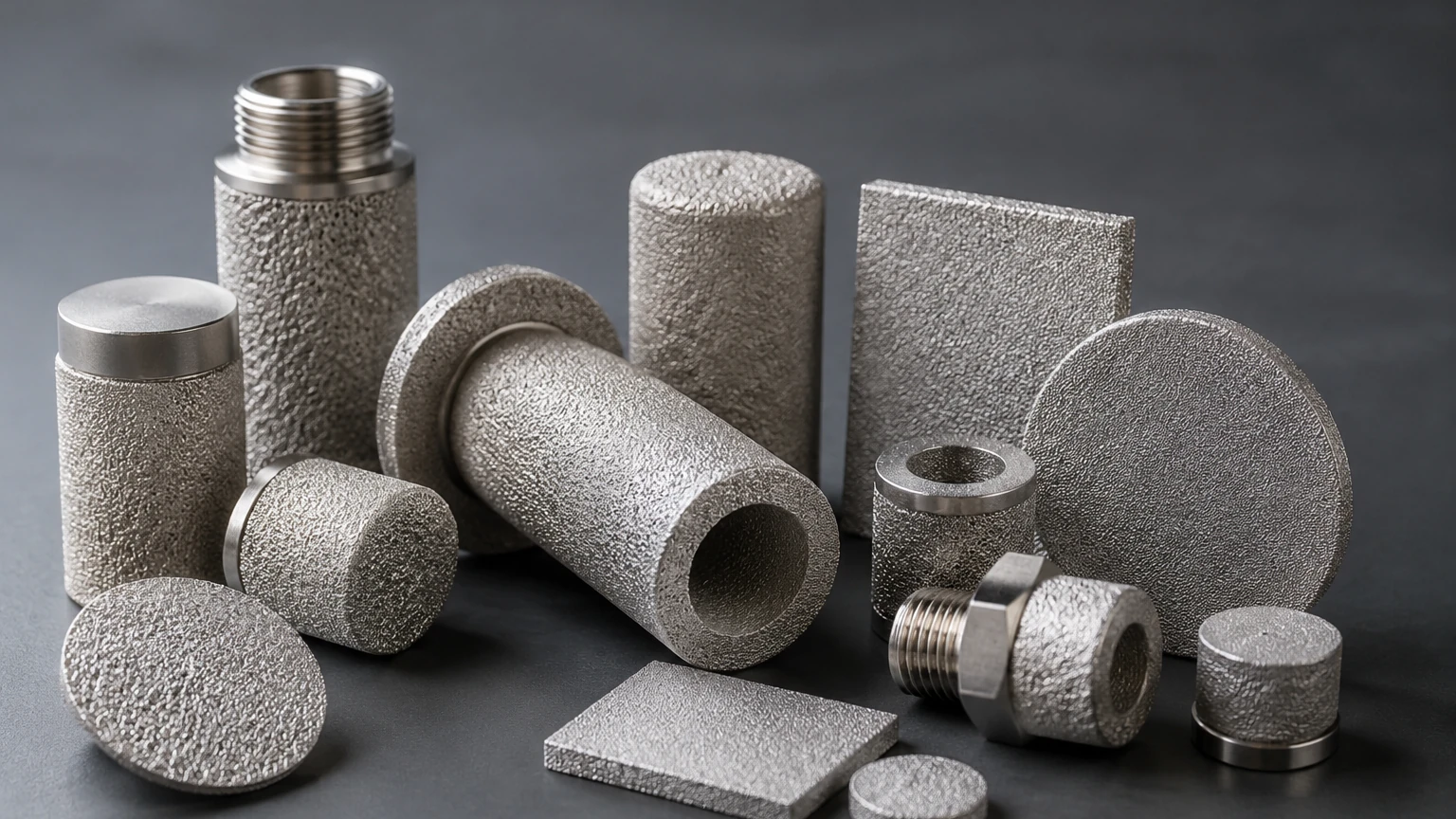
* Geometry: While cylindrical cartridges are standard, sintered media can be formed into discs, plates, cones, or custom-molded shapes for specialized machinery.
* End Fittings: To ensure a leak-proof seal, filters can be equipped with various connectors, including 222/226 O-ring configurations, NPT/BSP threaded ends, or flange mounts.
* Reinforcement: In high-pressure hydraulic or gas systems, the sintered media may be supported by an internal or external perforated core to prevent collapse or bursting under extreme differential pressure.
For a comprehensive overview of available configurations and technical support for custom designs, engineers can refer to our Main Page to evaluate how these components integrate into larger filtration assemblies.
Critical Applications in Demanding Industries
The unique properties of the sintered porous filter make it indispensable in sectors where failure is not an option.
Chemical and Petrochemical Processing
In these environments, filters are often exposed to aggressive solvents and high-pressure differentials. Sintered filters are used for catalyst recovery, where expensive precious metal catalysts must be reclaimed from a process stream with near-total efficiency. Their ability to be cleaned and reused makes them more cost-effective than disposable polymer filters in high-volume chemical production.
Food and Beverage Production
Steam filtration is a primary application here. Culinary-grade steam must be free of pipe scale and rust before it comes into contact with food products or is used for sterilizing tanks. Sintered stainless steel filters can handle the high temperatures of saturated steam while maintaining the hygienic standards required by regulatory bodies.
Pharmaceutical and Biotechnology
In the production of active pharmaceutical ingredients (APIs), sintered porous filters provide the necessary purity levels. They are often used for gas sparging—introducing gases into a liquid through very fine pores to create tiny bubbles, maximizing the surface area for gas-liquid reactions.
Maintenance, Cleaning, and Total Cost of Ownership
One of the most significant advantages of a sintered porous filter is its cleanability. Unlike disposable cartridges that contribute to waste and recurring procurement costs, sintered metal filters are designed for long-term service.
Cleaning Methodologies
Depending on the nature of the contaminant, several cleaning methods can be employed:
* Backpulsing/Backwashing: Using a reverse flow of clean fluid or gas to dislodge particles from the surface of the filter.
* Ultrasonic Cleaning: Using high-frequency sound waves in a cleaning solution to remove fine particles trapped deep within the pore structure.
* Chemical Cleaning: Using solvents, acids, or alkalis to dissolve organic or inorganic deposits without damaging the stainless steel matrix.
* Heat Treatment: Burn-off ovens can be used to remove organic polymers or carbonized residues.
Evaluating the Investment
While the initial purchase price of a sintered porous filter is higher than that of a polypropylene or pleated paper filter, the Total Cost of Ownership (TCO) is often lower. The extended service life, reduced downtime for filter changes, and elimination of disposal costs provide a significant Return on Investment (ROI) over the life of the equipment. When specifying these filters, engineers should calculate the expected number of cleaning cycles to determine the true economic value.
Technical Considerations Before Purchase
Before finalizing a specification for a sintered porous filter, technical professionals should confirm the following parameters with the manufacturer:
1. Maximum Differential Pressure (ΔP): What is the limit before the structural integrity of the filter is compromised?
2. Flow Rate vs. Pressure Drop: How will the clean pressure drop affect the overall system efficiency?
3. Particle Distribution: What is the specific size and shape of the contaminants? This determines whether a powder-based or mesh-based sintered filter is more appropriate.
4. Seal Compatibility: Ensure that O-rings or gaskets (EPDM, Viton, PTFE) are compatible with the process fluid.
By addressing these factors during the design phase, purchasing teams can avoid premature filter failure and optimize the performance of their filtration systems. Kaifil provides the engineering expertise necessary to navigate these choices, ensuring that every sintered porous filter is tailored to the specific mechanical and chemical demands of its environment. For further technical documentation and product specifications, please visit our Main Page.
